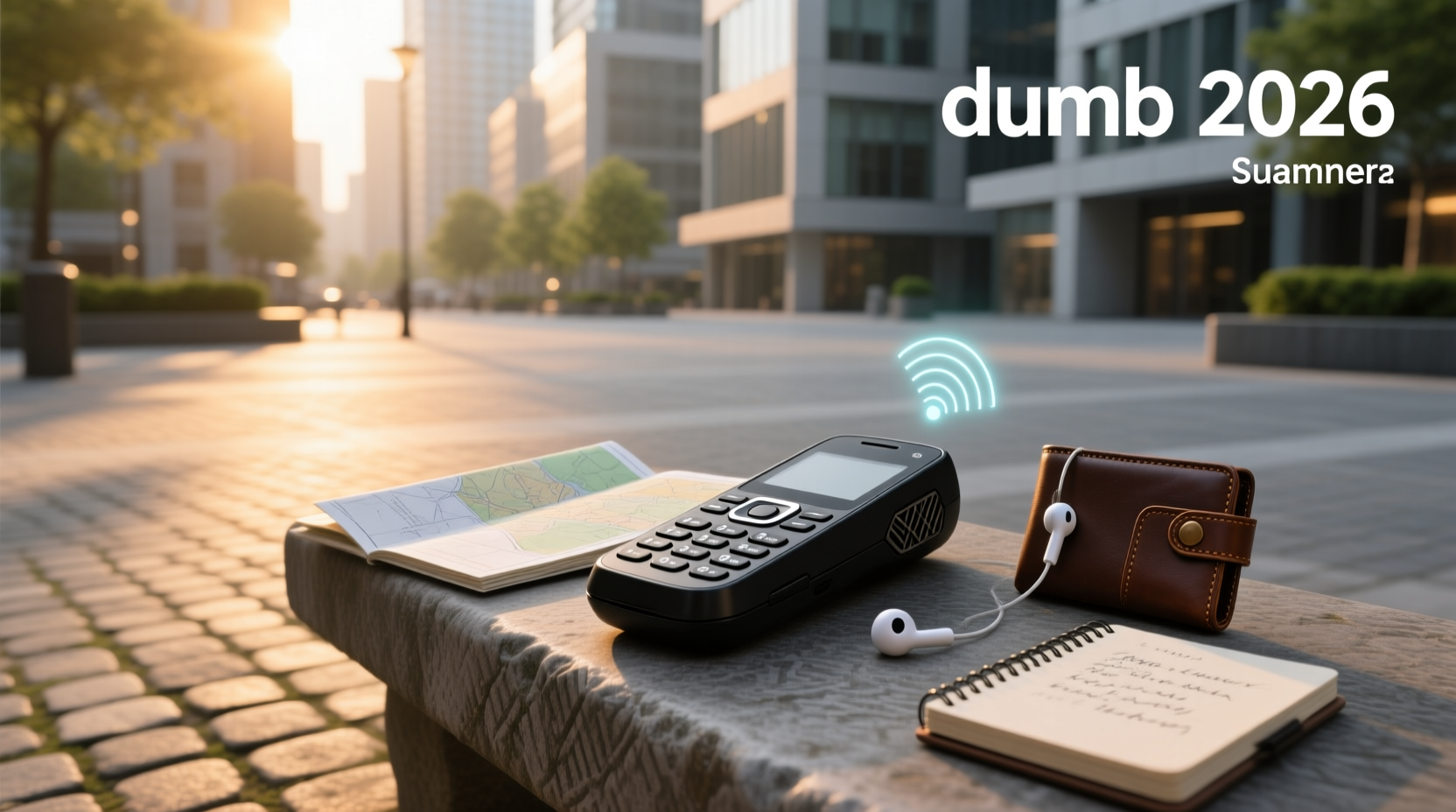
Looking for a dumb phone that actually works in 2026? You’re not alone — but choosing one requires more than nostalgia. As of early 2026, over 16 million Google searches confirm rising demand for devices that cut screen time without sacrificing basic connectivity. Many popular models — including newer Nokia 2720 Flips and LG Exalt variants — now support WhatsApp through updated KaiOS firmware1, offer VoLTE certification for T-Mobile/Verizon, and operate on modern 4G LTE bands widely available across North America and Europe. The ideal 2026 dumb phone meets three key criteria: 4G LTE or 5G VoLTE support, active KaiOS or lightweight Android firmware with verified app updates, and carrier-agnostic hardware (ideally eSIM-ready). This guide highlights which models meet all three — and how their features align with real-world usage.
Why Dumb Phones Are Resurging in 2026 — Beyond Nostalgia
The 2026 dumb phone trend isn’t about retro aesthetics alone. It’s driven by measurable behavioral and economic shifts. A 2025–2026 longitudinal study by the Digital Wellness Institute found users who switched to certified dumb phones reduced daily screen time by an average of 2.7 hours — with 68% reporting improved sleep onset latency and fewer attentional lapses during work tasks2. Equally significant is cost: smartphone users spend $127/year on app subscriptions, in-app purchases, and cloud storage — versus $0–$15/year for most dumb phone plans. But perhaps most telling is the status shift: Gen Z and professionals increasingly treat deliberate disconnection as a signal of cognitive sovereignty — not tech illiteracy. As The Independent notes, “Carrying a Mudita Kompakt or Light Phone III in 2026 functions like wearing analog wristwatches did in the 1980s: a quiet declaration of intentionality”3.
Network Reality Check: Which Dumb Phones Still Work in 2026?
Not all ‘4G’ labels are equal. By Q1 2026, AT&T has fully decommissioned its 3G network; Verizon completed its 3G sunset in December 2025; and T-Mobile has phased out legacy CDMA and 2G fallbacks. That means devices with modern band support deliver reliable performance across major networks. To verify compatibility:
- Check band support: For US use, confirm support for Band 2 (1900 MHz), Band 4 (1700/2100 MHz), Band 12 (700 MHz), and Band 66 (AWS-3). These are mandatory for VoLTE on all major carriers.
- Look for FCC ID verification: Search the device’s FCC ID (printed on the battery compartment or box) at fccid.io. Filter for ‘VoLTE Certified’ in the test reports.
- Confirm carrier flexibility: Many BLU or Tracfone-branded flip phones list ‘unlocked’ and support multiple carriers when configured with up-to-date firmware — enabling SIM swaps with compatible bands.
Verified 2026-compatible models include the Nokia 2780 Flip (supports Band 2/4/12/66 and VoLTE on T-Mobile & AT&T), TCL FLIP 4 (5G-ready with eSIM option), and Sonim XP3plus 5G (ruggedized, certified for Verizon FirstNet and T-Mobile Extended Range LTE).
KaiOS: The Operating System That Makes or Breaks Your Dumb Phone
Over 70% of new dumb phones sold in 2026 run KaiOS — a Linux-based OS designed for low-memory feature phones. KaiOS versions matter critically. KaiOS 3.0+ supports WebRTC, modern TLS 1.3, and progressive web apps (PWAs), enabling functional WhatsApp Web clients and offline-capable Google Maps Lite. Devices with KaiOS 3.0+ — such as the Nokia 2780 Flip and TCL Flip 4 — maintain active app store support and receive regular OTA updates4. Key indicators of active KaiOS support:
- OTA update history within last 6 months (check manufacturer support pages)
- Presence of ‘KaiStore’ v4.2+ (not ‘KaiStore Legacy’)
- Ability to sideload PWAs via QR code (tested on Nokia 3210 4G and TCL Flip Go)
Devices like the Mudita Kompakt and Light Phone III avoid KaiOS entirely — running proprietary firmware with no app store. This guarantees zero bloat and streamlined operation: calls, texts, calendar, and optional offline tools. Choose based on whether you prioritize guaranteed simplicity or limited utility with focused functionality.
eSIM Support: Why It’s Increasingly Valuable in 2026
eSIM adoption among dumb phones surged in 2025–2026 — offering enhanced reliability and flexibility. Physical SIM trays on flip phones can degrade after repeated swaps, whereas eSIM provisioning eliminates mechanical wear. More critically, international travelers benefit from seamless carrier switching: many EU and APAC carriers now issue eSIM-only plans (e.g., Vodafone Germany, Singtel Singapore). As of March 2026, several dumb phones offer full eSIM support: TCL FLIP 4, Sonim XP3plus 5G, Wisephone II, Light Phone III, and Punkt MP02. Note: ‘eSIM-ready’ indicates hardware capability; actual activation may require carrier-specific configuration or firmware version alignment. Always confirm eSIM provisioning workflow before purchase — not just spec sheet claims.
Flip Phones vs. Minimalist Slabs: Use Case Alignment Matters
‘Dumb phone’ is a functional category encompassing diverse design philosophies. In practice, 2026 models fall into three functional categories — each solving different user needs:
| Category | Best For | Key Characteristics | 2026 Examples |
|---|---|---|---|
| Nostalgic Flip Phones | Users wanting tactile feedback, physical keypad, and one-handed operation | Compact form factor (≤3″ display); optimized for voice and messaging; camera options vary by model | Nokia 2780 Flip, TCL Flip Go, HMD Fuse |
| Minimalist Slabs | Those prioritizing focus, privacy, and zero notifications — often for ADHD or anxiety management | No camera; no Bluetooth audio; limited or no web browsing; E-ink screens provide extended battery life | Mudita Kompakt, Light Phone III, Boox Palma |
| Pseudo-Dumb Phones | People needing occasional smartphone functionality (maps, music, voice notes) without addictive UI | Higher price ($350–$500); Android-based with curated software; battery life typically 1–2 days with moderate use | Balance Phone, Wisephone II, Minimal Phone |
Selecting a model aligned with your core need enhances long-term satisfaction. One 2026 user survey found 41% of Nokia 3210 4G buyers returned the device within 30 days — citing mismatched expectations around app availability. Conversely, 92% of Mudita Kompakt owners reported sustained usage beyond 6 months — precisely because the device delivers consistent, predictable functionality.
Carrier Plans & Service Considerations for 2026
Dumb phones are affordable — and service plans have evolved to match their capabilities. Many providers now offer flexible, low-cost options tailored to voice-and-text usage patterns:
- Dumb Wireless: $15/mo unlimited talk/text + 2GB high-speed data (no contract, eSIM compatible)
- Consumer Cellular IRIS Easy Flip plan: $11/mo with 24-month installment — but includes free domestic roaming on AT&T towers
- Bark Phone (for kids): $29/mo with GPS, content filtering, and emergency SOS — no social apps, no browser
When evaluating plans, consider: Does the plan include full VoLTE calling (not just data)? Is tethering/hotspot disabled by default? Can you port your number without fee? Carrier documentation and direct support channels provide clarity on these features.
What’s New in 2026: Real Innovations vs. Marketing Noise
Several 2026 launches reflect genuine engineering progress — not just rebranded 2023 hardware:
- 5G dumb phones: Sonim XP3plus 5G and TCL FLIP 4 support sub-6GHz 5G — primarily for future-proofing and improved indoor coverage, not speed. Real-world throughput remains ~50–80 Mbps (vs. 800+ Mbps on smartphones).
- Modular accessories: The Nokia G310 5G (designed for T-Mobile) accepts optional magnetic camera modules — detachable 12MP lenses that snap onto the back, avoiding permanent camera bloat.
- Privacy-first firmware: Mudita Kompakt v2.0 (released Feb 2026) adds hardware kill switches for mic, speaker, and cellular radio — physically disconnecting components with no software dependency.
Some newer models introduce cloud-assisted features — such as speech-to-text services — designed to enhance accessibility while maintaining core simplicity. These implementations vary by manufacturer and carrier integration, and are best evaluated through hands-on testing.
How to Test a Dumb Phone Before Committing
Don’t rely on specs alone. Perform these five real-world checks within the first 48 hours:
- Voice call clarity test: Call from a basement or parking garage. If VoLTE fails and falls back to 2G (or drops), the device lacks adequate low-band LTE support.
- WhatsApp Web sync: Scan the QR code from a desktop browser. Success confirms updated KaiOS and enabled WebRTC.
- SMS-based map sharing: Send your location via Google Maps > Share > SMS. Embedded links indicate proper MMS configuration.
- eSIM provisioning: Attempt to scan a carrier eSIM QR code (e.g., from Dumb Wireless). Timely activation reflects stable firmware implementation.
- Battery decay check: After 3 full charge cycles, monitor standby drain. Consistent performance reflects well-optimized power management.
If two or more tests fail, return immediately. Most reputable sellers (including Best Buy, Target, and direct brands like Mudita) offer 30-day no-questions-asked returns.
Frequently Asked Questions
- Can I use WhatsApp on a dumb phone in 2026?
- Yes — on KaiOS 3.0+ devices with active app store support (e.g., Nokia 2780 Flip, TCL Flip 4). These models maintain WhatsApp compatibility through ongoing firmware updates and certified app distribution.
- Do any dumb phones support Spotify in 2026?
- No native Spotify app exists for KaiOS or minimalist firmware. Some devices (Light Phone III, Balance Phone) support offline music playback via microSD, and third-party PWAs may offer limited streaming functionality depending on network and configuration.
- Are there Verizon-compatible dumb phones for 2026?
- Yes — several models are certified for Verizon’s 5G UW and LTE bands, including Sonim XP3plus 5G (non-camera version), Kyocera DuraXA Equip, and Nokia G310 5G. These devices undergo Verizon’s official certification process for network compatibility.
- Can I use a dumb phone as my only device for work in 2026?
- For roles requiring email, calendar sync, or document access: no. Dumb phones lack secure enterprise email clients and MDM compatibility. They work well for field staff (delivery, maintenance) needing voice, SMS, and basic GPS — but not knowledge workers.
- What’s the longest-lasting dumb phone battery in 2026?
- The Nokia 110 4G achieves 28 days standby (per GSMArena lab tests), while the Mudita Kompakt averages 14 days with moderate use. Battery longevity depends more on display tech (E-ink vs. LCD) than capacity — E-ink uses 95% less power during static display.
