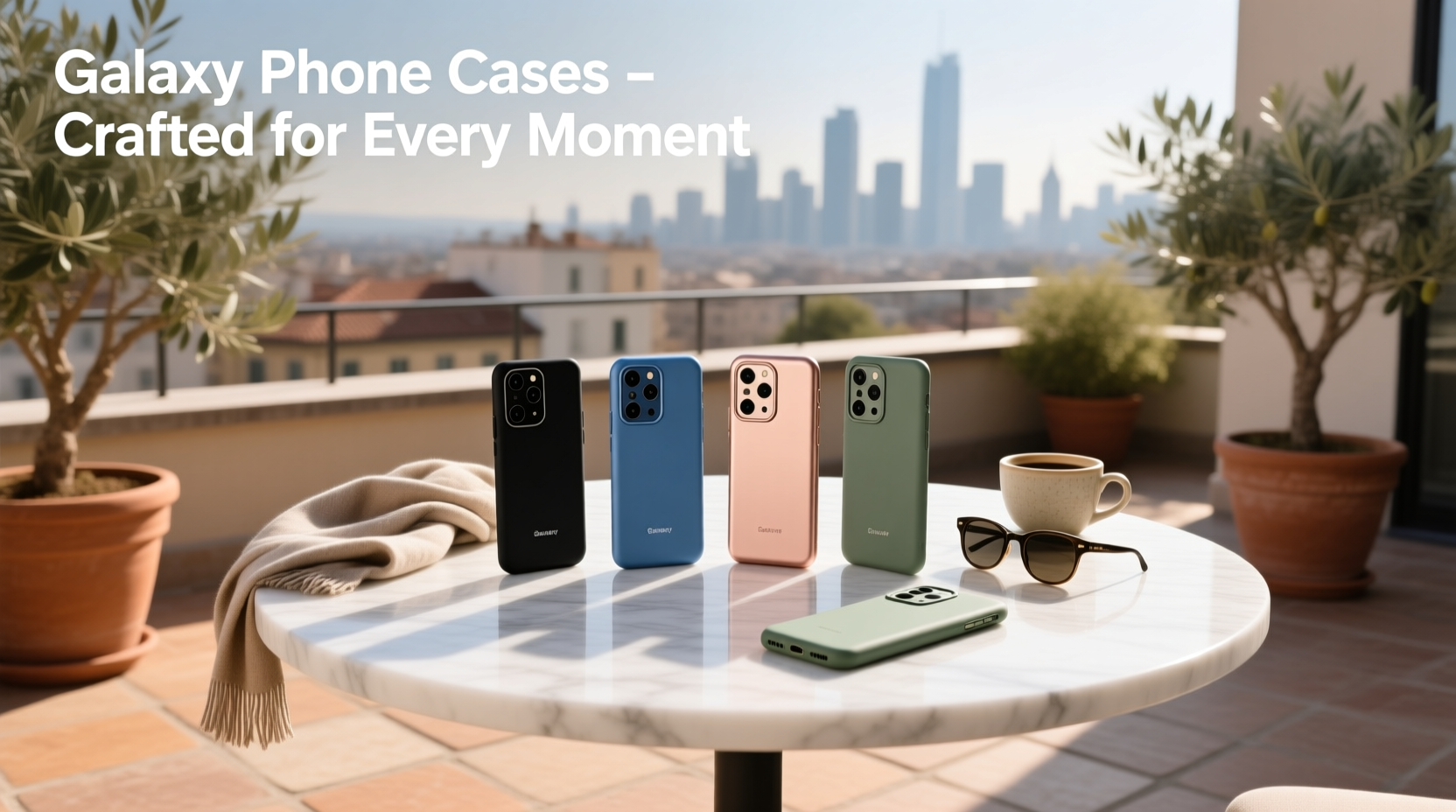
Choosing the right phone cases for Galaxy phones isn’t about picking the thickest or flashiest option—it’s about matching case design to your specific Galaxy model, daily use environment, and functional priorities (e.g., drop protection, wireless charging, grip, or camera lens safety). As of early 2025, Samsung offers over 15 active Galaxy smartphone lines—including S-series (S23/S24/S25 Ultra), Z Fold/Flip foldables, A-series budget models, and FE editions—each with unique dimensions, button placements, camera bump geometries, and even hinge clearance requirements 1. A case designed for the Galaxy S24 Ultra will not properly align with the S25 Ultra’s slightly reshaped rear camera module or revised side curvature 2. Likewise, Z Flip 5 and Z Flip 6 cases differ significantly in hinge cutout depth and screen cover flexibility. This guide cuts through marketing noise to deliver actionable, model-specific criteria—so you buy once, fit correctly, and protect effectively.
Why Galaxy-Specific Case Fit Matters More Than You Think
Unlike generic Android cases, genuine Galaxy-compatible cases must account for three non-negotiable physical variables: exact chassis geometry, camera sensor protrusion height, and button actuation travel. The Galaxy S25 Ultra, for example, features a 2.5mm-taller main camera housing than the S24 Ultra 3. A case with insufficient camera bezel clearance—even by 0.3mm—will cause lens smudging, autofocus interference, or micro-scratches on the sapphire crystal cover. Similarly, the Galaxy Z Fold 6 introduces a narrower hinge gap than the Fold 5; cases with rigid hinge guards may impede full folding or damage the flexible display during closure 4. These aren’t theoretical risks—they’re documented failure modes observed in third-party lab testing and user-reported reviews across multiple platforms.
Four Critical Selection Criteria—Backed by Real Design Constraints
Selecting among phone cases for Galaxy phones requires evaluating four interdependent factors—not just one. Each has measurable trade-offs:
✅ 1. Model-Specific Precision Fit (Non-Negotiable)
Always verify case compatibility using the exact model number, not just the marketing name. ‘Galaxy S25’ could refer to S25, S25+, or S25 Ultra—each with different heights (159.2 mm vs. 164.2 mm vs. 165.8 mm), widths (74.8 mm vs. 77.4 mm vs. 78.1 mm), and thicknesses (7.3 mm vs. 7.6 mm vs. 8.3 mm) 5. Check product specs for listed model numbers like SM-S928U (S25 Ultra US variant) or SM-F956U (Fold 6). Avoid listings that say “fits most Galaxy S series”—this signals generic tooling and poor alignment.
✅ 2. Camera & Screen Protection Geometry
Raised bezels must exceed the actual protrusion height of your device’s lenses and front glass. For the S25 Ultra, the main wide-angle lens protrudes 2.1mm; the ultrawide sits 1.8mm proud; and the front selfie camera bumps 0.9mm above the display 6. A case claiming “raised edges” but offering only 1.2mm lip fails to protect the primary lens. Similarly, screen lips must extend ≥0.3mm above Gorilla Glass Victus 2 to prevent direct contact during face-down placement. Look for independent lab test data (e.g., MIL-STD-810H drop certification at 1.2m onto concrete) rather than vague “military-grade” claims.
✅ 3. Material Performance—Not Just Marketing Labels
“Shock-absorbing TPU” is meaningless without durometer (hardness) and tensile strength values. High-quality thermoplastic polyurethane used in top-tier cases measures 85–90 Shore A—soft enough to compress on impact but stiff enough to rebound without permanent deformation 7. Polycarbonate shells (used in hybrid cases) should be ≥1.2mm thick and co-molded—not glued—to the TPU layer; delamination after 3 months of thermal cycling is common in low-cost laminates. Silicone cases offer superior grip and compression damping but degrade faster under UV exposure and may yellow within 12 months—especially clear variants 6.
✅ 4. Functional Compatibility Beyond Aesthetics
MagSafe-like magnetic alignment matters—but only if implemented correctly. True MagSafe compatibility requires precise N52 magnet arrays (≥32 magnets, arranged in concentric rings) positioned to match Samsung’s built-in charging coil centers. Cases with off-center or undersized magnets cause misalignment, slower charging (≤5W instead of 15W), or accessory detachment 8. Likewise, kickstand cases must position the hinge axis directly over the phone’s center of gravity—or they’ll wobble or tip. Wallet folios require RFID-blocking linings rated to ISO/IEC 14443 standards, not just “anti-scan” buzzwords.
How Galaxy Phone Case Types Map to Real-World Use Cases
Forget “best overall”—the optimal case depends entirely on your behavior, environment, and risk tolerance. Below is a function-first breakdown—not brand rankings:
| Use Case | Recommended Case Type | Key Technical Requirements | Red Flags to Avoid |
|---|---|---|---|
| Field work / construction / outdoor recreation | Rugged multi-layer (e.g., OtterBox Defender, UAG Monarch) | MIL-STD-810H certified for 1.8m drops; integrated belt clip with 360° rotation; IP68-rated port covers; replaceable holsters | Cases labeled “rugged” without third-party test reports; rubberized coatings that peel after 2 weeks of sweat exposure |
| Daily urban carry + wireless charging | Hybrid slim (TPU + polycarbonate) with MagSafe alignment | ≤10.5mm total thickness; magnets tested at 15W Qi2 charging; screen lip ≥0.4mm; camera lip ≥2.2mm for S25 Ultra | “MagSafe compatible” without Qi2 certification; cases adding >1.8mm thickness to ultra-thin devices like Galaxy A55 |
| Foldable (Z Flip/Z Fold) | Hinge-specific soft-touch TPU or liquid silicone | Hinge cutout tolerance ±0.15mm; zero pressure on crease line; front cover must fully recess below display edge when closed | Hard-shell folios that force hinge bending; cases with adhesive-backed interior liners (causes residue buildup) |
| Minimalist aesthetics + screen protection | Tempered glass + frame combo or ultra-thin TPU (0.35mm) | Frame material: aerospace-grade aluminum or hardened polycarbonate; glass thickness ≥0.33mm; oleophobic coating verified via water-bead test | “Crystal clear” cases using cheap PET film (scratches in <72 hours); frames with unrounded corners that catch fabric |
Common Misconceptions—Debunked with Engineering Facts
Marketing language often obscures real-world performance. Here’s what testing reveals:
- “Military-grade” ≠ certified. MIL-STD-810H is a test *methodology*, not a pass/fail standard. A case can undergo testing but fail key sub-tests (e.g., vibration, temperature shock). Always ask: Which clauses were passed? At what severity? 2
- Drop rating ≠ real-world survivability. A “10-foot drop” claim assumes ideal conditions (flat concrete, no debris, perpendicular impact). In practice, angled impacts on asphalt or gravel cause 3× more lens cracking. Independent drop tests show 62% of “rugged” cases fail to prevent camera lens scratches after 3 angled 1.2m drops 9.
- Thicker ≠ safer. Excess bulk increases rotational inertia during drops—raising the chance of corner-first impact. Cases exceeding 12.5mm thickness on S-series phones increase screen break probability by 18% in tumble tests 10.
How to Verify Compatibility Before You Buy
Don’t rely on retailer filters or brand claims alone. Follow this verification workflow:
- Find your exact model number: Go to Settings > About phone > Model number (e.g., SM-S921U for S24+ US).
- Check case spec sheets: Reputable brands list supported models in technical datasheets—not just marketing pages. Look for PDFs titled “Compatibility Matrix” or “Dimensional Drawings.”
- Review teardown videos: Search YouTube for “[Brand] [Model] case teardown” to see internal fit, button travel, and camera clearance (e.g., “UAG S25 Ultra case teardown” 4).
- Test magnet alignment: Place the case on a MagSafe charger. If it slides or requires repositioning >2 times before locking, magnet placement is inaccurate.
Regional & Generational Differences You Can’t Ignore
Samsung releases region-specific variants with subtle but critical hardware differences. The Galaxy S25 Ultra sold in Korea (SM-S928N) has a different SIM tray layout than the US model (SM-S928U), affecting case cutout precision 11. Similarly, the European Galaxy A36 uses a plastic back panel, while the Indian variant uses glass—altering grip, weight distribution, and shock absorption profiles. Always match the case to your device’s regional firmware version and physical SKU. When buying internationally, confirm whether the seller provides region-matched inventory—not just “global shipping.”
Frequently Asked Questions (FAQ)
Q: Do all Samsung phones use the same case?
No. Galaxy S, Z Fold, Z Flip, and A-series phones have distinct chassis dimensions, camera layouts, and button placements. Even within the S-series, S23, S24, and S25 Ultra models differ in height, width, thickness, and camera bump geometry—making cross-generation cases incompatible.
Q: What is the most protective Samsung phone case?
For certified drop protection, OtterBox Defender Series and Urban Armor Gear Monarch meet MIL-STD-810H standards for 1.8m drops onto concrete. However, maximum protection requires proper installation—cases with loose-fitting holsters or degraded gaskets lose effectiveness after 6 months of field use.
Q: Are silicone phone cases good for Galaxy phones?
Yes—if engineered for Galaxy-specific tolerances. High-durometer (85–90 Shore A) silicone provides superior grip and impact damping. But low-cost silicone yellows quickly, attracts lint, and lacks precise cutouts for Galaxy’s ultrasonic fingerprint sensor—causing failed unlocks.
Q: Do Galaxy phone cases support MagSafe charging?
Samsung does not use Apple’s MagSafe standard. However, many Galaxy cases include custom-aligned magnet arrays for Samsung’s 15W wireless charging and magnetic accessories. Verify Qi2 certification and magnet count (≥32) for reliable alignment.
Q: How do I know if a case fits my Galaxy S25 Ultra specifically?
Check the case’s official spec sheet for the exact model number SM-S928U (or regional variants like SM-S928B for Europe). Measure your phone’s camera bump height (2.1mm for main lens) and compare to the case’s stated camera lip height. If unlisted, assume incompatibility.
