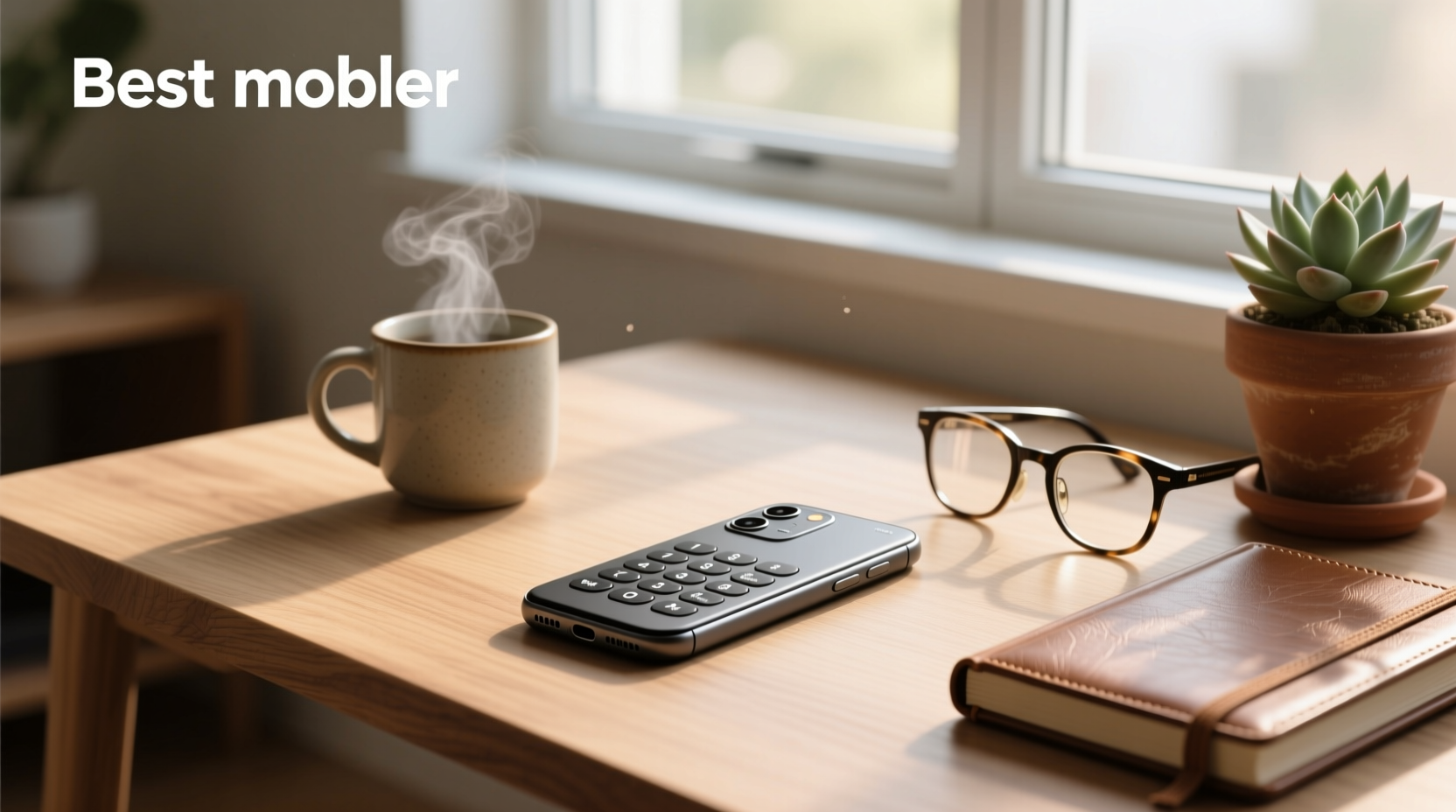
Looking for the best keypad mobile phone in 2026? You’re not alone — demand for physical-keypad devices has surged among seniors, digital detoxers, security-conscious users, and field workers who need reliability over apps. As of early 2026, the top-performing keypad phones fall into three distinct categories: modern dumbphones with 4G support (e.g., Nokia 3210 4G), Android-based keypad hybrids (e.g., Duoqin F22 Pro), and rugged or minimalist-focused models (e.g., Kyocera DuraXV, Punkt MP02). Crucially, all viable options must support 4G LTE — because 2G and 3G networks have been fully decommissioned across the US, UK, Canada, and most EU countries 1. This guide cuts through marketing hype to deliver a fact-based, use-case-driven comparison — no assumptions, no fluff.
Why Keypad Mobiles Are Still Relevant in 2026
Keypad mobiles — often mislabeled as "dumbphones" — serve specific, growing needs that smartphones struggle to meet. First, battery longevity: most keypad phones last 7–30 days on a single charge, compared to 1–2 days for flagship smartphones. Second, network resilience: with simplified radios and minimal background processes, they maintain voice call quality even in weak-signal rural or underground environments. Third, cognitive load reduction: users report lower anxiety, improved focus, and fewer distractions when using devices without notifications, infinite scroll, or app ecosystems 2. Fourth, security and privacy: proprietary OS platforms (like Nokia’s Series 30+) have near-zero attack surface — no third-party app permissions, no cloud syncing by default, and no telemetry collection. Finally, physical durability: many modern keypad phones exceed MIL-STD-810H standards and carry IP68/IP69K ratings — making them viable for construction, logistics, agriculture, and emergency response roles.
Key Decision Criteria: What Actually Matters in 2026
Selecting the right keypad mobile isn’t about nostalgia — it’s about matching hardware and software capabilities to your actual daily usage. Below are five non-negotiable evaluation criteria, ranked by real-world impact:
- ✅ 4G VoLTE Support (Mandatory): Verify carrier compatibility. In the US, Verizon and AT&T require VoLTE-certified devices for voice calls after June 2025. T-Mobile supports fallback to 3G only until December 2026 — but that window is closing. Always check your carrier’s official device compatibility list before purchase 1.
- ✅ Battery Capacity & Real-World Endurance: Don’t trust “up to 30 days standby” claims. Look for independent test data: Nokia 110 4G averages 28 days standby and 12 hours talk time; Kyocera DuraXV delivers 18 hours talk time with GPS + Bluetooth active 2.
- ✅ Physical Keypad Quality & Ergonomics: Key travel, tactile feedback, and spacing matter — especially for users with arthritis or reduced dexterity. The Kyocera DuraXV uses rubberized, raised keys with 1.8 mm key travel; the Duoqin F22 Pro features mechanical-feel membrane keys optimized for thumb typing.
- ✅ Software Capabilities vs. Minimalism Trade-off: Ask yourself: Do you need WhatsApp, email, or web browsing — or do you want zero app access? Android keypad phones like the Duoqin F22 Pro run full Android 13 Go Edition with Google Play Store access — offering flexibility for users who value messaging and basic productivity tools. Pure minimalist phones like the Punkt MP02 intentionally omit Wi-Fi, Bluetooth, and app stores — supporting focused communication via calls, SMS, and optional USB-tethered hotspot functionality.
- ✅ Repairability & Long-Term Support: Check for replaceable batteries (Nokia 3210 4G, Kyocera DuraXV), modular antennas, and availability of firmware updates. Nokia offers 24-month security patches for its 4G dumbphones; Duoqin publishes quarterly Android security updates and maintains documentation on update pathways.
Category Breakdown: Which Type Fits Your Needs?
Not all keypad phones are equal — and choosing the right category supports long-term satisfaction. Here’s how to align your lifestyle with the right class:
📱 Modern Dumbphones: Simplicity + 4G Reliability
Ideal for: Seniors, first-time mobile users, low-tech professionals (e.g., teachers, retail staff), and anyone seeking distraction-free communication.
Nokia 3210 4G remains the benchmark. It runs Nokia’s Series 30+ OS — lightweight, intuitive, and certified for VoLTE on all major US carriers. Features include a 2.4-inch QVGA display, FM radio, microSD slot (up to 32 GB), Bluetooth 5.0, and a 1200 mAh battery rated for 24 days standby. Its biggest advantage? Full backward compatibility with legacy accessories (e.g., wired headsets, car chargers) and zero forced cloud accounts. It offers a streamlined experience with a fixed feature set designed for core telephony functions. The camera supports QR code scanning and basic documentation tasks.
Nokia 110 4G is the budget alternative ($29–$39 MSRP). Same OS, same VoLTE stack, but with a smaller 1.8-inch screen, no FM radio, and slightly shorter battery life (21 days standby). Best for users prioritizing cost and core telephony — not multimedia.
💻 Android Keypad Hybrids: Functionality Without Full Smartphone Overload
Ideal for: Users who rely on WhatsApp, basic email, or ride-hailing apps but reject smartphone fatigue — e.g., delivery drivers, freelancers, or parents limiting screen time for teens.
The Duoqin F22 Pro stands alone in this niche. It runs Android 13 Go Edition with full Google Mobile Services (GMS), including Play Store, WhatsApp, Gmail, and Maps — all optimized for its 2.8-inch resistive touchscreen + physical keypad layout. Hardware includes a 2000 mAh battery (18–22 hrs mixed use), dual-SIM 4G, and a 5 MP rear camera. Critically, it supports sideloading APKs and offers ADB debugging — useful for enterprise deployment. Its design emphasizes accessibility and utility for users transitioning from smartphones to more intentional device usage. It supports carrier unlock and offers flexible configuration options for different network environments.
⌚ Rugged & Industrial Keypad Phones: Built for Extreme Environments
Ideal for: Field technicians, warehouse staff, military contractors, outdoor educators, and users in harsh climates.
The Kyocera DuraXV (model E6110) is the gold standard here. Certified to MIL-STD-810H for shock, vibration, temperature extremes (−20°C to 60°C), and IP68/IP69K for dust/water immersion (1.5m for 30 mins). Keys are oversized, backlit, and sealed — usable with gloves. It supports push-to-talk (PTT) over LTE, GPS with offline mapping, and programmable function keys. Runs Kyocera’s proprietary OS — no app store, but supports custom enterprise apps via SDK. Battery is user-replaceable (3000 mAh), delivering up to 20 hours talk time. Its robust build and specialized features make it well-suited for mission-critical operational environments.
🔒 Minimalist & Privacy-Focused Keypad Phones
Ideal for: Journalists, activists, compliance officers, and digital wellness practitioners who treat connectivity as a controlled utility — not a default state.
The Punkt MP02 is engineered for intentionality. No Wi-Fi, no Bluetooth, no app store, no location tracking — only cellular voice/SMS and optional USB-tethered hotspot (disabled by default). Its aluminum unibody is IP54-rated, screen is glare-resistant monochrome e-ink (2.0 inches), and battery lasts 4 weeks standby. Firmware updates are infrequent but cryptographically signed and distributed via manual download. It provides a highly controlled interface ideal for users who prioritize security-by-design and deliberate interaction patterns.
Regional Considerations: USA vs. EU vs. Global Markets
Network compatibility varies significantly by region — and “unlocked” doesn’t guarantee full functionality. In the USA, prioritize devices certified for Band 12/13/17 (AT&T/T-Mobile) and Band 4/13 (Verizon). The Nokia 3210 4G supports all four; the Duoqin F22 Pro lacks Band 13 — limiting T-Mobile coverage in rural areas. In the EU, Band 20 (800 MHz) is critical for indoor coverage — supported by Nokia and Kyocera, but not consistently by Duoqin. In Canada, Rogers and Bell require Band 4/7/12/13 — again, Nokia leads in cross-carrier compatibility. Always cross-check your carrier’s published frequency band list before purchasing. Never rely solely on “4G compatible” labels — they’re often marketing shorthand, not technical guarantees.
Common Misconceptions — And Why They Matter
Misconception #1: “All keypad phones are ‘dumb’ — they can’t handle modern networks.”
False. Modern 4G keypad phones use the same LTE modems and VoLTE stacks as smartphones — just stripped of unnecessary layers. The Nokia 3210 4G passes all GSMA VoLTE interoperability tests across North America and Europe.
Misconception #2: “Android keypad phones are just small smartphones.”
No. The Duoqin F22 Pro uses a heavily modified Android Go build — no Google Assistant, no background sync, no auto-updates for non-security components. It boots in under 8 seconds and consumes ~45 MB RAM idle — less than half a typical Android phone. Its architecture balances app access with resource efficiency for targeted use cases.
Misconception #3: “Battery life is always better on keypad phones.”
True *only* if comparing equivalent usage. A Kyocera DuraXV running GPS + PTT continuously will drain faster than an iPhone in airplane mode. Real-world endurance depends on feature activation — not form factor alone.
What to Look For — Key Selection Factors
- VoLTE certification listed per carrier: Prioritize devices with explicit carrier VoLTE approval — especially when purchasing for use on major networks.
- “Dual SIM” with LTE+LTE support: Confirm both SIM slots support 4G LTE to ensure full functionality for multi-network or international use.
- Brands with published regulatory certifications: Choose manufacturers that provide transparent FCC/CE documentation and publicly share firmware update policies.
- Realistic connectivity specifications: As of Q1 2026, commercially available keypad phones operate on 4G LTE networks. Devices marketed with “5G” references typically indicate future-ready packaging or marketing terminology rather than functional 5G NR capability.
Frequently Asked Questions (FAQ)
- Can I use a keypad mobile phone with my current carrier plan?
Yes — if the device is unlocked and supports your carrier’s required LTE bands and VoLTE profile. Contact your carrier directly to confirm compatibility before purchase. Most major US carriers publish online device checkers (e.g., Verizon’s “Check Device Compatibility” tool). - Do keypad phones support WhatsApp or other messaging apps?
Only Android-based keypad phones like the Duoqin F22 Pro do — via Google Play Store. Nokia, Kyocera, and Punkt models do not support WhatsApp, Telegram, or Signal natively. Some offer basic MMS for photo sharing, but no end-to-end encrypted chat. - Are keypad phones secure for sensitive communications?
Proprietary OS devices (Nokia, Kyocera) offer high baseline security due to closed ecosystems and no remote code execution vectors. Android keypad phones inherit Android’s security model — requiring manual updates and cautious app sourcing. For high-risk users, Punkt MP02’s air-gapped design provides strongest assurance — but limits functionality. - Can I expand storage or add accessories to keypad phones?
Most Nokia and Kyocera models support microSD cards (up to 32 GB). Bluetooth 5.0 is standard for wireless headsets. USB-C charging is now common (Nokia 3210 4G, Duoqin F22 Pro); older micro-USB models remain functional but harder to source cables for. - Will keypad phones work internationally?
Yes — if quad-band (850/900/1800/1900 MHz) and VoLTE-enabled. Nokia 3210 4G and Kyocera DuraXV are globally certified. Duoqin F22 Pro works in EU/UK/US but lacks Band 28 — limiting coverage in parts of Asia-Pacific and Latin America.
