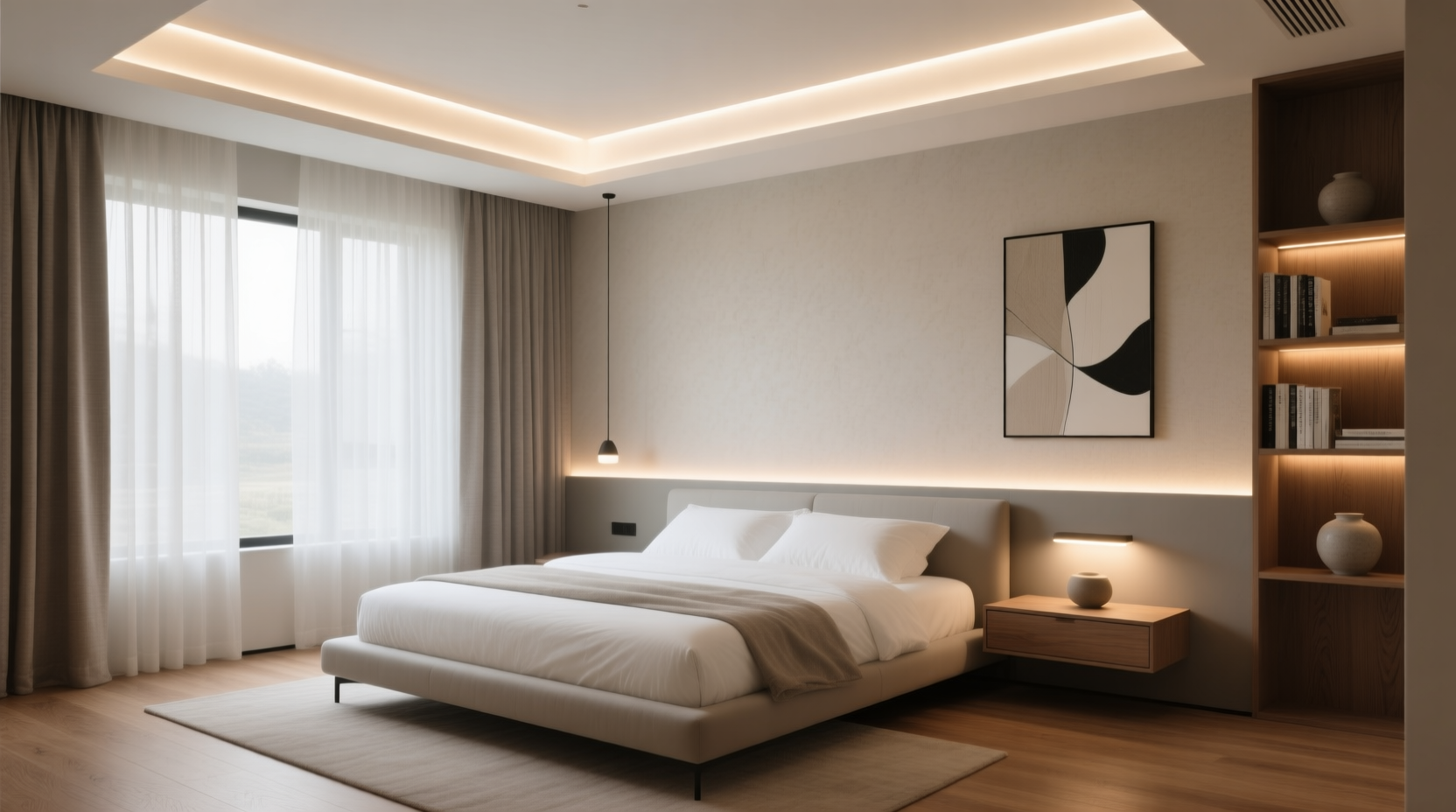
For most adults, the best LED lights for bedroom use emit light between 2700K and 3000K—a warm white spectrum that supports melatonin production and avoids circadian disruption 1. Unlike cool-white or daylight LEDs (5000K+), these warmer tones reduce blue light exposure in the evening—critical for sleep onset and quality. A typical bedroom needs only 40–60 watts’ worth of light output (≈450–800 lumens total per fixture), not raw wattage—since modern LEDs deliver that brightness at just 4–9W 2. And while strip lights dominate visual searches, layered lighting—ambient + task + accent—is what actually creates functional, restful spaces 3. This guide walks you through evidence-backed selection criteria, installation realities, and common missteps—so you invest time and money only where it improves comfort and biology—not just aesthetics.
Why Color Temperature Matters More Than Brightness in Bedrooms
Color temperature—measured in Kelvin (K)—is the single most consequential spec when choosing LED lights for bedroom environments. It directly influences how your brain interprets time of day. Light below 3000K appears yellowish or amber; above 4500K, it looks stark and bluish. Research confirms that exposure to blue-rich light (especially between 460–480 nm) in the 2–3 hours before bedtime suppresses melatonin by up to 50%, delaying sleep onset and reducing REM duration 1. That’s why 2700K–3000K is consistently recommended for bedrooms, living rooms, and other relaxation zones—while 4000K+ is reserved for kitchens or home offices where alertness is prioritized.
Yet many consumers buy ‘RGB’ or ‘tunable white’ strips without checking the minimum CCT (Correlated Color Temperature) they can reach. Some ‘warm white’ strips only go down to 3500K—not truly warm enough. Always verify the datasheet: look for “CCT range: 2700K–6500K” or “2700K fixed”. Avoid products labeled only “warm white” with no Kelvin value—this is often marketing vagueness, not technical specification.
Wattage ≠ Brightness: Understanding Lumens, Not Watts
Traditional incandescent wattage labels (e.g., “60W bulb”) are obsolete for LED selection. What matters is lumens (lm)—the actual measure of visible light output—and lumens per watt (lm/W), which indicates efficiency. A 60W incandescent emits ~800 lm. An equivalent LED uses only 8–9W to produce the same output 2. But brightness needs vary by function:
- Ambient (ceiling or wall wash): 15–20 lm/ft² — e.g., a 12′ × 14′ bedroom (168 ft²) needs ~2,500–3,400 lm total from overhead or indirect sources.
- Task (bedside reading): 400–500 lm per lamp—ideally directional, shielded, and dimmable.
- Accent (under-bed, cove, or headboard): 100–300 lm total—used for mood, not illumination.
Over-lighting a bedroom creates glare and visual fatigue. Under-lighting forces squinting and eye strain. Use a free lumen calculator (enter room dimensions and desired foot-candles) to estimate baseline needs—then subtract 20% if using warm-white LEDs, as human eyes perceive them as slightly dimmer than cooler tones at equal lumen output.
Strip Lights vs. Bulbs vs. Fixtures: Matching Form to Function
Search results show heavy emphasis on LED strip lights—but they’re only one tool. Here’s how each category serves distinct bedroom roles—and where trade-offs occur:
| Type | Best For | Key Limitations | Installation Notes |
|---|---|---|---|
| LED Strip Lights | Indirect ambient glow (coves, headboards, under-bed), color-mood customization | No built-in diffuser → visible dots unless covered; voltage drop beyond 16 ft; adhesive fails on textured/painted walls | Use aluminum channel + frosted cover for even diffusion; power every 16 ft with separate 12V feed; clean surface with isopropyl alcohol before mounting |
| Smart LED Bulbs | Overhead fixtures, lamps—full dimming, scheduling, CCT tuning | Require compatible dimmer switches (many legacy dimmers cause flicker); limited to E26/E27 base sockets | Verify bulb compatibility with your existing switch/dimmer model; avoid mixing non-dimmable and dimmable bulbs on same circuit |
| Dedicated LED Fixtures | Wall sconces, recessed downlights, ceiling panels—uniform, glare-free light | Higher upfront cost; permanent mounting; less flexible post-installation | Look for “UL Listed for Damp Locations” if installing near humidifiers or in shared bathrooms; choose CRI ≥90 for accurate skin-tone rendering |
Crucially: no single solution replaces layered lighting. A well-designed bedroom uses at least two layers—e.g., dimmable overhead + adjustable bedside lamps—or three layers if adding accent (e.g., soft under-bed glow). Relying solely on RGB strips creates high-contrast zones and insufficient task light—leading users to add unplanned lamps later.
The Hidden Risk: Blue Light, Flicker, and Circadian Mismatch
Not all warm-white LEDs are biologically safe. Two hidden factors undermine sleep support:
1. Spectral Power Distribution (SPD)
A 2700K LED can still emit disproportionate blue spikes if poorly engineered. Cheap LEDs often over-amplify 440–460 nm wavelengths to boost perceived brightness—even while labeling themselves “warm.” The only reliable way to verify low-blue emission is to check for IES TM-30-18 reports (look for Rf ≥85 and Rg ≈100) or third-party SPD graphs. Absent those, prioritize brands publishing photobiological safety data (IEC 62471 Risk Group 0 = exempt).
2. Flicker Percentage & Frequency
Flicker—rapid, imperceptible light modulation—causes headaches, eye strain, and reduced cognitive performance. Most budget LED strips operate at 100–120 Hz with >15% flicker percent. Medical-grade or premium architectural LEDs maintain <5% flicker at ≥3,000 Hz. Check product specs for “flicker-free,” “IEEE 1789 compliant,” or measured % flicker. If unavailable, assume risk—especially for side-of-bed or ceiling-mounted strips viewed peripherally for hours.
Installation Realities: What Tutorials Don’t Tell You
YouTube videos show flawless peel-and-stick application—but real-world walls vary. Paint type, texture, age, and cleaning residue drastically affect adhesion. Latex paint holds best; matte finishes outperform glossy; freshly painted walls (<30 days) often fail because plasticizers haven’t fully cured.
Here’s what actually works:
- Surface prep: Wipe with 70% isopropyl alcohol (not water or glass cleaner), then let dry 10 minutes. Sand lightly if glossy.
- Mounting: Use double-sided VHB tape (3M 4932 or 4952) instead of included adhesive—holds 3× longer on imperfect surfaces.
- Power delivery: For strips over 10 ft, run parallel 12V wires from both ends to prevent voltage sag (which causes yellowing at far end). Use a constant-voltage driver rated ≥20% above calculated load.
- Control: Avoid IR remotes in multi-strip setups—they lack addressing. Choose Bluetooth mesh or Wi-Fi systems with individual zone control (e.g., Matter-over-Thread) if managing >3 zones.
Also note: UL/ETL listing is mandatory for hardwired drivers and outlets—but many plug-in adapters and USB-powered strips skip certification. Unlisted units pose fire risk during extended overnight use. Always confirm certification marks on packaging or spec sheet—not just “CE” (a self-declared mark with no enforcement).
Dimming: Compatibility Is Non-Negotiable
Dimming LEDs isn’t plug-and-play. Incandescent dimmers use leading-edge (TRIAC) technology; most LED drivers require trailing-edge (ELV) or universal dimmers. Mismatches cause buzzing, limited range, or premature failure.
To avoid issues:
- Identify your existing dimmer model (e.g., Lutron Diva DVCL-153P).
- Consult the dimmer manufacturer’s compatible LED list—not the LED brand’s claim.
- If retrofitting, replace with an ELV dimmer rated for your total LED wattage (add 20% headroom).
- For smart systems, use native dimming (e.g., Zigbee or Matter dimmers)—not third-party IR blasters.
Pro tip: Test one fixture first. Dimming behavior varies even within same product line due to batch differences in driver firmware.
Common Misconceptions—Debunked
Misconception #1: “More colors = better bedroom lighting.”
RGB strips enable fun effects—but saturated red/green/blue light has no proven benefit for sleep or relaxation. In fact, uncontrolled color shifts disrupt melatonin rhythm more than static warm white. Reserve RGB for occasional use (e.g., parties), not nightly ambiance.
Misconception #2: “All ‘dimmable’ LEDs work with any dimmer.”
False. Dimmability is a system property—not just a bulb feature. A “dimmable” LED paired with an incompatible dimmer will flicker, buzz, or not dim below 30%.
Misconception #3: “Brightness = quality.”
No. A 1000-lumen 2700K LED with poor CRI (Color Rendering Index < 80) makes skin look gray and fabrics dull. For bedrooms, aim for CRI ≥90—especially for vanities or reading nooks.
Final Selection Checklist
Before purchasing any LED light for bedroom use, verify these five criteria:
- Color Temperature: Confirmed 2700K–3000K (not “warm white” alone).
- Lumen Output: Matches functional need (e.g., 450 lm for bedside, not 1200 lm).
- Dimmability: Verified compatibility with your existing or planned dimmer system.
- Certification: UL/ETL listed for safety; IEC 62471 RG0 for photobiological safety.
- Diffusion: Includes lens, channel, or housing to eliminate visible LED dots (critical for indirect lighting).
If any item is unconfirmed or missing from specs, treat it as a red flag—not a detail to “figure out later.”
Frequently Asked Questions
- Can I install LED strip lights behind my headboard safely?
- Yes—if using UL-listed low-voltage (12V or 24V) strips with proper heat dissipation. Avoid covering strips with fabric or foam; mount on aluminum channel to act as a heatsink. Never use non-certified AC-powered strips in enclosed spaces.
- Do LED lights for bedroom emit UV or infrared radiation?
- Quality white LEDs emit negligible UV (<0.1 µW/lm) and no meaningful infrared. Unlike halogen or incandescent bulbs, they don’t rely on thermal radiation—so heat output is minimal and spectrally confined to visible light.
- How long do bedroom LED lights last—and does usage pattern affect lifespan?
- L70 lifetime (time until output drops to 70%) is typically 25,000–50,000 hours. However, frequent on/off cycling (e.g., motion-sensor strips turning on/off hourly) reduces longevity more than continuous operation. Heat management is the largest factor—poorly ventilated drivers fail first.
- Are smart LED lights for bedroom secure against hacking?
- Wi-Fi–based systems inherit router-level risks. Choose brands supporting local control (no cloud dependency) and regular firmware updates. Avoid devices lacking TLS 1.2+ encryption or those requiring proprietary cloud accounts with weak password policies.
- Can I mix LED strip brands in one bedroom circuit?
- Technically yes—but strongly discouraged. Different brands use varying voltage tolerances, PWM frequencies, and controller protocols. Mixing causes inconsistent dimming, color drift, and communication conflicts. Stick to one ecosystem per zone.
