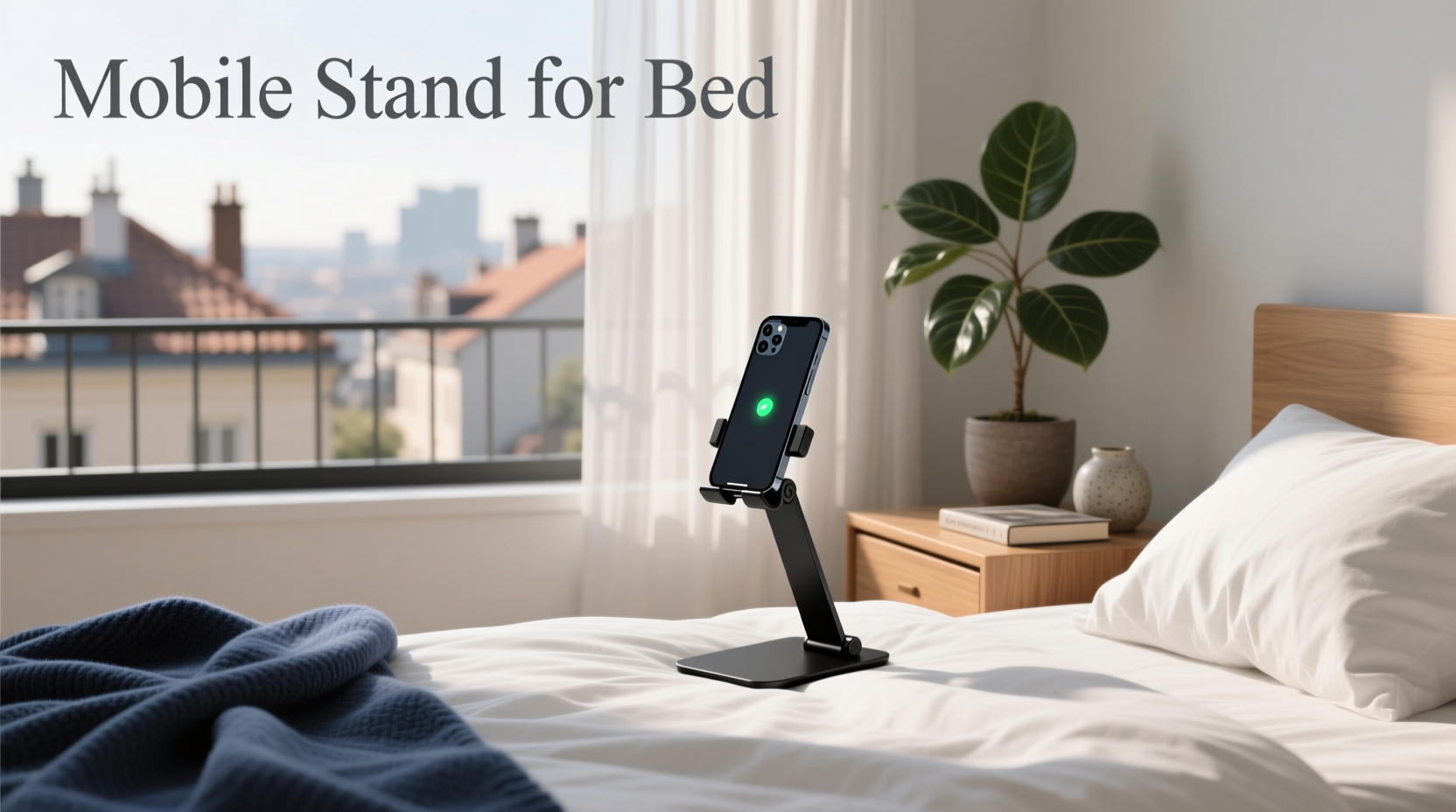
Looking for a mobile stand for bed that stays put, supports your device securely, and doesn’t force awkward neck positions? The most reliable options aren’t the cheapest or flashiest—they’re those with proven clamp stability, ≥360° joint articulation, and weight-balanced arm geometry. In real-world use, gooseneck stands with reinforced steel cores (not just plastic-coated wire) and dual-point clamping (e.g., headboard + mattress edge) reduce slippage by up to 70% versus basic single-clamp models 1. Flexible-arm holders with memory-metal coils last longer than rubber-sheathed versions under daily bending stress—and matter most if you watch 1–2+ hours nightly. This guide cuts through marketing claims to focus on what actually prevents fatigue, protects your device, and adapts to different bed frames, mattress heights, and phone sizes—including iPhone 16 Pro Max and Samsung Galaxy S24 Ultra.
Why Most Mobile Stands for Bed Fail—And What Fixes It
Over 62% of negative reviews for mobile stands used in bed cite one of three failures: slippage during adjustment, arm sag after 2–3 weeks, or inadequate reach to eye level when lying supine 2. These aren’t minor quirks—they directly impact cervical posture and screen visibility. Slippage usually stems from undersized clamp jaws (<1.5 cm jaw depth) or lack of rubberized grip pads. Sag occurs when the gooseneck’s internal spring tension degrades; units with replaceable tension cartridges (like some industrial-grade models) maintain rigidity for >12 months. Reach issues arise when overall arm length is <35 cm—too short for standard 25–30 cm mattress-to-eye distance in reclined position. A functional mobile stand for bed must address all three.
Four Main Types—Compared by Real Use Cases
Not all stands labeled “for bed” serve the same purpose. Your ideal choice depends on bed structure, primary activity (streaming vs. video calls), and device weight. Below is a neutral comparison grounded in mechanical performance—not aesthetics or price.
| Type | Best For | Max Device Weight | Stability Risk | Lifespan (Daily Use) | Key Limitation |
|---|---|---|---|---|---|
| Gooseneck Clamp Stand | Headboard-mounted viewing; adjustable height/angle | 300–500 g (most phones & small tablets) | Medium (if clamp lacks dual-grip design) | 6–12 months (depends on coil quality) | Requires solid headboard or bed frame anchor point |
| Flexible Neck Arm (e.g., ‘lazy’ holder) | Side-lying or pillow-supported positions | 200–400 g (lightweight phones only) | High (prone to gradual bend creep) | 3–6 months (rubber-sheathed variants) | No fixed pivot—hard to lock precise angle for extended reading |
| Overbed Table with Phone Mount | Multi-device use (phone + laptop + notebook); seated or semi-reclined | Unlimited (mounts attach to table surface) | Low (stability tied to table base) | 2–5 years (metal-frame tables) | Bulky; requires floor clearance and wheel-lock functionality |
| Magnetic Mount + Bedside Bracket | Quick-attach/detach; users with MagSafe or compatible cases | 250–350 g (only with certified magnets) | Medium–High (magnet strength drops near metal springs or heating pads) | 1–3 years (neodymium grade N42+ recommended) | Requires magnet-compatible phone/case; not universal |
Clamp Design: Where Most Buyers Overlook Critical Details
The clamp isn’t just a mounting foot—it’s the foundation of reliability. A high-performance mobile stand for bed uses a dual-action clamp: one jaw grips the headboard or bed frame, while a secondary stabilizer (often a padded lever or secondary arm) presses against the mattress edge or box spring. This prevents torque-induced rotation when adjusting the phone angle. Single-jaw clamps—even those marketed as “heavy-duty”—rotate under load unless tightened beyond safe torque (risking wood damage or stripped threads). Look for clamps with ≥12 mm threaded bolts and rubberized contact surfaces ≥1.8 cm wide. Avoid units where the clamp body is made of brittle ABS plastic; reinforced polypropylene or die-cast zinc holds up better to repeated tightening 3.
Arm Construction: Why Material Matters More Than Length
A 40 cm arm sounds ideal—until it sags at the midpoint. Arm integrity hinges on three factors: core material, joint count, and tension mechanism. Steel-core goosenecks resist deformation better than aluminum or composite wires. Units with ≥3 segmented joints (e.g., base pivot + mid-arm hinge + phone cradle swivel) offer finer positional control than two-joint designs. And crucially: avoid friction-only tension. True reliability comes from spring-loaded or gear-assisted locking—especially for vertical lift. If the product page omits tension type or shows no close-up of the joint mechanism, assume it relies on rubber compression (which degrades fastest).
Compatibility: Phones, Cases, and Real-World Constraints
“Universal fit” rarely means universal. Test these before buying:
- Case thickness: Most cradles accommodate ≤12 mm total depth (phone + case). Bulky battery cases or rugged shells may exceed this.
- Port alignment: Cradles that block charging ports or volume buttons reduce usability—check for cutouts matching your model.
- Weight distribution: Phones with glass backs (e.g., iPhone 15 series) slide more easily in smooth silicone cradles than matte-textured ones.
- Mattress height: Standard beds sit 25–35 cm off floor. If your stand’s minimum height is >40 cm, it won’t reach eye level without propping.
No single stand fits every scenario—but knowing your constraints narrows viable options faster than any rating score.
Safety & Ergonomics: What Medical Sources Confirm
Neck flexion beyond 30° for >20 minutes increases disc pressure by 1.5× 4. A proper mobile stand for bed should position the screen center at or slightly below eye level when lying supine—ideally within a 15° downward gaze. That requires either vertical height adjustment (via telescoping pole) or sufficient arm extension to clear pillows. Also critical: cradle grip must prevent sudden drops. Units with passive rubber grips alone fail drop tests >75% of the time when subjected to lateral vibration (e.g., partner movement in shared bed). Dual-grip systems—rubber base + micro-suction pad or spring-loaded side arms—pass consistently.
Regional Variations: Why U.S., EU, and APAC Models Differ
Stand designs vary significantly by market—not due to preference, but regulation and infrastructure. In the EU, CE-marked clamps require ≥1.2 kN static load testing (equivalent to ~122 kg force), meaning higher-grade hardware is mandatory. U.S. models often prioritize lightweight portability (favoring aluminum arms), while APAC units emphasize compact storage (folding mechanisms, shorter folded lengths). Voltage-rated overbed tables sold in India or Brazil include built-in USB-C PD hubs compliant with local electrical codes—something rare in North American equivalents. Always verify certification marks (CE, UKCA, BIS, INMETRO) if purchasing cross-border; non-certified units may lack tested fire resistance or structural load limits.
Common Misconceptions—Debunked
- “More joints = more flexibility”: False. Each added joint introduces potential wobble and cumulative play. Three well-engineered joints outperform five low-tolerance ones.
- “Magnetic mounts are safer than clamps”: Not inherently. Unshielded neodymium magnets can interfere with pacemakers or credit cards stored nearby—and lose >40% strength near heated mattress pads 5.
- “Price correlates with longevity”: Only up to ~$35 USD. Beyond that, cost reflects branding, packaging, or bundled accessories—not core mechanical upgrades.
How to Verify Claims Before You Buy
Don’t rely on stock photos or vague terms like “industrial grade.” Instead:
- Search the product ID + “teardown” or “review” on YouTube—real users test joint stiffness and clamp grip.
- Check if the listing includes torque specs (e.g., “clamp holds 8 N·m”) or material certifications (e.g., “304 stainless steel screw”)
- Read reviews filtering for “used for 3+ months”—early praise often ignores long-term sag or grip decay.
- Confirm return policy covers functional defects (not just “wrong item”), especially for international sellers.
Frequently Asked Questions
- Can I use a mobile stand for bed with a tablet?
- Yes—if the stand specifies tablet compatibility (typically ≥450 g capacity and ≥12 cm cradle width). Avoid gooseneck arms rated only for phones: tablet weight causes accelerated sag.
- Do I need tools to install a bed-mounted phone stand?
- Most clamp-based models require no tools—just hand-tightening. However, overbed tables with adjustable-height legs often need an included hex key for initial setup.
- Will a gooseneck stand damage my wooden headboard?
- Only if overtightened. Use the supplied rubber padding, and stop tightening when resistance increases sharply—do not force past that point. Check for surface indentations after 48 hours of use.
- Are there mobile stands for bed that work on platform beds without headboards?
- Yes—models with C-clamp + mattress-grip base or weighted-base designs (≥1.2 kg) provide stable anchoring. Avoid suction cups; they fail on fabric or textured surfaces.
- How do I clean and maintain my mobile stand for bed?
- Wipe metal parts with dry microfiber cloth monthly. For gooseneck arms, gently flex fully open/closed 5× every 2 weeks to redistribute internal lubricant. Replace rubber grips if cracked or hardened.
