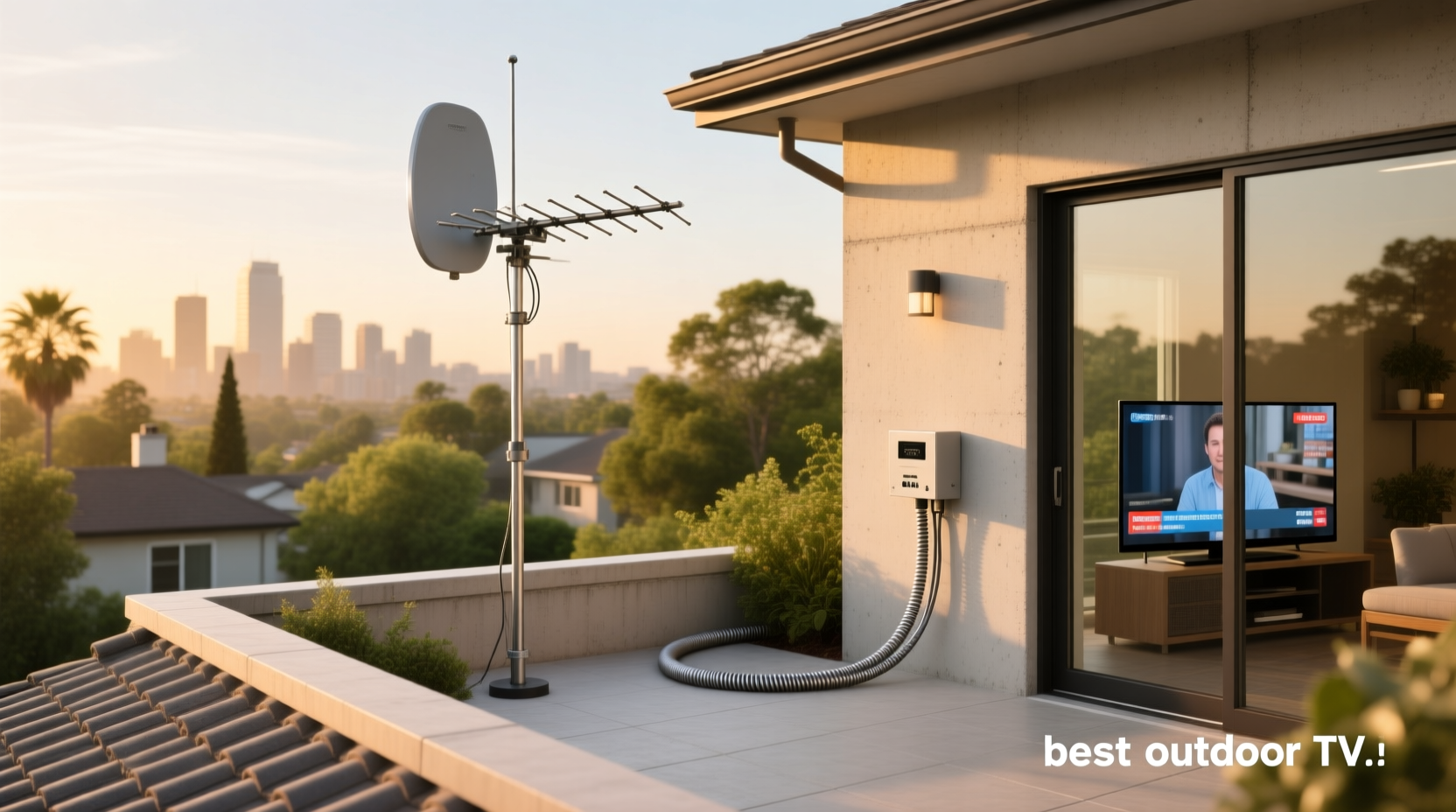
Looking for the best outdoor TV antenna for rural areas, suburban rooftops, or locations with weak over-the-air (OTA) reception? The answer isn’t a single model—it’s the right antenna for your specific location and broadcast environment. Based on independent testing across 2024–2025, top-performing outdoor antennas like the Winegard Elite 7550, Televes Dat Boss Mix LR, and Antennas Direct ClearStream 4MAX consistently deliver reliable UHF/VHF-Hi reception within 40–65 miles—when properly oriented, mounted, and matched to local signal conditions. This guide helps you identify your real-world reception needs, interpret FCC TV Fool data, avoid common installation pitfalls, and select an antenna that performs effectively in your environment.
Why ‘Best’ Depends Entirely on Your Location 📍
The phrase “best outdoor TV antenna” has no universal meaning. A directional Yagi-style antenna may offer higher gain in a rural valley—but is well-suited for environments where broadcast towers are aligned within a narrow arc. Conversely, an omnidirectional antenna (e.g., Winegard MS6000D) supports simplified setup in urban fringe zones where signals arrive from multiple directions—providing flexibility without requiring precise aiming. What matters most is your actual signal environment, not lab-tested peak gain or amplifier specifications.
Start with TV Fool1, a free, FCC-aligned tool that uses your ZIP code and address to generate a precise signal report. It shows:
- Distance and compass bearing to each active broadcast transmitter
- Signal strength prediction (in dBm) for VHF-Low (channels 2–6), VHF-High (7–13), and UHF (14–36)
- Recommended antenna type (directional vs. omnidirectional) based on tower dispersion
- Whether LTE/5G interference is likely—and whether you need a built-in filter
For example: If TV Fool lists three strong UHF signals all within ±20° of due north, a high-gain directional antenna (e.g., Antennas Direct Element or Winegard YA7000C) is optimal. If it shows six usable signals spread from 45° to 290°, an omnidirectional or multi-directional design becomes practical—even if gain is slightly lower.
Key Technical Factors That Actually Matter 🛠️
Ignore inflated “200-mile range” claims. Real-world OTA reception rarely exceeds 70 miles—even under ideal line-of-sight conditions—due to Earth’s curvature, terrain blockage, and digital cliff effect (where signal drops from perfect to zero with minor degradation). Focus instead on these verified, measurable attributes:
1. Frequency Band Coverage: VHF vs. UHF Reality Check
Many modern antennas advertise ‘full-band’ support but vary in sensitivity below 174 MHz (VHF-High) or especially below 54 MHz (VHF-Low). Yet stations like PBS affiliates, NBC affiliates in smaller markets, and some religious broadcasters still transmit on VHF-Low. If TV Fool shows usable VHF-Low signals at your location, consider antennas with low-band capability—such as the Winegard YA7000C (with optional VHF-Low rods) or the Televes DAT BOSS Mix LR 2. Compact ‘HD’ antennas typically focus on UHF performance and may not support VHF-Low reception.
2. Gain (dBi) — Not Just a Number
Gain measures how well an antenna focuses energy—not raw power. A 12 dBi directional antenna emphasizes signals from its front lobe while reducing noise and multipath from the sides/rear. That’s why gain must be interpreted alongside front-to-back ratio (F/B) and beamwidth. For instance:
| Antenna Model | Peak UHF Gain (dBi) | Front-to-Back Ratio | Beamwidth (°) | VHF-Low Capable? |
|---|---|---|---|---|
| Winegard Elite 7550 | 15.5 | 22 dB | 52° | No |
| Televes Dat Boss Mix LR | 14.2 | 25 dB | 48° | Yes (with extension) |
| Antennas Direct ClearStream 4MAX | 13.0 | 18 dB | 60° | No |
| Channel Master CM-3020 | 16.0 | 28 dB | 40° | No |
Source: Manufacturer datasheets and independent RF measurements published by Antenna Man (2024–2025 field tests)3.
A narrower beamwidth (e.g., 40°) improves rejection of reflected signals—beneficial near hills, water, or large buildings. A 60° beam offers broader coverage and greater aiming flexibility—well-suited for varied installation scenarios.
3. Amplification: When It Helps (and When It Hurts)
Pre-amplifiers (mounted at the antenna) boost weak signals before cable loss degrades them. They also amplify ambient RF noise—and may overload on strong signals, affecting signal stability. Use one only if:
- You’re using >50 ft of RG6 coax
- Your strongest signal is ≤ −75 dBm (per TV Fool)
- You have confirmed low-noise pre-amps (e.g., Winegard LNA-200, Channel Master Titan2)
Powered indoor amplifiers placed after long cable runs amplify existing noise, potentially lowering signal quality. Antennas with non-bypassable, fixed-gain amplifiers offer less adaptability across varying signal strengths.
Mounting Height & Placement: The #1 Performance Factor 📡
Height above ground is the single largest determinant of reception success—more impactful than antenna model choice. Signal propagation follows a near-line-of-sight path. Every 10 feet of elevation increases horizon distance by ~4 miles. GEARit’s 2025 field study found that raising an antenna from 15 ft to 30 ft above roof level improved usable channel count by 3.2 channels on average—and enhanced reliability on marginal UHF stations 4.
Practical mounting guidance:
- Rooftop mounts: Secure to chimney or ridge vent using UL-listed mast clamps—not screws into shingles. Avoid metal gutters or HVAC units that cause reflection.
- Pole mounts: Use Schedule 40 PVC or galvanized steel (≥1.5" OD). Anchor base in concrete; avoid wood posts (warping causes misalignment).
- Attic installs: Only viable in homes with asphalt shingle roofs (not metal or foil-backed insulation). Expect reduced signal compared to outdoor mounting.
- Ground-level placement: Generally not recommended. Even at 10 ft, foliage, fences, and neighboring structures can affect signal consistency.
Omnidirectional vs. Directional: Which Should You Choose?
This is the most frequent source of buyer consideration. Here’s how to decide:
Choose Directional If:
- All major transmitters fall within a 90° arc (verified via TV Fool map view)
- You live >25 miles from towers and benefit from focused gain
- You experience co-channel interference (e.g., two NBC affiliates on same frequency)
- You’re in hilly or forested terrain where side-lobe pickup causes ghosting
Choose Omnidirectional If:
- Transmitters span >120° (e.g., city center + distant mountain repeater + lake-side translator)
- You cannot rotate or re-aim the antenna (e.g., HOA restrictions, rental property)
- You receive both analog FM radio and DTV (some omnidirectional models support 88–108 MHz)
- You prioritize ease of install and broad coverage
Note: True omnidirectional antennas (e.g., Winegard MS6000D) are designed for full 360° coverage. Many marketed as ‘omni’ are wide-beam directional designs with 100–120° coverage—suitable for many dispersed scenarios.
Common Misconceptions & Costly Mistakes ❌
Misconception #1: “Amplified = Better Reception”
Amplification boosts existing signal—it does not create signal. In strong-signal areas (e.g., within 15 miles of towers), amplifiers may increase noise floor and affect signal fidelity. Independent tests show amplified antennas perform comparably to non-amplified equivalents in urban/suburban zones when used appropriately 5.
Misconception #2: “Bigger Antenna = More Channels”
Size correlates with low-frequency capability—not channel count. A 4-ft-wide VHF-Low antenna provides enhanced low-band response, while compact UHF-optimized antennas deliver excellent performance where local signals are primarily UHF.
Misconception #3: “Indoor/Outdoor Hybrid Models Are a Good Compromise”
Hybrid antennas (e.g., ClearStream 1MAX) balance versatility with weather resistance. They are rated for extended outdoor exposure and incorporate UV-stabilized materials. For permanent outdoor use, dedicated outdoor models provide long-term durability; hybrids offer adaptable solutions for evolving needs.
Regional Considerations: Germany, UK, US Differences 🌐
While core physics remain constant, regional broadcast standards influence antenna selection:
- United States & Canada: ATSC 3.0 rollout is ongoing. Most new antennas are backward-compatible with ATSC 1.0, but future-proofing requires UHF support up to 700 MHz and tolerance for higher-order modulation. VHF-Low remains relevant in ~22% of markets 6.
- Germany & EU: DVB-T2 dominates. Antennas must cover 470–790 MHz (UHF) and often include integrated LTE filters (700–800 MHz) to prevent 4G/5G interference—a common consideration near cell towers. Models like One For All SV9455 are certified for CE/DIN 45310 compliance 7.
- UK: Freeview Play relies on DVB-T2 + MHEG-5. VHF use is minimal; focus on UHF gain and group B/C/D filtering. Roof height and neighbor obstruction influence performance more than raw gain due to dense housing.
How to Verify Your Antenna Is Working Correctly ✅
Don’t rely on “signal bars.” Use your TV’s built-in signal diagnostics:
- Run a full channel scan after mounting and aiming.
- Access the signal meter (usually via Menu > Settings > Channels > Signal Strength). Look for:
- Signal Strength: ≥ 65% (indicates adequate carrier power)
- Signal Quality (SNR): ≥ 22 dB (indicates clean, error-free data)
- If Strength is high but Quality is low → multipath or amplifier overload
- If both are low → poor aiming, obstruction, or wrong antenna type
- Rescan weekly for 3 weeks—seasonal foliage and atmospheric changes affect OTA reliability.
Frequently Asked Questions (FAQ)
- Are outside TV antennas worth it?
- Yes—if you’re >10 miles from broadcast towers, experience frequent streaming buffering, or want reliable local news/weather without internet dependency. Field data shows outdoor antennas deliver 30–50% more stable reception than indoor models in suburban/rural settings.
- What is the best external antenna for weak signal areas?
- Not a single model—but a system: high-gain directional antenna (e.g., Winegard Elite 7550 or Televes Dat Boss Mix LR), mast-mounted pre-amplifier (if signal < −75 dBm), and elevation ≥30 ft above ground. Prioritize VHF/UHF balance over peak gain alone.
- How to make outdoor antenna signal stronger?
- 1) Increase height (most effective); 2) Eliminate obstructions (trim trees, relocate away from metal); 3) Use quad-shielded RG6 cable; 4) Add a mast-mounted pre-amp only if signals are truly weak; 5) Re-aim precisely using compass + TV Fool bearings.
- How do I choose an outdoor TV antenna for my location?
- Step 1: Run your address through TV Fool. Step 2: Note tower bearings and signal bands (VHF/UHF). Step 3: Select directional if towers cluster within 90°; omnidirectional if spread >120°. Step 4: Confirm VHF-Low support if needed. Step 5: Choose mounting method and verify height feasibility.
- Do I need a rotor for my outdoor antenna?
- Only if towers lie in widely separated directions (e.g., >120° apart) AND you require channels from all directions simultaneously. Rotors add cost, complexity, and failure points. Most users achieve effective results with a wide-beam antenna or strategic compromise aiming.
