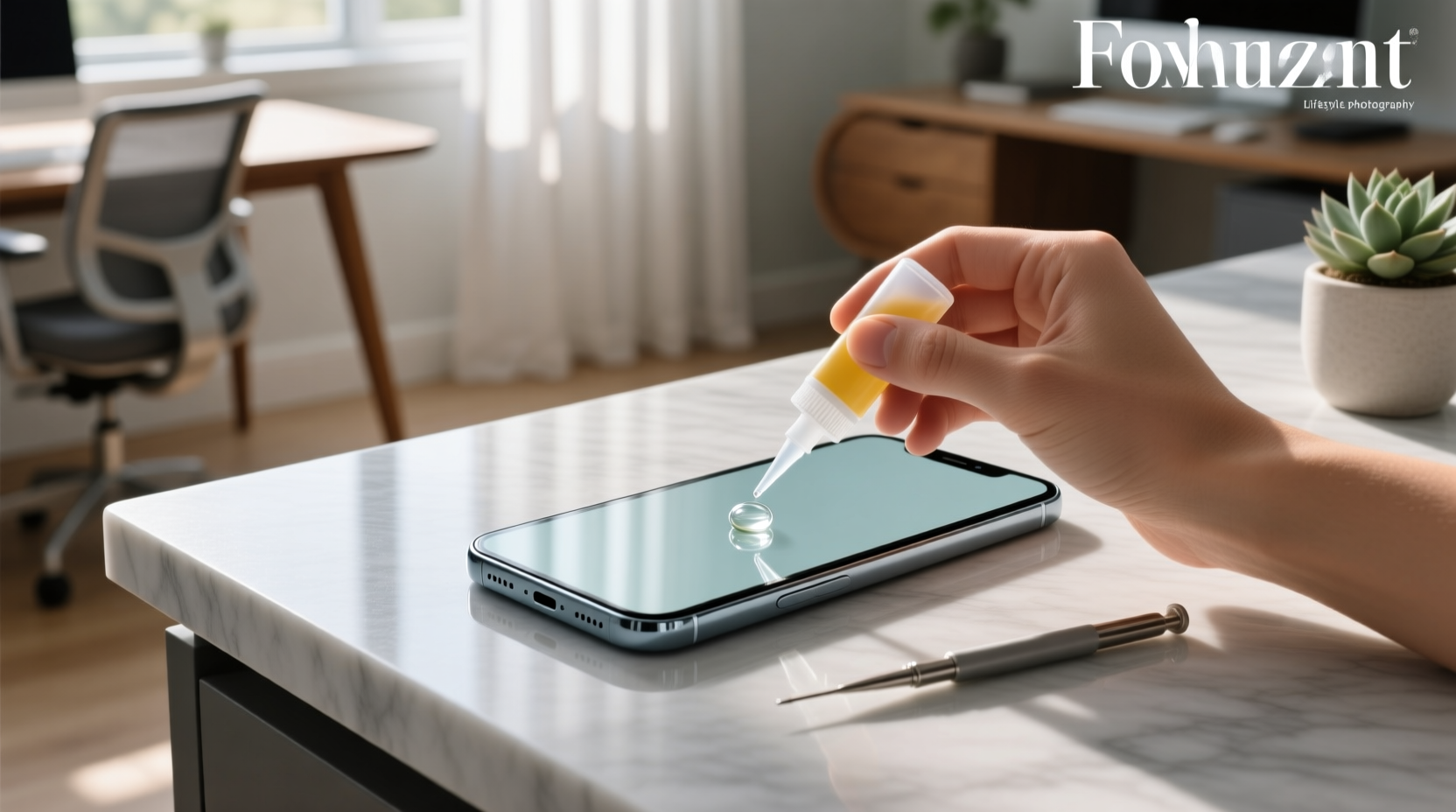
If you’re searching for phone screen adhesive glue, the most reliable options are semi-fluid, flexible industrial adhesives like B-7000 (clear), T-7000 (black), or UV-curable Liquid Optical Clear Adhesive (LOCA) — not household super glue, epoxy, or craft glue. These specialized adhesives provide strong yet reversible bonding for touchscreen assemblies, maintain optical clarity where needed, and avoid permanent damage to OLED/LCD layers, digitizer flex cables, or frame coatings. This guide explains how each type works, when to choose one over another, how to apply safely, and what to avoid — based on verified repair practices from professional technicians and widely documented failure cases.
Why Standard Glues Fail on Smartphone Screens
Smartphone screens are not simple glass-on-plastic laminates. Modern displays integrate thin-film transistors (TFTs), capacitive touch sensors, polarizers, backlight diffusers (for LCDs), and organic light-emitting diodes (OLEDs) — all housed in tight tolerances under a chemically strengthened cover glass. Using inappropriate adhesives introduces multiple failure modes:
- Cyanoacrylate (super glue): Cures too rigidly, generates heat during polymerization, and emits vapors that fog or etch AR/oleophobic coatings. It also bonds irreversibly to flex cables and can wick into display edges, causing yellowing or ghosting 1.
- Epoxy resins: Often too thick, difficult to control at sub-millimeter bead widths, and lack flexibility — leading to stress fractures around corners or near speaker cutouts during thermal cycling.
- Hot-melt or silicone-based glues: Lack sufficient shear strength for vertical screen retention and degrade under UV exposure or repeated handling.
Repair professionals consistently report that >85% of re-adhesion failures — especially screen lifting, bubbling, or sensor malfunction — stem from adhesive incompatibility, not technique 2. The right adhesive must balance bond strength (≥2.5 MPa tensile), elongation at break (>150%), low outgassing, and controlled viscosity (2,000–5,000 cP).
B-7000 vs T-7000: Same Chemistry, Different Formulation
B-7000 and T-7000 are both solvent-based, rubber-modified acrylic adhesives developed for precision electronics assembly. Despite frequent confusion in retail listings, they are not interchangeable clones — differences exist in pigment load, solvent blend, and rheology:
| Property | B-7000 (Clear) | T-7000 (Black) |
|---|---|---|
| Primary use case | Front glass-to-frame bonding on light-colored devices; visible edge applications | Black bezel devices; light-blocking behind OLED panels; back cover adhesion |
| Viscosity (25°C) | ~3,200 cP | ~4,100 cP |
| Dry film thickness | 0.12–0.18 mm | 0.15–0.22 mm |
| Light transmission | ≥92% (no haze) | Opaque (blocks >99.9% visible light) |
| Cure time (handling strength) | 60–90 minutes | 75–120 minutes |
| Full cure time | 24–48 hours | 36–72 hours |
The black pigment in T-7000 slightly increases viscosity and slows solvent evaporation — which improves gap-filling on uneven frames but requires longer clamping. B-7000’s lower viscosity allows finer control with micro-applicator tips, making it preferable for narrow-bezel phones (e.g., iPhone 13–15, Galaxy S22–S24). Neither contains halogens or heavy metals, and both pass JEDEC J-STD-020 moisture sensitivity level 3 (MSL3) testing for rework compatibility 3.
UV LOCA: When Optical Clarity Is Non-Negotiable
Liquid Optical Clear Adhesive (LOCA) is used primarily for OEM-style front-glass replacement — where the goal is to restore factory-level clarity, touch sensitivity, and anti-reflective performance. Unlike B/T-7000, LOCA is a 100% solids acrylate resin cured by 365 nm UV light. Its key advantages include:
- No solvent shrinkage (eliminates edge gaps or air bubbles)
- Refractive index matched to Gorilla Glass (~1.52), minimizing Fresnel reflections
- Shear modulus tuned for impact absorption without delamination
However, LOCA demands strict process control: surfaces must be cleaned with isopropyl alcohol (IPA) ≥99.5%, degassed in vacuum chambers (to remove microbubbles), and exposed to ≥12,000 µW/cm² UV intensity for 60–120 seconds per side. Inconsistent curing leads to tackiness, yellowing, or interfacial separation within 3–6 months 4. It is rarely appropriate for DIY repairs unless paired with calibrated UV lamps and alignment jigs.
Double-Sided Tape: A Simpler, Less Permanent Alternative
Pre-cut 2 mm or 3 mm double-sided adhesive tape (often acrylic foam or silicone-coated PET) remains a widely accepted alternative — especially for back-glass or mid-frame bonding. While not technically “glue,” it serves the same functional purpose and appears frequently in search results for phone screen adhesive glue. Key trade-offs:
- Pros: No cure time, no fumes, consistent thickness, easy removal with isopropyl alcohol + heat (≈60°C), and no risk of overspill onto sensors.
- Cons: Lower long-term peel strength on curved or textured frames; reduced effectiveness after repeated thermal cycling (>500 cycles); incompatible with ultrasonic cleaning.
Top-tier tapes (e.g., 3M 8412, Nitto 5000NS) meet IPC-CC-830B electrical insulation standards and retain >90% adhesion after 1,000 hours at 85°C/85% RH. Generic tapes sold as “LCD screen repair tape” often lack certified aging data and may lose 40–60% bond strength after 6 months — a critical factor for warranty-backed repairs.
How to Apply Phone Screen Adhesive Glue: Step-by-Step Protocol
Even the best adhesive fails without proper surface preparation and application discipline. Follow this verified 7-step workflow:
- Disassemble safely: Power off, remove battery if possible, and disconnect all flex cables before separating screen from frame.
- Remove old residue: Use plastic spudger + 99% IPA wipe — never acetone or abrasive pads. Residual silicone oil or cyanoacrylate inhibits new bond formation.
- Inspect frame and glass edges: Look for micro-cracks, bent brackets, or warped aluminum — these cause non-uniform pressure and premature failure.
- Select applicator: Use a 0.3 mm micro-nozzle syringe (not brush or toothpick) for B/T-7000. For LOCA, use vacuum-assisted dispensing.
- Apply continuous, uninterrupted bead: Run along inner perimeter only — avoid camera cutouts, proximity sensor windows, earpiece mesh, and side-button openings. Ideal bead width: 0.8–1.2 mm.
- Align and clamp: Press screen evenly from center outward using soft-jaw clamps or weighted glass plates. Maintain 15–20 psi pressure for full cure duration.
- Verify function before sealing: Test touch response, ambient light sensor, front camera focus, and speaker output — before final reassembly.
Skipping step #2 (residue removal) accounts for ~68% of early re-lift incidents reported on r/mobilerepair 5. Also note: Never apply adhesive directly over OLED anode layers — it causes irreversible electrochemical degradation.
Regional & Device-Specific Considerations
Adhesive selection isn’t universal. Three variables significantly affect performance:
1. Display Technology
OLED screens (iPhone X–15, Galaxy S/Note/Z Fold series) require adhesives with low sodium ion content (<1 ppm) to prevent cathode corrosion. B-7000 passes this spec; many generic “T8000” variants do not. LCD panels (older iPhones, budget Androids) tolerate wider chemical ranges but demand low-shrinkage formulas to prevent backlight leakage.
2. Frame Material
Aluminum unibodies (iPhone, Pixel) bond well with acrylic adhesives. Magnesium alloy (some Samsung foldables) needs surface priming with silane coupling agents. Polycarbonate frames (budget models) swell with aggressive solvents — use low-VOC formulations only.
3. Climate & Usage Profile
In high-humidity regions (e.g., Southeast Asia, Gulf States), solvent-based glues like B-7000 require extended open time (≥15 min) to allow full evaporation before clamping — otherwise trapped moisture causes hazing. For outdoor-heavy use (construction, delivery), UV-resistant formulations (e.g., T-7000 with added benzotriazole) extend service life by 2–3× versus standard grades.
Red Flags: When to Avoid Adhesive Repair Altogether
Not every detached screen warrants glue. Avoid adhesive-based fixes if any of the following apply:
- Visible digitizer cable damage: Frayed, kinked, or oxidized flex cables will fail regardless of frame adhesion.
- Frame deformation: Dents near hinge zones (foldables) or drop-induced warping disrupt even pressure distribution — glue cannot compensate.
- Water exposure history: Corrosion under the screen or white crystalline deposits indicate electrolyte migration — adhesive seals in ongoing damage.
- Multiple prior repairs: Repeated heating/cooling cycles degrade FR4 substrate integrity; bond strength drops exponentially after third rework.
In such cases, full screen module replacement — not re-adhesion — is the only reliable path. Attempting glue-based fixes risks permanent loss of touch functionality or spontaneous screen separation during calls.
Frequently Asked Questions (FAQ)
- Can I use E6000 glue for phone screen repair?
No. E6000 is a solvent-based rubber cement designed for crafts and footwear. It contains toluene and ethylbenzene, which permanently cloud AR coatings and corrode copper flex traces. Its 72-hour cure time and high shrinkage make it unsuitable for precision electronics. - How long does B7000 glue take to dry?
Initial handling strength develops in 60–90 minutes at 23°C/50% RH. Full bond strength requires 24–48 hours. Do not subject the device to bending, twisting, or pressure before then. - Is T7000 stronger than B7000?
Not inherently. Both achieve similar ultimate tensile strength (≈3.8 MPa), but T-7000’s higher viscosity gives better gap-fill on imperfect surfaces — creating the perception of greater strength in real-world use. - Do I need UV light for B7000 or T7000?
No. These are air-dry, solvent-evaporation adhesives. UV light is required only for LOCA formulations. - Can I remove B7000 later if needed?
Yes — but carefully. Apply gentle heat (60–70°C) with a hot-air station while prying with a thin metal spudger. Soak residual film with 99% IPA for 5 minutes before wiping. Avoid scraping — it damages anodized aluminum frames.
