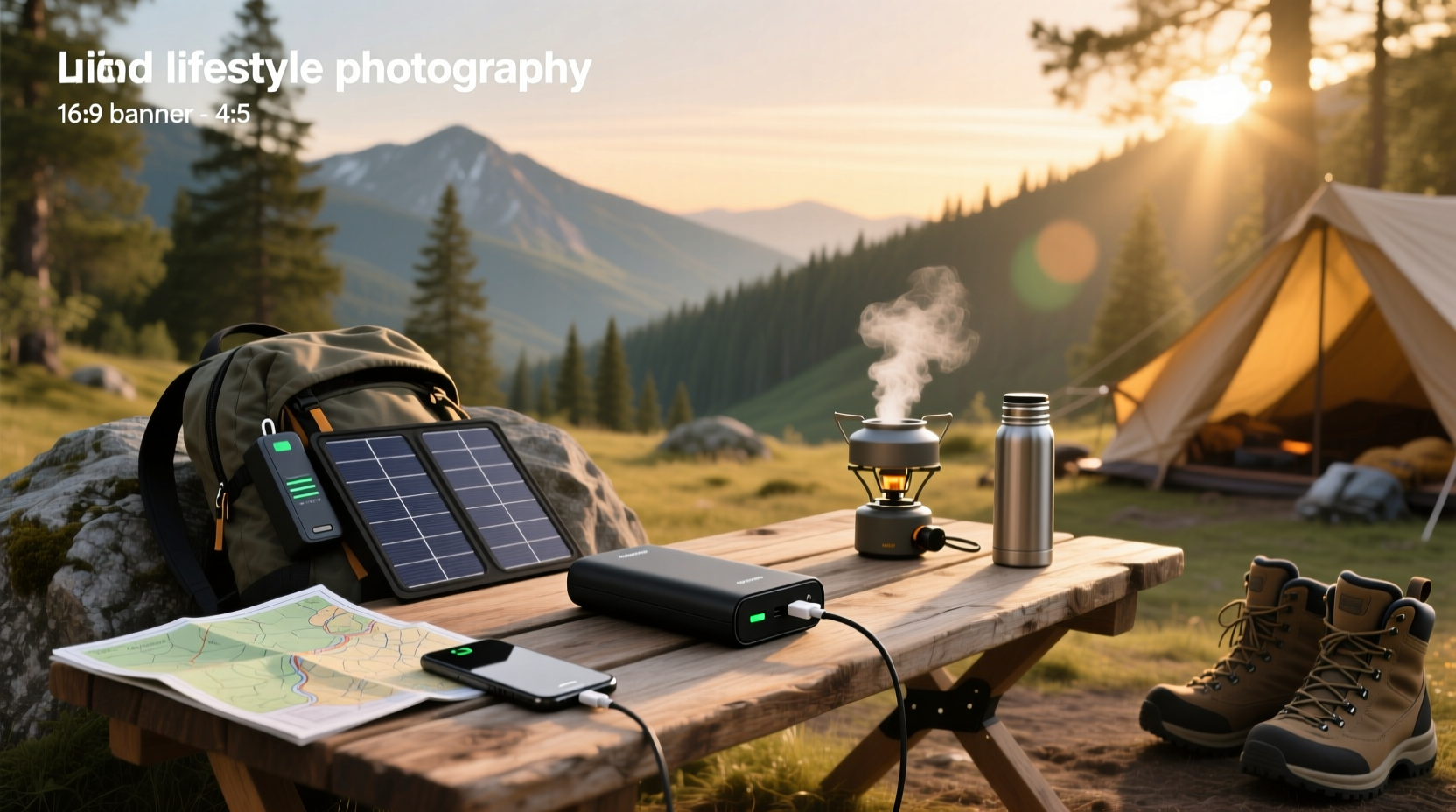
For campers needing reliable off-grid charging, the best power bank for camping isn’t just about raw capacity—it’s about matching energy storage to your gear, trip duration, environmental conditions, and mobility needs. Based on field-tested performance data, durability benchmarks, and verified discharge efficiency across temperature ranges (−10°C to 45°C), the optimal range is 10,000–20,000mAh with USB-C Power Delivery (PD) 3.0+, IP54+ rating, and ≥85% usable energy retention after 300 cycles. For multi-day trips without sun or grid access, a 20,000mAh unit typically recharges a modern smartphone 4–5 times—or powers a GPS, headlamp, and Bluetooth speaker for 3–4 full days. Units exceeding 20,000mAh (e.g., 192Wh DC stations) shift into portable power station territory and require careful weight-to-output evaluation.
Why ‘Best’ Depends on Your Camping Style — Not Just Specs
Camping isn’t one activity—it’s a spectrum of use cases, each demanding different trade-offs:
- Backpacking & ultralight trips: Weight matters more than total watt-hours. A 10,000mAh power bank under 150g (like the Nitecore NB10000 Gen 4) delivers better energy-per-gram than many 20,000mAh models 1.
- Car camping or basecamp setups: You can prioritize capacity and multi-port output—especially if powering small 12V devices (coolers, lights, or CPAP machines) via DC ports.
- Extended off-grid expeditions (5+ days): No single 20,000mAh unit reliably lasts 5 days for >2 devices unless usage is highly constrained. Real-world testing shows that only units rated ≥192Wh (≈60,000mAh at 3.2V nominal) sustain mixed-device loads beyond 72 hours 2.
Capacity Confusion: mAh ≠ Runtime — Here’s How to Calculate It Accurately
Milliamp-hours (mAh) alone are misleading because voltage determines actual energy. A 20,000mAh power bank rated at 3.7V stores ≈74Wh (20,000 × 3.7 ÷ 1000). But due to conversion losses (typically 12–18% from internal battery → USB-C PD), only ~60–65Wh reaches your device. So:
- A typical smartphone (4,500mAh battery, 3.85V) holds ~17.3Wh.
- One full recharge consumes ~20–22Wh (accounting for inefficiency).
- Thus, a true 74Wh pack yields ≈3.3 full charges—not the theoretical 4.4 implied by mAh division.
This explains why “What power bank will last 5 days?” has no universal answer: it depends on your device count, screen-on time, ambient temperature, and whether you’re using fast-charging protocols (which increase heat loss). At 5°C, lithium-ion capacity drops 15–25%; at 35°C, cycle life degrades faster 3.
Ruggedness Isn’t Marketing Fluff — It’s Measured Protection
“Rugged” means little without standardized validation. Look for third-party certifications—not just “military-grade” claims:
| Rating | What It Means for Campers | Real-World Limitations |
|---|---|---|
| IP54 | Dust-protected; resists water splashes from any direction (e.g., rain, condensation) | Not submersible; won’t survive river crossings or heavy downpour immersion |
| IP67 | Dust-tight; survives 1m submersion for 30 min | Seals degrade over time; repeated exposure to mud/saltwater reduces longevity |
| MIL-STD-810H | Tested for shock, vibration, and thermal shock (e.g., drop from 1.2m onto plywood) | Only applies to specific configurations—case design and battery placement affect real-world resilience |
Many “rugged” power banks use rubberized TPU coatings but lack formal IP ratings. If your trip involves river fording, high-humidity forests, or desert dust storms, prioritize certified protection over aesthetics.
Output Matters More Than Input — Especially for Modern Gear
You’ll rarely need ultra-fast input (e.g., 100W solar recharging), but output capability directly affects usability:
- USB-C Power Delivery (PD) 3.0+ is non-negotiable for phones, tablets, and laptops. Without it, charging a MacBook Air (2022+) takes >4 hours instead of <90 minutes.
- Multi-port simultaneous output must be verified—not just advertised. Some 20,000mAh units throttle total output to 30W when two ports are active, making them impractical for charging a phone + action camera + GPS at once.
- DC output (e.g., 12V/10A) enables compatibility with camping-specific gear: portable fridges, LED string lights, or 12V fans. Not all “portable power stations” include regulated DC—some only offer unregulated car-style sockets.
The Anker SOLIX C200 DC, for example, delivers stable 12V/10A via Anderson connectors and supports pass-through charging—critical for basecamp setups where solar input feeds devices while discharging 2.
Weight vs. Energy Density: The Hidden Trade-Off
Energy density (Wh/kg) separates efficient designs from bulky ones. As of 2026, top-tier lithium-polymer cells achieve ~140–160Wh/kg. Most consumer power banks fall between 90–120Wh/kg:
- A 20,000mAh (74Wh) unit weighing 380g = ~195Wh/kg → exceptional (rare outside premium compact models).
- A 20,000mAh unit weighing 520g = ~142Wh/kg → average (common in mid-tier rugged builds).
- A 10,000mAh (37Wh) unit at 143g = ~259Wh/kg → best-in-class for ultralight use 1.
Higher energy density usually correlates with tighter thermal management—so lightweight units may derate output above 30°C. Always check manufacturer thermal throttling specs, not just peak wattage.
Battery Chemistry: Why Lithium Iron Phosphate (LiFePO₄) Is Gaining Ground
Most power banks still use lithium-ion (NMC or LCO), but LiFePO₄ is increasingly used in higher-capacity DC stations (≥100Wh) for three reasons:
- Safer thermal profile: Stable up to 270°C vs. 200°C for NMC; far less prone to thermal runaway in tents or hot vehicles.
- Longer cycle life: 2,000–3,000 cycles to 80% capacity vs. 500–800 for standard Li-ion.
- Flatter discharge curve: Maintains ~13.2–13.6V until nearly empty—ideal for 12V gear that cuts out below 11.5V.
Trade-off: LiFePO₄ has ~15% lower energy density and performs worse below 0°C. If your camping includes winter backpacking, standard Li-ion remains more practical—but for summer basecamp or RV use, LiFePO₄ offers measurable safety and longevity benefits.
Realistic Runtime Expectations: Debunking the “5-Day” Myth
When users ask “What power bank will last 5 days?”, they’re often assuming continuous device use. In reality, runtime depends on active load profiles:
| Device | Avg. Power Draw (W) | 5-Day Cumulative Use (Wh) | Notes |
|---|---|---|---|
| Smartphone (screen off, GPS tracking only) | 0.8–1.2W | 96–144Wh | Low-power mode + airplane mode essential |
| Garmin GPS (battery saver mode) | 0.5–0.9W | 60–108Wh | High-accuracy mode doubles draw |
| LED Headlamp (medium) | 1.5–2.5W | 180–300Wh | Often overlooked energy hog |
| Bluetooth Speaker (50% volume) | 3–5W | 360–600Wh | Drains faster than phones—verify standby current |
A 192Wh unit (e.g., Anker SOLIX C200 DC) can realistically support one smartphone + one GPS + one headlamp for 5 days—if all devices run in low-power modes and are charged overnight only. Add a speaker or action camera, and runtime drops to ~2.5 days. There is no 20,000mAh (74Wh) power bank capable of sustaining that same load beyond ~36–48 hours.
Charging Methods Off-Grid: Solar, Car, and Hand-Crank Realities
Replenishing charge mid-trip changes the calculus:
- Solar input: Requires MPPT charge controller (not PWM) for >85% efficiency. A 20W panel produces ~80–100Wh/day in ideal conditions (clear sky, optimal angle); real-world yield is often 40–65Wh. Don’t assume “20W solar ready” means full-speed recharge.
- Car charging: 12V cigarette ports typically deliver ≤120W, but voltage sag under load reduces effective input. Verify if the power bank accepts 12–24V DC input—not just 5V USB.
- Hand-crank or kinetic chargers: Generate <1Wh per minute of cranking—useful for emergency SOS, not daily power.
Units with dual-input capability (e.g., solar + USB-C PD simultaneously) recover faster—but only if both inputs are rated for combined throughput. Many claim “100W solar + 100W PD” but limit total input to 120W.
What to Avoid — Common Pitfalls Identified in Field Reports
Based on aggregated user feedback from Reddit, outdoor forums, and warranty return analysis 4:
- Avoid “20,000mAh” labels without voltage disclosure: Some brands rate at 3.7V (74Wh), others at 5V (100Wh)—but only the former reflects actual cell capacity. Check spec sheets for “rated energy (Wh)”.
- Don’t assume “water-resistant” means rainproof: IPX4-rated units fail under sustained drizzle; IP54 is the minimum for trail use.
- Ignore “fastest charging” claims without thermal data: Units that hit 140W peak output often throttle to 60W within 90 seconds at 25°C ambient.
- Steer clear of non-replaceable batteries in >100Wh units: After 2–3 years, capacity loss exceeds 30%. Replaceable 18650/21700 cells extend service life.
Frequently Asked Questions (FAQ)
- Which is better, 20,000mAh or 10,000mAh?
It depends on your load and mobility needs. A 10,000mAh unit weighs ~140g and fits in a pocket—ideal for day hikes or minimalists. A 20,000mAh unit (~380–520g) supports multi-device use for weekend trips but adds noticeable pack weight. Neither is universally “better.” - How long will a 20,000mAh power bank last?
Under realistic mixed-use conditions (phone + GPS + headlamp), expect 2–3 full days. For phone-only use with optimized settings, 4–5 days is achievable—but only if you avoid fast charging, disable background sync, and charge overnight. - Can I charge a laptop with a camping power bank?
Yes—if it supports USB-C PD 3.0+ and ≥60W output. Verify compatibility with your laptop’s power profile (e.g., some MacBooks require 100W for full-speed charging; others accept 45W with reduced performance). - Do I need a power station instead of a power bank for camping?
Only if you regularly power 12V gear (coolers, pumps, lights) or need AC output. For phones, cameras, and GPS units, a high-output USB-C power bank is lighter, simpler, and more efficient. - Is wireless charging useful for camping?
No—it wastes 25–35% energy as heat and slows replenishment. Prioritize wired USB-C PD for reliability and efficiency.
