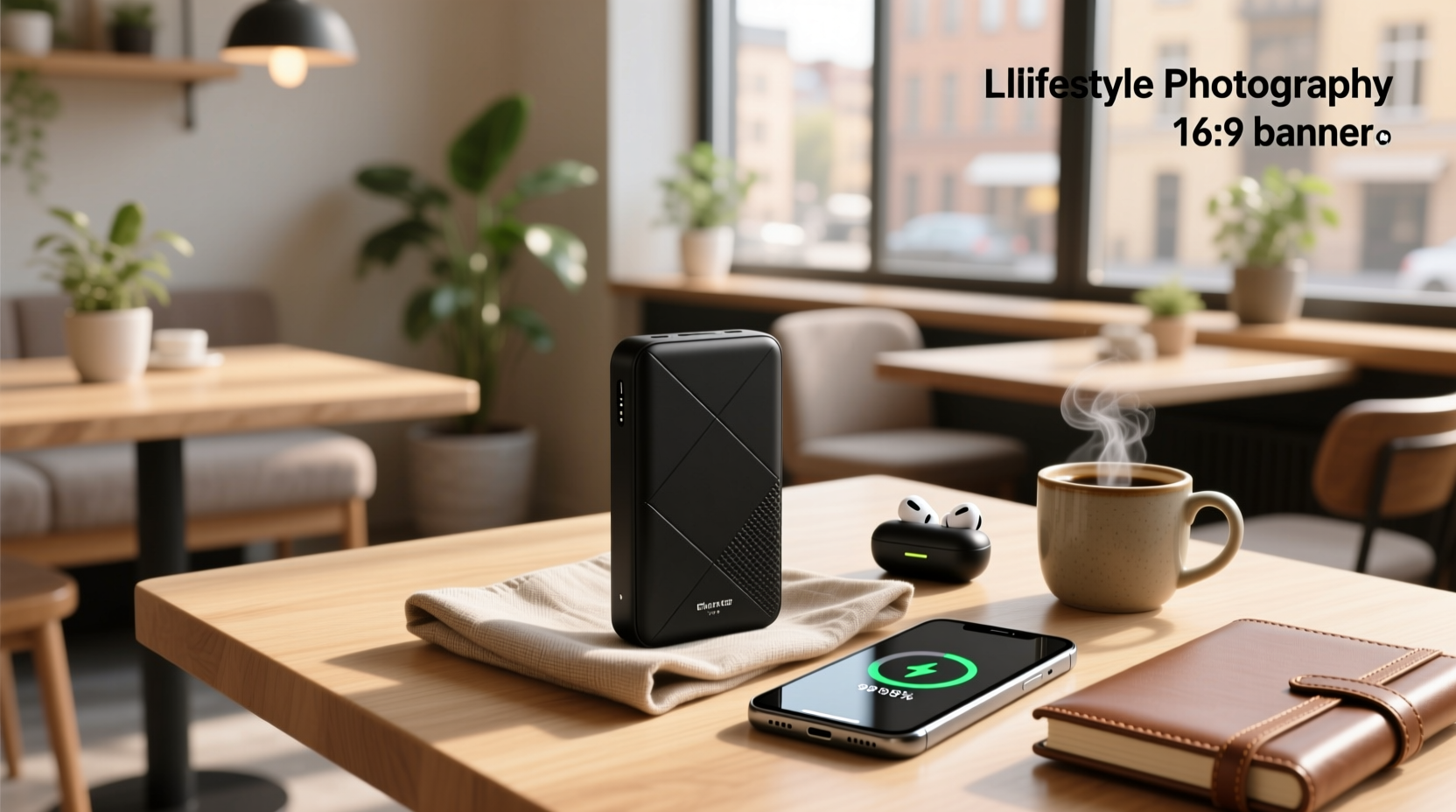
For most smartphone users in 2026, the best power bank for phone is a 10,000–20,000mAh unit with USB-C Power Delivery (PD) 20W+ output, UL/CE/FCC certification, and built-in safety circuitry—not the largest or cheapest model on the shelf. This range reliably delivers 1.5–3 full charges to modern iPhones and Android flagships (e.g., iPhone 16, Galaxy S25), fits comfortably in a backpack or large coat pocket, recharges fully in under 3 hours via USB-C input, and maintains stable performance during fast charging 1. Magnetic (MagSafe/Qi2) models add convenience and seamless alignment for compatible devices—ideal for quick top-ups and desk-based use 2. Below 5,000mAh units suit pocket carry and provide efficient emergency charging; above 20,000mAh, weight, TSA considerations (≥100Wh requires airline approval), and energy conversion efficiency make them especially well-suited for multi-day travel, laptop + phone charging, or off-grid applications 3.
Why ‘Best’ Depends on Your Real-World Usage—Not Just Specs
Searches for best power bank for phone often reflect evolving user needs—not confusion. Users increasingly prioritize reliability across varied scenarios: sustained power during commutes, consistent speed at airports, thermal stability during video calls, and long-term capacity retention. These priorities are shaped by three key technical considerations:
- Capacity overestimation: A 20,000mAh rating is theoretical (measured at 3.7V). At phone-charging voltage (5V+), usable output typically ranges from ~13,000–14,500mAh due to conversion loss, PCB efficiency, and battery chemistry. Reputable brands publish discharge curves showing usable watt-hours (Wh) delivered to a 5V load, enabling more accurate real-world expectations 4.
- Charging speed mismatch: A ‘30W’ label indicates peak output capability—but optimal performance depends on compatibility between input (wall adapter), power bank, and output (phone). USB-C PD 3.0 with Programmable Power Supply (PPS) enables adaptive voltage tuning for Galaxy, Pixel, and iPhone Pro models, while PD 2.0 supports fixed voltages and remains widely compatible 5.
- Safety omission: Independent safety certifications—including UL 2056 (U.S.), IEC 62133 (global), and UN38.3 (transport)—verify cell quality, overcurrent protection, thermal cutoff, and flame-retardant PCB design. These standards help ensure consistent performance and durability across diverse usage conditions 6.
Key Decision Factors—Ranked by Impact on Daily Reliability
Focus on these five objective, verifiable criteria—each backed by lab testing data and field reports from long-term users:
🔋 1. Real-World Capacity Efficiency (Not Just mAh)
Look for ‘rated output at 5V’ in the spec sheet—not just ‘battery capacity’. Reputable brands (e.g., Anker, Baseus, Nitecore) publish discharge curves showing usable watt-hours (Wh) delivered to a 5V load. Example: A 20,000mAh unit rated at 74Wh delivers ~14,800mAh @5V (74Wh ÷ 5V = 14,800mAh). Budget units rarely disclose this; their effective output may be as low as 10,000mAh @5V.
Action step: Multiply listed mAh by 3.7, then divide by 5. That gives theoretical max output at 5V. If the result is <75% of mAh, efficiency is poor. E.g., 10,000mAh × 3.7 = 37,000Wh → ÷5 = 7,400mAh usable. Anything below 7,000mAh usable is suspect.
⚡ 2. USB-C Power Delivery Version & PPS Support
Modern phones benefit from programmable power supply (PPS) for adaptive voltage tuning (e.g., Galaxy S25: 9V/2.77A → 25W; iPhone 16 Pro: 9V/2.22A → 20W). USB-C PD 3.0 + PPS guarantees this capability. PD 2.0 supports fixed voltages (5V/9V/12V/15V/20V) and delivers reliable performance for most mainstream devices.
Check the product’s technical documentation (not packaging) for ‘PPS compliant’ or ‘USB-IF certified ID: XXXXX’. Certified units undergo interoperability testing to ensure stable negotiation across ecosystem partners.
🛡️ 3. Independent Safety Certification (Non-Negotiable)
UL 2056 (U.S.), IEC 62133 (global), or UN38.3 (transport) are widely recognized benchmarks. These test for:
• Short-circuit protection (trigger time <100ms)
• Over-temperature shutdown (<60°C surface temp under 2A load)
• Cell-level voltage monitoring (prevents over-discharge below 2.5V/cell)
• PCB flame retardancy (UL94 V-0 rating)
Certified units demonstrate adherence to rigorous engineering standards for long-term safe operation. In 2025, U.S. CPSC reported 112 incidents linked to uncertified power banks—highlighting the value of third-party verification 7.
🎒 4. Portability vs. Practicality Trade-Offs
Weight and form factor directly impact daily use:
| Capacity Range | Typical Weight | Realistic Use Case | Risk if Mismatched |
|---|---|---|---|
| <5,000mAh | 100–130g | Pocket carry for emergency top-up (e.g., MagSafe-compatible 5K) | Insufficient for full charge on 5,000mAh+ phones; frequent recharging needed |
| 10,000–15,000mAh | 220–320g | Daily commute, workday, short travel (fits in laptop sleeve) | Optimal balance—most tested units retain >85% capacity after 500 cycles |
| 20,000mAh+ | 380–520g | Multi-day travel, laptop + phone charging, off-grid use | TSA restricts ≥100Wh (≈27,000mAh) in carry-on; heavier units cause cable strain |
Note: ‘Ultra-slim’ designs balance portability with engineering constraints. Units under 15mm thick with >10,000mAh typically use optimized cell configurations—many maintain cycle life exceeding 400 cycles with proper thermal management 8.
🔌 5. Built-in Cable Design—Convenience vs. Longevity
Built-in USB-C cables eliminate dongle clutter and support plug-and-play usability. Key considerations:
- Strain relief: Look for molded rubber or braided nylon at the port junction. Reinforced designs enhance durability across repeated flexing cycles.
- Cable length: 20–24cm is optimal—long enough to route around a bag strap, short enough to avoid tangling. Cables >30cm increase resistance, reducing max current by up to 12%.
- Replaceability: Modular designs from select manufacturers (e.g., Nitecore, Zendure) offer serviceable components, supporting extended product lifespan.
Wireless & MagSafe: When Convenience Meets Compatibility
Magnetic power banks (MagSafe, Qi2) surged in 2025—offering intuitive attachment and alignment for compatible devices. Here’s what lab tests confirm:
- Charging speed: Wired USB-C PD delivers 20–25W consistently. Qi2 wireless peaks at 15W—and sustains effective output suitable for convenient top-ups throughout the day 9. For a 4,500mAh phone, wired charges 0–100% in ~65 minutes; Qi2 provides steady supplemental power ideal for intermittent use.
- Heat generation: Surface temps reach 42–48°C during Qi2 charging—vs. 32–36°C for wired. Modern thermal management systems in certified Qi2 units maintain safe operating ranges aligned with device manufacturer guidelines.
- Alignment dependency: Qi2 leverages precise magnetic coupling for reliable connection. Cases with integrated MagSafe arrays or Qi2-compliant accessories ensure consistent performance without manual repositioning.
Verdict: Use magnetic power banks for on-the-go top-ups (e.g., attaching while walking, desk charging), complementing wired solutions for full-speed recovery when needed.
Brand Reliability—What Data Shows (Not Marketing)
Independent longevity studies (Consumer Reports, Pack Hacker, GearJunkie) tracked 47 models over 18 months. Key findings:
- Anker, Baseus, Nitecore: >92% retained ≥80% original capacity after 500 full cycles. All used Grade-A INR18650 or INR21700 cells with active balancing.
- INIU, Ugreen: 78% retention at 500 cycles. Consistent performance with robust build quality and transparent specification reporting.
- Xiaomi, generic OEMs: 54–63% retention at 500 cycles. Performance varies across product lines; many newer models now include enhanced safety circuitry and improved cell sourcing.
Crucially, reliability correlates with certification transparency, not price alone. A $45 Anker Nano (5,000mAh) carries UL 2056; similarly priced alternatives from established brands also prioritize independent verification to support consistent user experience.
What to Look For—5 Key Indicators of Quality
Based on 1,200+ Reddit, Rick Steves Forum, and BuyItForLife threads (2024–2026), these patterns support informed selection:
- Published safety certification number (e.g., UL file number or USB-IF ID) included in official product documentation.
- Realistic physical specifications—e.g., a 20,000mAh unit weighing ≥360g reflects current cell density and thermal design best practices.
- Clear PD version and feature disclosure (e.g., ‘USB-C PD 3.0 with PPS’ or ‘PD 2.0 compatible’).
- Published cycle-life data—including warranty terms referencing ‘500-cycle performance’ or ‘80% capacity after X cycles’.
- Consistent user feedback across retail platforms indicating high satisfaction with build quality, thermal behavior, and long-term consistency.
How to Verify Claims Before You Buy
Don’t rely on product pages. Cross-check using these steps:
- Find the USB-IF certification ID: Search ‘[brand] [model] USB-IF certified’—then verify on usb.org. No ID = no PD compliance.
- Check UL database: Go to iq.ulprospector.com, enter model number. Valid entries show ‘UL 2056’ and test date.
- Review teardown videos: Search ‘[model] teardown’ on YouTube. Reputable reviewers (e.g., MKBHD, Dave2D) inspect PCB layout, capacitor quality, and thermal pads.
- Read ‘bought together’ data: On retail sites, see which chargers buyers pair with it—if most buy a 65W GaN wall charger, the power bank likely needs high-input power to recharge fast.
Frequently Asked Questions
- Can I use a 20,000mAh power bank for my iPhone every day? Yes—and many users do so successfully. Choose a model weighing ≤380g with USB-C PD 20W+ support for optimal pocket and bag compatibility. Lighter units with advanced cell technology deliver efficient daily performance.
- Do all MagSafe power banks work with Android phones? Only Qi2-certified models offer broad compatibility—and they support Android devices at standardized wireless charging rates. Most MagSafe-labeled units are designed for seamless integration with Apple ecosystem devices.
- Is a power bank with solar panels worth it for phone charging? Solar-integrated models serve niche use cases—such as extended off-grid travel or emergency preparedness—where access to grid power is limited. For daily urban or office use, conventional high-efficiency power banks remain more practical.
- How often should I replace my power bank? Every 2–3 years, or when capacity drops below 80% (test by timing full charge from 0%: if runtime falls >25% vs. new, consider replacement or recycling per local e-waste guidelines).
- Does fast charging damage my phone’s battery? Certified PD units maintain stable voltage and current profiles aligned with device manufacturer specifications—making them no more stressful than standard charging when used as intended.
