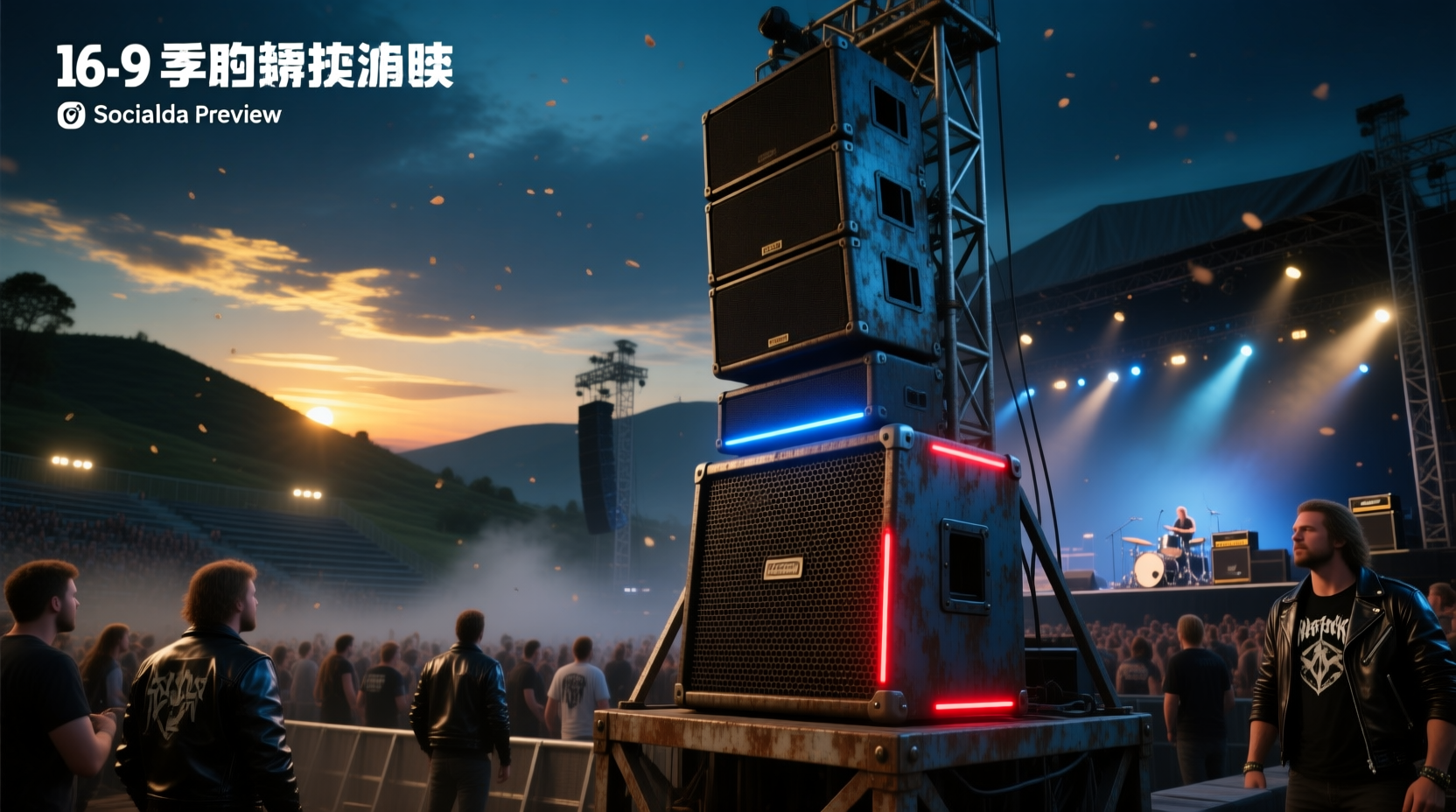
For rock music, the best speakers prioritize three measurable traits: dynamic punch (fast transient response), high-efficiency design (≥90 dB sensitivity), and bass driver scale (10–15" woofers for drum kick and bass guitar authority). Models like the JBL 4312B, Cerwin-Vega XLS-215, Klipsch RP-600M, and ATC SCM 50A consistently meet these criteria across user reports, technical reviews, and live monitoring use cases123. This guide explains why those traits matter—not just which models are named—and how to verify them yourself before buying.
Why Rock Music Is Harder on Speakers Than Most Genres
Rock isn’t just loud—it’s dynamically demanding. A single track can swing from a whispered vocal verse (~60 dB) to a full-band chorus with double-bass drumming and distorted power chords (≥105 dB peak SPL). Unlike jazz or classical, where tonal balance and decay matter most, rock stresses three specific engineering parameters:
- Transient speed: How quickly a speaker starts and stops moving—critical for snare crack, palm-muted guitar, and staccato bass lines. Slow drivers smear rhythm and blur articulation.
- Power handling & efficiency: Rock peaks require headroom. A 90 dB/W/m speaker needs ~4× more amplifier power than a 96 dB/W/m model to reach the same volume without compression or distortion.
- Bass extension under load: Not just “how low it goes,” but whether the woofer maintains control at high excursion. Loose, flabby bass drowns out midrange detail—a common failure point in budget bookshelf models.
These aren’t subjective preferences—they’re measurable behaviors tied directly to driver materials, cabinet rigidity, crossover topology, and magnet structure. Ignoring them leads to fatigue, muddiness, or premature driver failure.
Key Technical Criteria—Not Just Brand Names
When evaluating speakers for rock music, go beyond aesthetics or brand reputation. Focus on these four objective indicators:
🔊 Driver Size & Configuration
Rock benefits from larger low-frequency radiators—but size alone is misleading. A 12" paper-cone woofer in a ported, flex-prone cabinet may distort earlier than a well-braced 8" polypropylene unit with a long-throw motor. What matters is effective piston area + linear excursion capability.
- Floorstanding speakers: Ideal for dedicated listening rooms or home studios. Look for dual 10" or single 12–15" woofers with ≥12 mm peak-to-peak Xmax (measured excursion limit) and rigid cone materials (e.g., aluminum, Kevlar, or treated pulp).
- Bookshelf speakers: Viable only if they include a high-efficiency tweeter (e.g., horn-loaded or titanium dome), ≥6.5" woofer, and ≥90 dB sensitivity. Avoid sealed designs under 6" unless paired with a capable subwoofer—rock’s fundamental bass energy lives between 40–80 Hz.
The Cerwin-Vega XLS-215 uses dual 15" woofers with heavy-duty ferrite magnets and reinforced cones—designed explicitly for high-SPL club reinforcement4. Its 99 dB sensitivity means it reaches concert-level peaks with modest amplification—unlike many high-end bookshelf models rated at 86–88 dB.
⚡ Sensitivity & Impedance Stability
Sensitivity (dB @ 1W/1m) tells you how loudly a speaker plays with 1 watt of input. For rock, aim for ≥90 dB. Below 87 dB, even powerful amps struggle to deliver clean peaks without clipping.
Equally important is impedance curve stability. Many speakers dip to 3–4 ohms at key frequencies (e.g., 80–120 Hz)—causing some solid-state amps to overheat or current-limit. Check published impedance plots (not just “nominal 8 ohms”). The JBL 4312B maintains >6 ohms across its entire operating band—a major reason it remains a studio monitor staple for tracking drums and guitar cabinets3.
⏱️ Transient Response (“Speed”)
“Speed” isn’t marketing jargon—it’s quantifiable via step response, group delay, and impulse measurements. Fast speakers have minimal time-domain smearing: the woofer stops moving within milliseconds after the signal ends.
Three design features improve speed:
- Low moving mass: Lightweight diaphragms (e.g., titanium tweeters, carbon-fiber woofers) accelerate faster.
- Stiff suspension: Reduces overshoot and ringing—critical for tight snare decay.
- Minimal crossover phase shift: First-order crossovers (6 dB/octave) preserve timing better than steep 24 dB/octave filters, though they demand precise driver integration.
The ATC SCM 50A uses a proprietary 75 mm soft-dome midrange and first-order crossover—delivering exceptional midband clarity for vocal texture and guitar harmonics1. It’s why engineers use it for mixing rock vocals: not because it sounds “bright,” but because it reveals timing inaccuracies in the source.
📦 Cabinet Rigidity & Damping
A resonant cabinet adds its own coloration—especially problematic for rock’s dense mixes. Look for:
- MDF thickness ≥18 mm (not particleboard)
- Internal bracing (cross- or H-bracing)
- Non-parallel side walls (reduces standing waves)
- Dense damping material (e.g., constrained-layer composites, not loose fiberglass)
The Bowers & Wilkins 705 Signature uses a decoupled FST™ midrange housing and anti-resonance plug in the bass driver—techniques borrowed from studio monitors to eliminate cabinet-induced artifacts2. In contrast, many budget plastic-ported enclosures exhibit audible “box boom” above 100 Hz when driven hard.
Real-World Speaker Categories—Match to Your Use Case
There is no universal “best speaker for rock.” The right choice depends on room size, amplifier pairing, and primary use case. Below is a functional taxonomy—not a ranking—based on verified performance traits:
🎸 Live Monitoring / High-Volume Home Studio
Requirements: ≥98 dB sensitivity, 15"+ LF drivers, 1000W+ program power handling, wide dispersion.
Cerwin-Vega XLS-215: Dual 15" woofers, 100 dB sensitivity, horn-loaded 3" compression driver. Built for stage-side clarity—not hi-fi refinement. Downsides: large footprint (32" W × 20" D × 55" H), weight (~120 lbs), and limited high-frequency finesse below 2 kHz. Verified by studio engineers using it for guitar cab emulation and drum submix reference4.
🏠 Dedicated Listening Room (15–30 m²)
Requirements: Balanced output from 40 Hz–20 kHz, ≥92 dB sensitivity, controlled dispersion, stable impedance.
JBL 4312B: 12" woofer, 1" titanium dome, 96 dB sensitivity, 8 ohm nominal load. Known for “forward mids” that project vocal presence and guitar grit without harshness. Its sealed mid-bass section eliminates port turbulence—critical for tight kick drum reproduction. Still used in broadcast vans and mastering suites decades after release3.
📚 Small Apartment or Desktop Setup
Requirements: ≥90 dB sensitivity, compact footprint (<20" H), active EQ or DSP support, subwoofer output.
Klipsch R-40PM: Active bookshelf with 6.5" woofer, 93 dB sensitivity, built-in 100W amp, and RCA/optical inputs. Its Tractrix horn tweeter delivers high-frequency energy without listener fatigue—ideal for extended sessions. Limitation: passive bass extension rolls off below 55 Hz; adding a sub (e.g., SVS SB-1000) is recommended for full rock spectrum fidelity3.
🎧 Critical Mixing & Detail-Oriented Listening
Requirements: Flat anechoic response ±2 dB (200 Hz–10 kHz), low distortion (<0.5% THD), neutral tonality.
ATC SCM 50A: Passive 3-way with 12" bass, 3" midrange, and 0.75" soft dome. Uses proprietary dual-suspension midrange for ultra-low coloration. Measures flat to ±1.5 dB from 80 Hz–16 kHz. Used by Abbey Road and Metropolis Studios for rock album finalization1. Trade-off: requires ≥250W per channel and careful room treatment—less forgiving of setup errors than consumer-focused models.
What NOT to Prioritize (Common Misconceptions)
Several widely repeated assumptions about speakers for rock music lack empirical support:
- “More watts = louder rock sound”: Amplifier power only matters relative to speaker sensitivity and room size. A 50W tube amp driving a 98 dB JBL will outperform a 300W Class-D amp into an 86 dB planar magnetic—especially during transients.
- “Biggest bass driver always wins”: A poorly controlled 15" woofer produces one-note boom—not articulate low end. Check published excursion limits (Xmax) and BL product (motor strength × voice coil length).
- “Vintage = better for rock”: Some vintage designs (e.g., Altec Lansing A7) excel at midrange energy but lack modern low-end control and high-frequency extension. Verify measured performance—not just nostalgia.
- “The ‘83% rule’ guarantees safe volume”: This unofficial guideline (limiting volume to 83% of max knob position) has no basis in acoustics or amplifier design. Safe SPL depends on exposure duration, frequency content, and hearing health—not dial position.
How to Test Speakers Yourself—Before You Buy
Spec sheets lie. Real-world behavior doesn’t. Here’s how to validate claims:
- Listen to known rock references: Use tracks with layered production—e.g., Radiohead’s “15 Step” (complex rhythm), Nirvana’s “Smells Like Teen Spirit” (dynamic contrast), or Foo Fighters’ “The Pretender” (dense guitar layering). Note whether kick drum transients blur, bass guitar notes lose definition, or cymbals sizzle unnaturally.
- Check for compression: Play at increasing volumes. Does the sound “shrink” or lose air around instruments? That’s amplifier or driver compression—not room acoustics.
- Verify bass linearity: Use a test tone sweep (30–120 Hz) at moderate level. Does output drop sharply below 50 Hz? Does it boom at 70 Hz? Both indicate tuning or enclosure flaws.
- Read independent measurements: Sites like Audio Science Review publish full-range anechoic data, distortion sweeps, and impedance curves—for models like Klipsch RP-600M and Polk T15. Compare actual sensitivity, not brochure claims.
Budget Options—Where Compromise Is Acceptable
You don’t need $3,000 speakers to enjoy rock. These models deliver core rock traits at entry price points:
- Polk Audio T15: 5.25" woofer, 90 dB sensitivity, rear port. Delivers tight mid-bass and clear highs—ideal for small rooms with modest amplification. Verified by Reddit users for garage-band practice monitoring3.
- Dayton Audio B652-AIR: 6.5" woofer, 89 dB sensitivity, silk dome tweeter. Offers surprising coherence for $100/pair—but requires careful placement away from rear walls due to port location.
Both sacrifice deep bass extension and absolute dynamics—but retain enough speed and efficiency to avoid fatigue during hour-long listens.
Frequently Asked Questions
- What speakers do rock bands use?
Professional touring acts typically use line arrays (e.g., L-Acoustics K2) or high-output wedges (e.g., QSC K12.2) for stage monitoring. In studios, JBL 4312B, Yamaha NS-10, and ATC SCM series remain standards—not for “pleasing sound,” but for revealing mix flaws. - What speaker did Metallica use?
During the *Black Album* sessions, Metallica tracked guitars through Marshall cabinets miked with Shure SM57s—but monitored mixes on Yamaha NS-10s and later ATC SCM20As. Their choice prioritized accuracy over euphony. - What is the best speaker for rock guitar?
No single speaker reproduces guitar cabinets accurately. For direct monitoring, use a reactive load box (e.g., Two Notes Captor) feeding a neutral full-range speaker like the ATC SCM19. For cabinet simulation, rely on IR-based software—not raw speaker specs. - Do I need a subwoofer for rock music?
Yes—if your main speakers roll off below 60 Hz. Rock’s bass guitar fundamentals sit at 41 Hz (E string) and 31 Hz (drop-C). A sealed sub with 20–60 Hz extension (e.g., Rythmik F12) tightens low-end without bloat. - Can bookshelf speakers handle rock at high volume?
Only if they meet three criteria: ≥90 dB sensitivity, ≥6.5" woofer with high Xmax, and robust cabinet construction. Otherwise, distortion and driver damage occur before reaching satisfying loudness.
