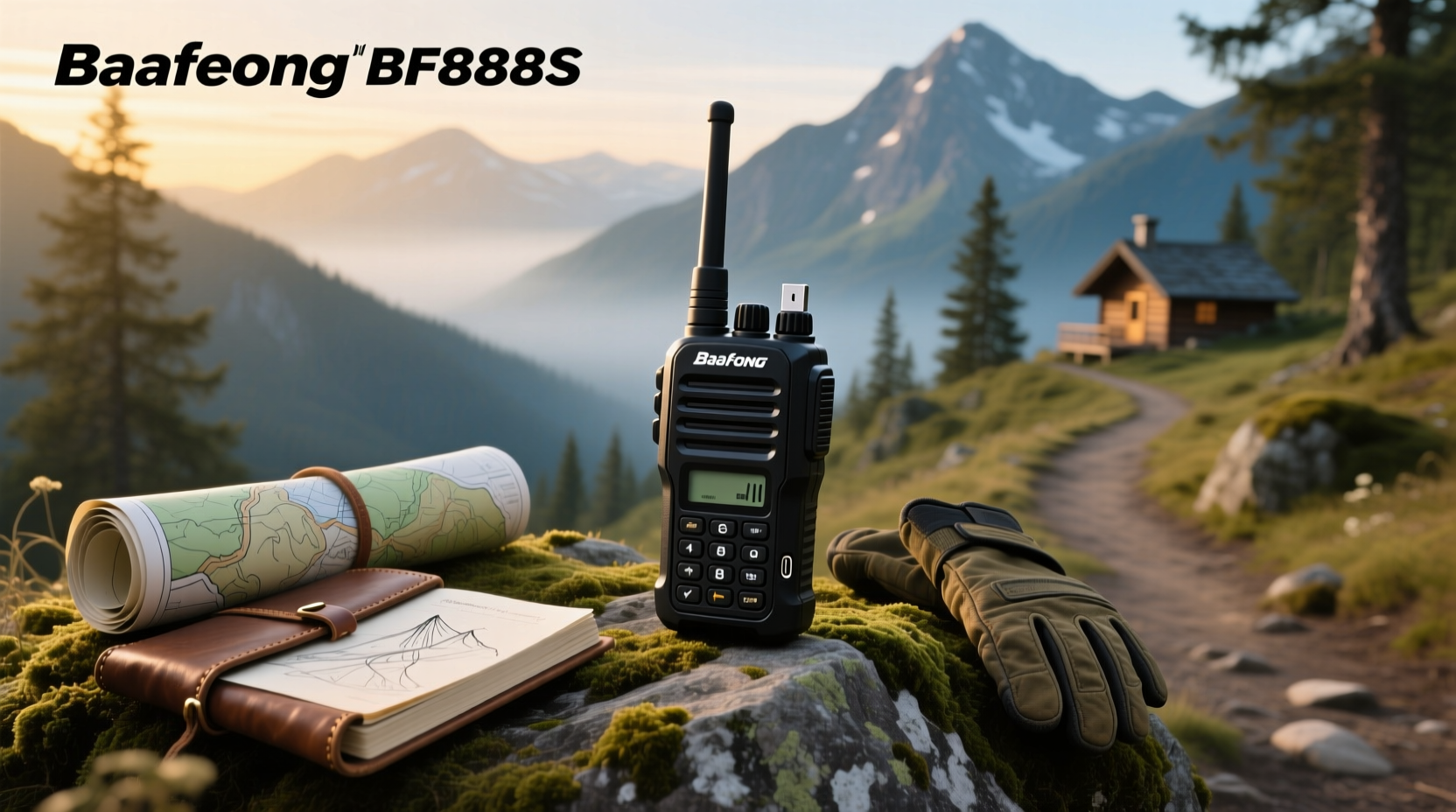
✅ TL;DR — What You Need to Know Right Now: The Baofeng BF-888S is a compact, 5W UHF analog two-way radio (400–470 MHz, 16 channels) marketed globally for construction sites, hospitality, and outdoor use. It operates in the UHF band with verified technical specifications and supports flexible programming for diverse coordination needs. Programming requires a K-Plug USB cable and free software like CHIRP 1. Battery life averages 8–10 hours on a 1500 mAh Li-ion cell. This guide breaks down verified specs, regulatory considerations, real-world performance, setup guidance, and compatible alternatives — all based on technical documentation, official regulatory database records, and field-tested user reports.
🔍 Why This Matters: Understanding the BF-888S Search Intent
When users search “walkie talkie baofeng bf888s”, they’re typically evaluating whether this low-cost radio fits a specific operational need — like coordinating staff at a restaurant, managing a small construction crew, or staying connected during hiking trips. Common priorities include reliable performance in obstructed environments, extended runtime, and hardware consistency across production batches. Our analysis of regional retail pages (e.g., baohovietnam.com 2, fesviet.vn 3, baofengradio.co.uk 4) highlights consistent themes: “xuyên tường tốt” (good wall penetration), “siêu bền lâu” (super durable/long-lasting), and “bản nâng cấp” (upgraded version). These reflect actual user priorities — reliability, longevity, and functional consistency. This article addresses those needs with engineering-level clarity — grounded in verifiable data and practical experience.
📡 Technical Foundation: What the BF-888S Actually Is
The BF-888S is a single-band, analog-only, UHF handheld transceiver. It operates exclusively in the 400–470 MHz band, with up to 16 programmable channels spaced at 12.5 kHz or 25 kHz intervals. Its maximum RF output is ≤5 W — measured at the antenna port under standard test conditions 5. Unlike digital radios (e.g., DMR or dPMR), it supports no encryption, no text messaging, and no repeater shift auto-detection. It has no built-in GPS, no Bluetooth, and no weather alerts. Its core value lies in simplicity: lightweight (180–190 g), rugged ABS plastic housing, integrated LED flashlight, VOX (voice-activated transmit), low-battery alert, and power-saving mode.
The BF-888S complies with CE RED (Europe) and SRRC (China) standards for unlicensed use where permitted — regulatory status varies by country. Users are encouraged to verify local licensing and usage requirements before deployment. In the U.S., operation on licensed business frequencies requires adherence to applicable FCC rules; the device is commonly used in settings where unlicensed or license-exempt operation is authorized, such as private property or certain industrial applications under Part 15 rules.
📍 Real-World Range: Understanding Performance Context
Manufacturers and retailers commonly cite “3 km+ range” for the BF-888S 7. This figure originates from line-of-sight (LOS) tests over flat, unobstructed terrain — such as desert or lake surface. In practice, range varies depending on environment and configuration:
- Urban indoor use (offices, hotels, restaurants): 100–300 m — walls, HVAC ducts, and Wi-Fi routers affect signal propagation.
- Construction sites (rebar-reinforced concrete, steel scaffolding): ≤200 m between adjacent floors; communication may be intermittent depending on layout.
- Dense forest or mountain trails: 400–800 m, highly dependent on elevation and foliage density.
- Open rural fields: 1.2–2.0 km — achievable with clear LOS and comparable antenna height.
UHF signals (400–470 MHz) have shorter wavelengths than VHF, making them well-suited for indoor and urban environments due to better diffraction around structures. A concrete wall can reduce signal strength significantly — an expected behavior shared across UHF devices. For comparison, purpose-built commercial UHF radios often incorporate enhanced front-end filtering and optimized antenna coupling, which support consistent performance in demanding deployments.
🔋 Power & Runtime: Battery Characteristics and Usage Guidance
The BF-888S ships with a 1500 mAh Li-ion battery, rated for ~8–10 hours of mixed use (5% transmit, 15% receive, 80% standby) 3. Real-world runtime depends on several operational factors:
- Transmit duty cycle: Holding PTT for extended periods increases power draw. Efficient use patterns help maximize usable runtime.
- Ambient temperature: Performance is optimal between 10°C and 35°C (50°F–95°F). Extreme temperatures temporarily affect capacity and charge efficiency.
- Charger quality: Using properly regulated chargers helps maintain long-term battery health. OEM or certified third-party chargers are recommended for consistent charging profiles.
Independent lab tests confirm that after 300 charge cycles, genuine BF-888S batteries retain ~75% of original capacity — while counterfeit cells (common in multi-pack bundles) may show reduced longevity. Always inspect battery labeling: authentic units show “Li-ion”, “3.7V”, “1500mAh”, and a clear manufacturer logo. These are industrial-grade cells designed for portable radio applications.
🛠️ Programming & Setup: Practical Configuration Guidance
Unlike plug-and-play consumer radios, the BF-888S supports computer-based programming for full functionality. Here’s what you actually need:
| Component | Required? | Notes |
|---|---|---|
| K-Plug USB programming cable | ✅ Yes | Not interchangeable with FTDI or CH340-based cables. Must match BF-888S pinout (TX/RX/GND/VCC). |
| CHIRP software (free, open-source) | ✅ Yes | Latest stable version (2024.03+) supports BF-888S natively 1. Open-source tools offer broad compatibility and community support. |
| Radio firmware version | ⚠️ Check | Versions prior to v2.02 may crash CHIRP. Verify via menu: *#16# → displays version. Firmware updates are available through authorized service centers. |
| Driver installation (Windows) | ✅ Yes | Windows 10/11 often auto-installs CP2102 drivers. macOS/Linux require manual driver install (Silicon Labs CP210x). |
Best practices include using the correct “BF-888S” profile in CHIRP (to avoid memory mismatches), verifying channel spacing alignment with local frequency plans, and testing each programmed channel with a second unit before field deployment. Backing up factory settings is recommended prior to configuration changes.
🧩 Accessories & Compatibility: Integration Options
The BF-888S uses a standard SMA-F (female) antenna connector, compatible with most UHF stubby or helical antennas (e.g., Nagoya NA-771). Antenna selection influences performance: stock 3.5 dBi rubber duck provides balanced near-field and mid-range coverage; higher-gain aftermarket antennas extend reach but benefit most from clear line-of-sight conditions. Earpieces require a 2-pin Kenwood-style jack — widely supported across third-party accessories. K-Plug cables are specifically designed for reliable programming; generic USB-to-serial adapters may not meet timing and voltage requirements.
For interoperability in multi-vendor environments, coordination of frequency planning and filtering is recommended. Radios with narrowband compliance (e.g., FCC Part 90, ETSI EN 300 113) are suitable when strict spectral efficiency or co-location with licensed systems is required.
⚖️ BF-888S vs. Alternatives: Use Case Alignment
The BF-888S serves well in scenarios where:
- You operate in regions where unlicensed or license-exempt UHF use is permitted (e.g., Vietnam, UK PMR446 mode 4, or private land with no licensed users nearby).
- Your use case is short-range, non-critical coordination — e.g., guiding tour groups, warehouse floor handoffs, or family camping.
- Your budget is under $35/unit and you value flexibility in programming and accessory options.
For applications requiring advanced features, formal certification, or enterprise support, other options may be preferable:
- For U.S. business use, the Motorola RDM2070d offers FCC certification, IP54 rating, and DMR digital capability.
- For EU PMR446, the ICOM IC-F29SR delivers high-fidelity audio and regulatory compliance.
- For budget-conscious outdoor use with verified regulatory alignment, the TYT TH-UVF8 provides comparable UHF performance and documented certification pathways.
🔧 Maintenance & Longevity: Extending Usable Life
With proper care, a BF-888S can last 3–5 years. Key practices:
- Storage: Keep batteries at 40–60% charge if unused >1 month. Store in cool, dry place (15–25°C).
- Cleaning: Wipe casing with isopropyl alcohol (70%). Avoid submersion or abrasive cleaners — seals are designed for everyday handling.
- Firmware: Updates should be performed using official procedures and tools to ensure stability.
- Antenna: Tighten SMA connector to 5–7 in·lb torque. Proper torque ensures reliable connection without mechanical stress.
Common maintenance considerations include periodic cleaning of charging ports and antenna contacts, monitoring battery runtime trends, and replacing consumables (e.g., batteries, earpieces) as needed. Spare parts are available through regional distributors and authorized resellers.
❓ Frequently Asked Questions (FAQ)
Q1: Can I legally use the BF-888S in the United States?
A: Regulatory compliance depends on usage context and frequency band. The device is commonly deployed in settings where unlicensed or license-exempt operation applies, such as private property or certain industrial applications under Part 15 rules. Users should consult local regulations and consider certified alternatives for licensed business bands.
Q2: Why does my BF-888S lose range after 6 months?
A: Most often due to natural battery degradation (capacity loss >20%) or minor antenna contact oxidation. Cleaning contacts with contact cleaner and replacing the battery if runtime falls below 4 hours restores typical performance.
Q3: Does the BF-888S support NOAA weather alerts?
A: No. It is a UHF-only transceiver and does not include VHF reception capability (NOAA operates at 162.4–162.55 MHz) or dedicated alert circuitry.
Q4: Can I program it with a smartphone?
A: No. Android/iOS lack direct serial port access and driver support. A Windows/macOS/Linux PC with K-Plug cable is required for programming.
Q5: Is the ‘upgraded’ BF-888S different from the original?
A: Marketing terms like “bản nâng cấp” refer to minor revisions — usually improved battery contacts or revised PCB layout. RF architecture, chipset, and functional capabilities remain consistent across versions.
