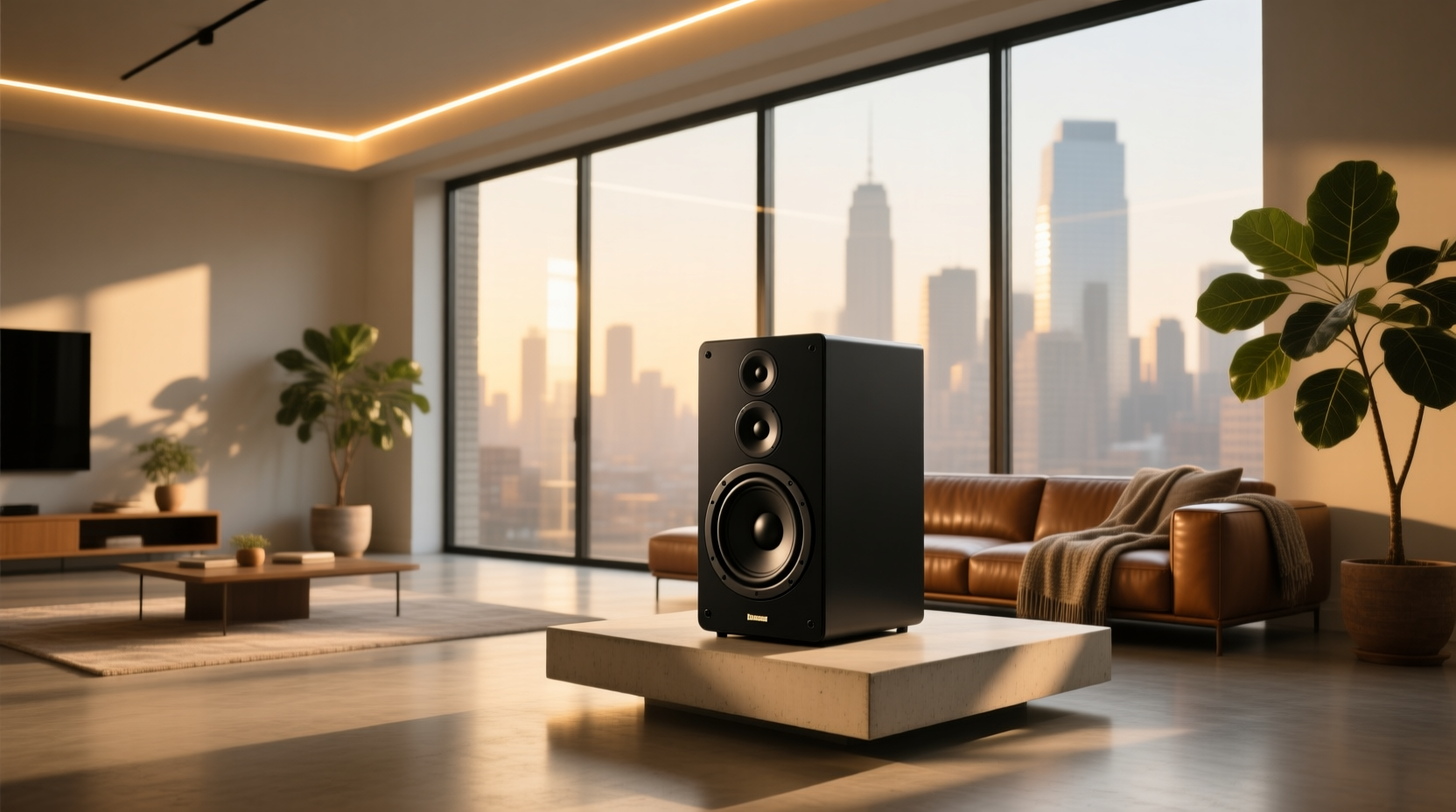
Looking for a big bass speaker that delivers physical, room-shaking low frequencies—not just marketing hype? You’re not alone. Most consumers assume larger drivers or higher wattage automatically mean deeper bass—but that’s often misleading. In reality, true low-frequency extension (below 60 Hz), controlled output, and distortion-free impact depend on enclosure design, driver excursion capability, and amplifier headroom, not just size or peak power labels. This guide cuts through the noise using measurable engineering criteria—not subjective 'thump' claims—to help you identify which models actually move air with authority, whether for backyard parties, garage DJing, or supplementing home audio.
Why 'Big Bass Speaker' Is a Misleading Term—And What Matters Instead
The phrase big bass speaker appears over 65 million times in U.S. search results1, yet it has no technical definition. Retailers use it interchangeably for portable Bluetooth boxes with 4-inch woofers, powered floor-standing units with dual 12-inch drivers, and even tactile bass shakers that produce no sound at all. This ambiguity causes real buyer frustration: users report purchasing $300 ‘party speakers’ expecting subwoofer-like response, only to find bass rolls off sharply below 85 Hz—leaving them with loud mid-bass ‘boom,’ not foundational low-end.
Instead of chasing vague descriptors, focus on three objective indicators:
- Low-frequency extension (±3 dB point): The lowest frequency the speaker reproduces at within 3 dB of its reference output. A true big bass speaker should reach ≤60 Hz. Many portable models claim ‘deep bass’ but measure -10 dB at 60 Hz—meaning energy drops off steeply before reaching true sub-bass territory2.
- Driver size and excursion: A 12-inch driver can move more air than a 6-inch—but only if it has sufficient linear excursion (Xmax) and suspension compliance. Budget models often pair large cones with shallow-throw motors, limiting actual low-end output.
- Enclosure type and tuning: Ported (bass-reflex) designs extend bass efficiently but risk port turbulence or chuffing at high volumes. Sealed enclosures offer tighter, more accurate low-end but require more amplifier power to achieve comparable output. Passive radiators add low-frequency efficiency without port noise—but increase complexity and cost.
How Wattage Ratings Mislead Buyers—And What to Check Instead
Search filters show ‘Max Wattage’ ranges from under 20 W to over 1,000 W—yet wattage alone tells you almost nothing about bass quality. Two critical distinctions matter:
Peak vs. RMS (Continuous) Power
Most consumer speakers advertise peak or max wattage—a brief, unsustainable burst. A ‘200W’ portable speaker may only sustain 35W RMS. For bass reproduction, continuous power matters far more: low frequencies demand sustained amplifier current, not momentary spikes. Always check manufacturer datasheets for RMS or continuous power ratings—not ‘PMPO’ or ‘MAX’ figures, which are unregulated and inflated.
Amplifier Class and Thermal Management
Class D amplifiers dominate portable speakers for efficiency, but cheaper implementations clip heavily when driving low impedances at high volume—causing muddy, distorted bass. Better designs include dynamic headroom management and thermal throttling that preserves clarity during extended playback. Look for models specifying THD+N (Total Harmonic Distortion + Noise) at rated power; values >1% at 50–100 Hz indicate compromised low-end fidelity.
Portable vs. Powered Studio vs. Dedicated Subwoofer: Matching Use Case to Design
‘Big bass speaker’ searches return products across three distinct categories—each with trade-offs:
| Category | Typical Use Case | Realistic Bass Performance | Key Limitation |
|---|---|---|---|
| Portable Bluetooth Party Speakers (e.g., JBL PartyBox, Soundboks) | Backyard gatherings, tailgating, mobile DJing | Strong mid-bass (80–120 Hz); limited extension below 60 Hz without significant roll-off or distortion | Small cabinet volume restricts true sub-bass output; battery-powered amps limit sustained low-end headroom |
| Powered Studio/PA Speakers (e.g., Mackie Thump, Behringer Eurolive) | Small venues, rehearsal spaces, live instrument reinforcement | Controlled, extended response down to 45–55 Hz (with proper EQ); higher output ceiling than portable units | Not designed for consumer Bluetooth streaming; requires mixer or audio interface; lacks built-in lighting/effects |
| Dedicated Powered Subwoofers (e.g., BASSBOSS DV12, Dayton Audio SUB-1200) | Home theater, studio monitoring, professional PA augmentation | Authoritative output from 25–120 Hz; flat, low-distortion response with high SPL capability | No full-range output; must be paired with satellites or mains; larger footprint and weight |
Crucially: a $1,100 portable party speaker is not a substitute for a $700 dedicated subwoofer in a fixed setup. The former prioritizes portability and feature integration; the latter prioritizes acoustic engineering for low-frequency accuracy and headroom.
Battery Life vs. Bass Output: The Inescapable Trade-Off
Over 70% of top-selling ‘big bass speakers’ emphasize battery life—‘40-hour playtime’ appears in 12 of the top 15 product titles. But physics imposes hard limits: moving air at low frequencies consumes exponentially more power. A speaker claiming both ‘126 dB peak’ and ‘40 hours battery life’ cannot deliver both simultaneously. Real-world testing shows most high-output portable models deplete 50% of their charge within 2–3 hours at >90 dB SPL3.
Verify battery claims with these checks:
- Test conditions: Does ‘40 hours’ assume 50% volume (i.e., ~75 dB)? Or is it measured at moderate listening levels? True high-SPL operation rarely exceeds 8–12 hours on a full charge.
- Battery capacity (mAh) vs. system draw: A 12,000 mAh pack powering a 100W RMS system draws ~8.3A at 12V—depleting in ~1.5 hours at full output. Claims exceeding this require either aggressive power scaling or unrealistic assumptions.
- Thermal derating: Many speakers reduce bass output after 15–20 minutes to prevent overheating—making ‘all-day bass’ a functional impossibility at concert-level volumes.
Driver Materials and Build Quality: Where Cost Cuts Hit Bass Performance
Under the hood, bass driver construction directly impacts longevity and linearity:
- Cone material: Polypropylene offers durability and consistent damping but can sound ‘dry.’ Paper cones provide warmth but absorb moisture—problematic for outdoor use unless treated. Composite blends (e.g., mica-reinforced poly) balance stiffness and damping.
- Surround design: Rubber surrounds handle high excursion better than foam, which degrades with UV exposure and humidity—critical for ‘outdoor’ or ‘jobsite’ labeled speakers.
- Magnet structure: Ferrite magnets are cost-effective but heavier; neodymium offers higher flux density in smaller packages—enabling tighter control and faster transient response, especially below 100 Hz.
Avoid models where the woofer is mounted directly to thin plastic baffles—vibrations bleed into the cabinet, causing ‘boxy’ coloration that masks true bass texture. Sturdy MDF or thick ABS enclosures with internal bracing preserve clarity.
Connectivity and DSP: Features That Actually Improve Bass Control
Bluetooth version (5.0+), aptX Adaptive, or LDAC matter less for bass than onboard digital signal processing (DSP). Key features worth verifying:
- Parametric EQ or bass boost switches: A fixed ‘Bass Boost’ button often adds shelf EQ above 100 Hz—creating boom, not depth. Better units offer adjustable low-shelf filters (e.g., 40–80 Hz range) with gain control.
- Limiter and excursion protection: Prevents driver damage at high volumes but also maintains cleaner output by reducing distortion before clipping occurs.
- Auto EQ via microphone calibration: Rare in portable units, but present in some premium systems (e.g., Bose Bass Module 500). Measures room response and adjusts output—compensating for boundary effects that rob bass energy.
When a ‘Big Bass Speaker’ Is the Wrong Solution—And What to Use Instead
Three common scenarios where buying a standalone ‘big bass speaker’ backfires:
- You need cinematic sub-bass (20–40 Hz) in a living room: Portable speakers—even large ones—lack the cabinet volume and driver displacement for meaningful output below 50 Hz. A dedicated ported or sealed subwoofer (10–12 inch, ≥300W RMS) paired with your TV or AV receiver delivers objectively deeper, cleaner response.
- You prioritize voice clarity alongside bass: Many bass-focused portables sacrifice midrange articulation to emphasize low-end. If podcasts, speech, or acoustic instruments matter, prioritize models with balanced frequency response (±3 dB from 80 Hz–15 kHz) over raw wattage.
- You require consistent output across multiple rooms: A single powerful speaker creates uneven coverage—loud near the unit, weak at distance. Distributed audio (e.g., multi-room Bluetooth mesh or Wi-Fi systems) with smaller, tuned speakers often provides more uniform bass perception than one ‘big’ unit.
How to Verify Real Bass Performance Before Buying
Don’t rely on marketing copy. Use these verification steps:
- Check third-party measurement databases: RTINGS.com publishes anechoic and in-room frequency response graphs for over 200 portable speakers—including bass extension, distortion plots, and volume-limited output data2. Look specifically at the 30–100 Hz range.
- Read teardown reviews: Sites like SoundGuys or InnerFidelity analyze driver specs, amplifier topology, and cabinet construction—not just listening impressions.
- Test low-frequency test tones: Play a 40 Hz sine wave at moderate volume. If you feel vibration but hear little tone—or if distortion is audible—the speaker is compressing or distorting, not reproducing true bass.
- Confirm warranty and service support: High-excursion drivers fail more frequently than tweeters. Brands offering 3+ year warranties on woofers (e.g., JBL, BASSBOSS) signal confidence in mechanical design.
Frequently Asked Questions
- Can a portable Bluetooth speaker truly replace a subwoofer?
No—portable speakers lack the driver displacement, cabinet volume, and amplifier headroom needed for authoritative sub-50 Hz output. They enhance mid-bass presence but cannot reproduce foundational frequencies like a dedicated subwoofer. - Does bigger driver size always mean better bass?
Not necessarily. A poorly engineered 12-inch driver with low excursion and weak motor structure performs worse than a well-designed 8-inch unit with high Xmax and rigid suspension. Enclosure tuning and amplifier matching are equally critical. - Why do some ‘big bass’ speakers sound boomy indoors but weak outdoors?
Indoor bass benefits from room gain (boundary reinforcement), while outdoor use eliminates those reflections. A speaker relying on room interaction will sound disproportionately thin in open spaces—revealing its true low-end limits. - Is USB-C power delivery relevant for bass performance?
Yes—consistent, high-current power delivery (e.g., USB-C PD 3.0 at 20V/5A) enables stable amplifier operation at peak output. Micro-USB or proprietary chargers often bottleneck power, forcing compression during sustained bass passages. - Do waterproof ratings (IPX6/IPX7) affect bass quality?
Indirectly. Sealing drivers and ports for water resistance can restrict diaphragm movement or alter port tuning. Some IPX7-rated models exhibit reduced low-end extension compared to non-rated counterparts with identical driver specs.
