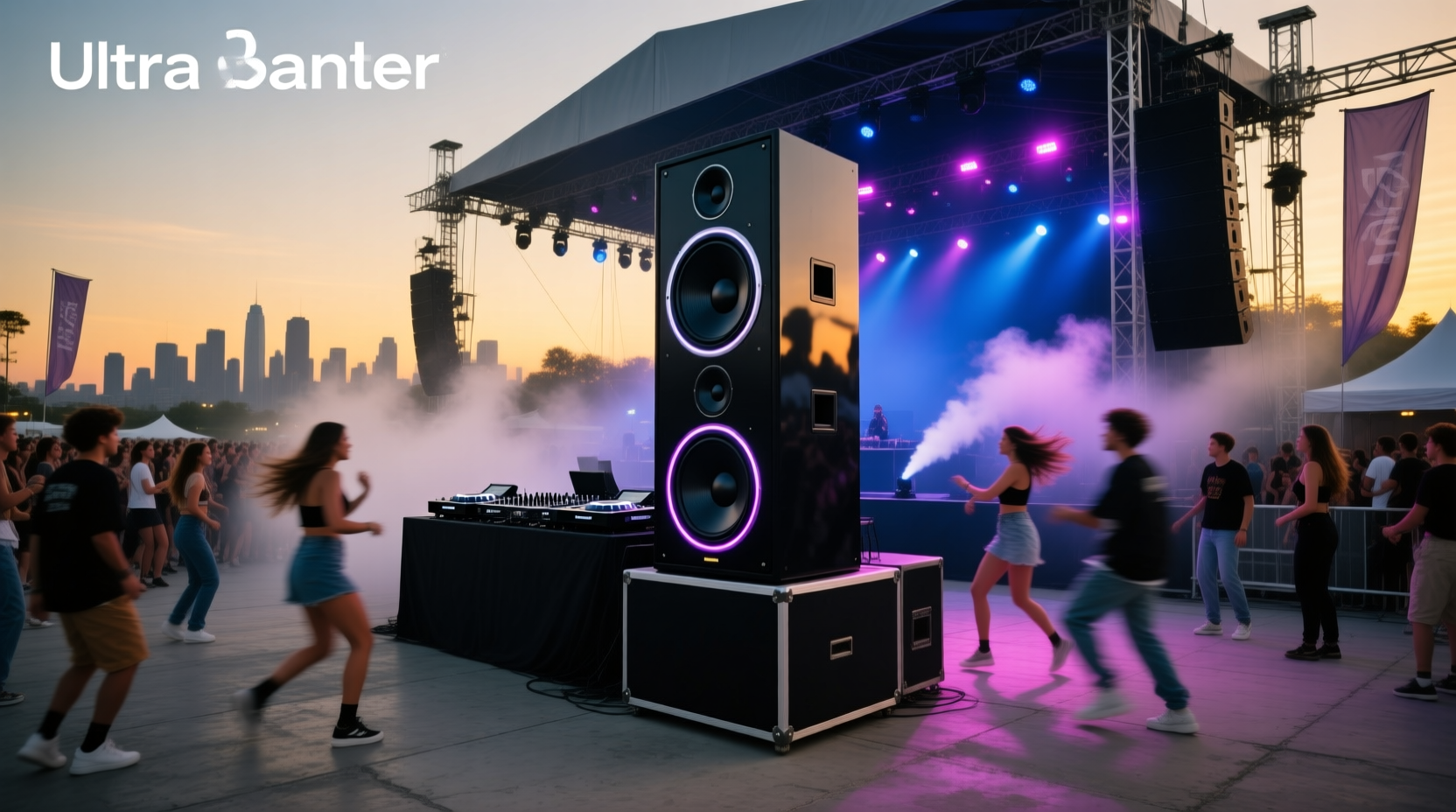
Big DJ speakers aren’t just louder—they’re engineered for acoustic control, coverage consistency, and power handling at scale. If you’re evaluating systems like the PRORECK Club 6000 (dual-15″), JBL JRX225 (2000W passive), or Pioneer XPRS152 (15″ active), focus first on program power, dispersion pattern, and intended venue size—not PMPO ratings or cabinet dimensions alone. Real-world loudness depends on sensitivity (dB @ 1W/1m), not just amplifier output. A well-designed 1200W active speaker with 98 dB sensitivity often outperforms a 4000W unit rated at 92 dB in medium-sized indoor venues 1. This guide breaks down what ‘big’ actually means—and when it’s essential, overkill, or misleading.
Why ‘Big’ Is a Misleading Term—And What It Really Signals
The phrase big DJ speakers triggers assumptions about raw volume or physical size—but neither guarantees suitability. In professional audio, ‘big’ usually refers to form factor optimized for specific acoustic tasks: long-throw projection, wide horizontal coverage, deep sub-bass extension, or high SPL sustainability over extended periods. A 15″ two-way active speaker may be physically larger than a compact column array, yet deliver less even coverage across a 30-meter dance floor 2.
Key indicators that a speaker qualifies as ‘big’ in functional terms:
- Driver complement: Dual 15″ woofers (e.g., MR DJ Pro215s) or single 18″ low-frequency drivers (e.g., PRORECK Club 4000) signal serious LF capability—not just size.
- Continuous power rating: Look for RMS (not PMPO) specs ≥1000W per cabinet. The 8000W PMPO claim on many ‘big party speakers’ is mathematically meaningless and unverifiable in real use 3.
- Cabinet construction: Reinforced plywood (not MDF or plastic), integrated rigging points, and weather-resistant coatings indicate stage-grade durability—not consumer-grade portability.
Three Core Types of Big DJ Speakers—And Where Each Fits
‘Big’ isn’t monolithic. It maps to distinct design philosophies, each solving different problems:
✅ Point-Source Active/Passive Loudspeakers (Most Common)
Examples: Mackie Thump 215 (1400W), JBL JRX225 (2000W passive), RCF HD32 MK4 (1000W+).
Best for: Clubs, mobile DJs, mid-size festivals (up to 500 people), fixed installations needing directional control.
Why they’re ‘big’: High continuous power, large LF drivers (15″–18″), horn-loaded compression drivers for focused high-frequency projection.
Critical trade-offs: Heavy (often 35–55 kg), requires external amplification if passive, limited vertical dispersion without stacking or flying.
✅ Line Array Systems (True Scalable ‘Big’)
Examples: Earthquake Sound DJ Array Gen 2, EXOTON 2000W Column, Pioneer XPRS series configured as arrays.
Best for: Outdoor events, arenas, churches, or any space >800 people where even sound pressure and reduced front-to-back volume drop matter.
Why they’re ‘big’: Acoustic coupling of multiple drivers creates coherent wavefronts; vertical stacking enables precise throw control and reduced sound decay over distance.
Critical trade-offs: Requires array optimization software (e.g., EASE Focus), proper splay angles, and structural rigging. Not plug-and-play—needs trained setup.
✅ All-in-One Powered Tower Speakers (Consumer-Adjacent ‘Big’)
Examples: QFX 8-woofer party speaker, Mr DJ ProBAT118 (4000W battery-powered), Elite Party 65.
Best for: Backyard parties, small bars without dedicated sound tech, temporary setups where portability trumps fidelity.
Why they’re ‘big’: Integrated battery, mixer, Bluetooth, lighting, and massive driver counts—but rarely engineered for flat frequency response or thermal stability.
Critical trade-offs: Distortion rises sharply above 75% volume; bass lacks definition below 50 Hz; battery life drops to <2 hours at full output. Not suitable for professional DJing or critical listening.
How to Evaluate ‘Big’ Claims—5 Metrics That Matter (Not Marketing Fluff)
When comparing big DJ speakers, ignore flashy packaging. Prioritize these measurable, standardized specs:
| Metric | Why It Matters | What to Look For | Red Flag Example |
|---|---|---|---|
| Continuous (RMS) Power | Determines thermal headroom and sustained output without clipping or damage | ≥1000W for main cabinets; ≥1500W for subwoofers | ‘8000W PMPO’ with no RMS value listed |
| Sensitivity (dB @ 1W/1m) | Measures efficiency—higher = louder per watt. Critical for matching amp power | 95–100 dB for mains; 98–102 dB for subs | Unlisted sensitivity or values <90 dB (inefficient, needs huge amps) |
| Frequency Response (±3 dB) | Defines usable low-end extension and high-end clarity—not just ‘20Hz–20kHz’ | Mains: 50–18,000 Hz; Subs: 35–120 Hz | ‘30Hz–20kHz’ with no tolerance band (meaningless without ±dB spec) |
| Dispersion Angle (H × V) | Determines coverage area shape—narrow vertical = less ceiling reflection; wide horizontal = broad audience reach | Mains: 90°×60° typical; Line arrays: 10°×40° vertical control | No dispersion data provided |
| Max SPL (peak, 1m) | Real-world loudness ceiling—correlates with perceived impact and fatigue threshold | Mains: ≥130 dB; Subs: ≥135 dB | ‘Extreme loudness!’ with no SPL figure or measurement method |
When Do You *Actually* Need Big DJ Speakers?
Size follows function—not ego. Here’s how to decide:
✔️ Yes—You Need Big Speakers If:
- You regularly play venues >300 people indoors or >500 outdoors;
- Your current system distorts at 70–80% volume, especially in bass-heavy genres (house, techno, hip-hop);
- You rely on consistent coverage from front row to back wall—no ‘dead zones’ or excessive bass buildup near subs;
- You require >4 hours of continuous operation without thermal shutdown (critical for festivals or weddings).
❌ No—Big Speakers Are Overkill If:
- You DJ primarily in living rooms, small cafes (<100 m²), or bedrooms;
- You prioritize portability over sound quality (e.g., carrying gear solo in a hatchback);
- Your budget is under $1,200 USD for a matched pair—entry-level ‘big’ systems start at ~$1,800 for reliable RMS power and build;
- You lack access to proper speaker stands, rigging hardware, or basic EQ tools (big speakers expose room acoustics and mixing flaws).
Common Misconceptions About Big DJ Speakers
Marketing language fuels persistent myths. Let’s correct them:
❌ ‘More Watts = More Volume’
False. Doubling amplifier power yields only +3 dB SPL increase—barely perceptible. A 2000W speaker with 94 dB sensitivity is quieter than a 1200W unit rated at 99 dB. Sensitivity and cabinet design dominate perceived loudness 4.
❌ ‘Dual 15″ Means Twice the Bass’
Not necessarily. Two 15″ drivers in one cabinet don’t double output unless perfectly time-aligned and loaded in identical enclosures. Poorly designed dual-driver boxes often suffer from phase cancellation below 100 Hz—reducing bass impact, not enhancing it.
❌ ‘Bluetooth Built-In = Professional Ready’
Rarely. Bluetooth 5.0 adds latency (~150–200 ms), compression artifacts, and limited bandwidth—unsuitable for live DJ monitoring or cueing. Pro systems use XLR, TRS, or AES67 digital inputs. Bluetooth should be a convenience feature—not your primary input.
❌ ‘Weatherproof = Outdoor-Ready’
IPX4 (splash resistant) ≠ IP55 (dust + jet water resistant). Most ‘outdoor’ big speakers lack UV-stabilized plastics or condensation drainage—leading to voice coil corrosion after repeated humidity exposure. True outdoor duty requires sealed drivers, conformal-coated PCBs, and gasketed enclosures.
Practical Setup Tips for Big DJ Speakers
Even the best big speakers fail without proper deployment:
- Elevate mains: Place on sturdy 1.2–1.5 m stands to clear audience heads and reduce floor coupling. Never place directly on carpeted floors—bass energy gets absorbed.
- Angle deliberately: Tilt cabinets downward 5–8° so HF energy lands on ears—not ceilings. Use inclinometers or smartphone apps for precision.
- Subwoofer placement matters more than mains: Avoid corners (bass boom) or center-stage (nulls). Try the ‘sub crawl’: place sub where you’ll stand, then measure response at listening position while moving sub location.
- Use high-pass filters: Engage 80–100 Hz HPF on mains when using subs. Prevents low-mid mud and protects drivers from destructive excursion.
- Verify ground continuity: In outdoor or multi-cable setups, improper grounding causes hum or equipment damage. Use a multimeter to confirm <1 Ω resistance between chassis grounds.
Cost vs. Value: What You’re Really Paying For
Price gaps between ‘big’ speakers reflect engineering choices—not just branding:
- $800–$1,500/pair: Entry-tier actives (e.g., Gemini GSP2200). Adequate for small venues but often use lower-grade magnets, thinner voice coils, and basic DSP limiting.
- $1,800–$3,200/pair: Mid-pro grade (e.g., Mackie Thump 215, Pioneer XPRS152). Better thermal management, neodymium drivers, FIR filtering, and consistent dispersion.
- $4,000–$12,000+/pair: Tour-grade (e.g., RCF HD32 MK4, Electro-Voice EKX-15P). Carbon-fiber diaphragms, bi-amped designs, onboard network control (Dante/AES67), and certified rigging points.
Don’t assume higher price = better for your use case. A $10k RCF may be over-engineered—and harder to repair—for a mobile DJ doing 2–3 gigs/week in community centers.
Frequently Asked Questions
- Can I use big DJ speakers for home studio monitoring?
Generally no. Big speakers emphasize SPL and coverage—not flat frequency response or nearfield accuracy. Studio monitors (e.g., KRK Rokit, Yamaha HS) are time-aligned, low-distortion, and designed for critical listening at low volumes. - Do I need a separate subwoofer with big DJ speakers?
Depends on driver size and genre. Dual-15″ or 18″ mains often integrate sufficient LF (down to 45 Hz). But for EDM, drum & bass, or hip-hop, adding a dedicated sub (e.g., 18″ or 21″) extends usable output below 40 Hz and reduces main cabinet strain. - Are passive big DJ speakers obsolete?
No—they offer flexibility, serviceability, and upgrade paths. Passive systems let you swap amps, apply external DSP, or reconfigure for different venues. Active speakers simplify setup but lock you into one vendor’s processing and thermal design. - How long do big DJ speakers last?
With proper ventilation, voltage regulation, and avoiding clipping, expect 8–12 years of regular use. Drivers wear gradually—listen for ‘farting’ at high bass levels or high-frequency harshness, which signal diaphragm fatigue or tweeter damage. - Can I fly (hang) big DJ speakers myself?
Only if certified and equipped. Flying requires load-rated rigging hardware, structural anchor verification, and dynamic load calculations. Unqualified hanging risks catastrophic failure. Use ground stacks or tripod stands unless trained and insured.
