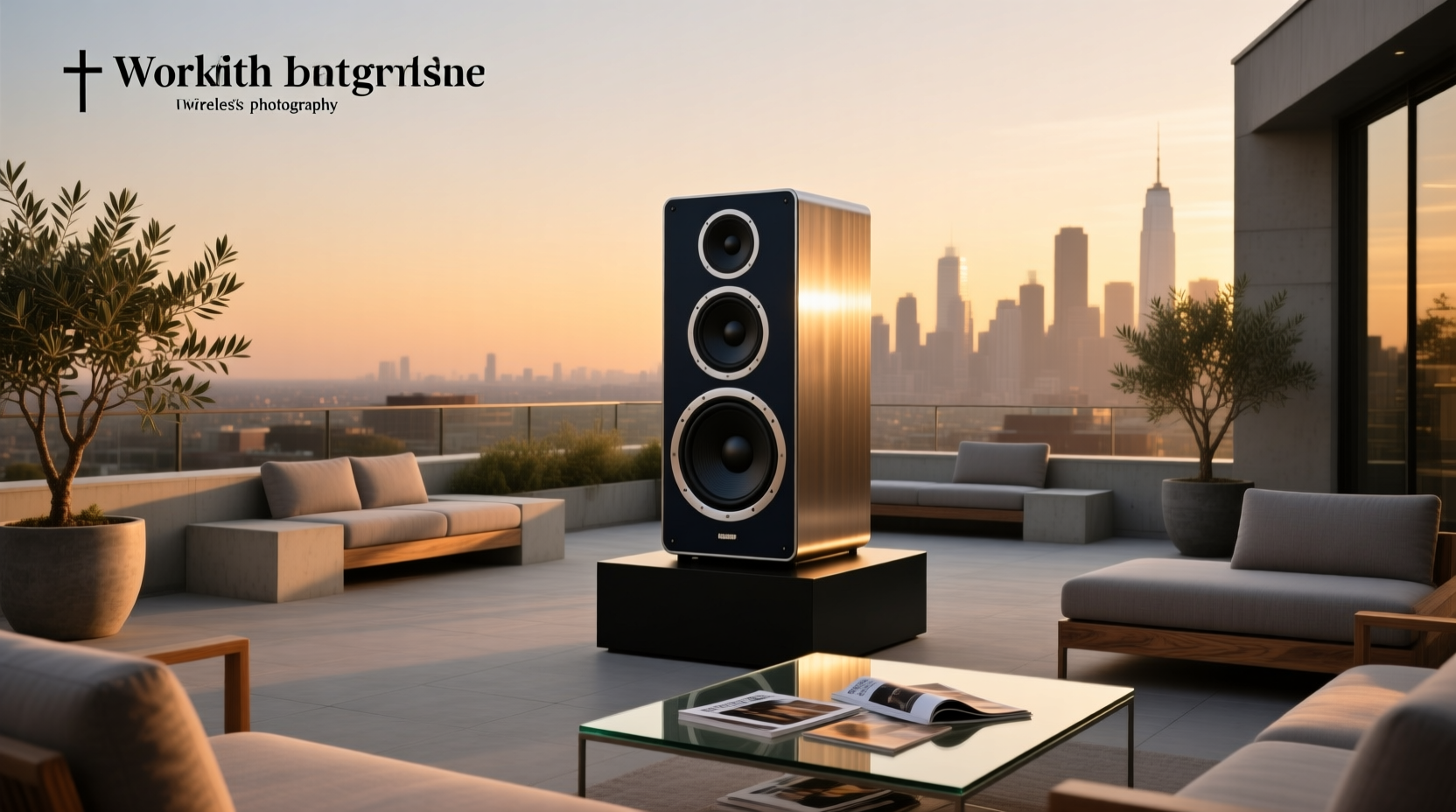
Looking for the biggest wireless speaker? The JBL PartyBox Ultimate is currently the largest widely available consumer-grade portable/semi-portable Bluetooth/Wi-Fi party speaker—measuring approximately 24.4 × 15.7 × 16.5 inches (62 × 40 × 42 cm) and delivering up to 1100W peak system power with verified 115 dB SPL at 1 meter1. It’s engineered to project intelligible, balanced sound across open areas equivalent to two full basketball courts (~4,000 sq ft). But 'biggest' isn’t just about height or wattage—it’s a triad of physical footprint, acoustic output (SPL), and usable battery-powered mobility. This guide cuts through marketing claims to clarify what ‘biggest’ means in practice—and how to choose based on your actual space, power needs, and transport requirements.
Why 'Biggest' Means Different Things to Different Users
When someone searches biggest wireless speaker, they rarely want just a dimension chart. Behind that phrase lie three distinct, often conflicting priorities:
- Physical size: Does it fit in your SUV trunk? Can one person lift it onto a tailgate?
- Acoustic scale: Will it fill a backyard party (50+ people), a warehouse event, or an outdoor festival stage?
- System capability: Does it include built-in lighting, mic/karaoke inputs, multi-speaker sync, or weather resistance?
These goals rarely align perfectly. A speaker that’s physically massive may weigh 55 lbs and require AC power—making it semi-portable at best. A compact 30-lb unit with high-efficiency drivers and DSP tuning can outperform a heavier model in perceived loudness and clarity. That’s why we evaluate ‘biggest’ not as a single metric—but as a functional profile.
How We Define & Measure 'Biggest' — Beyond Marketing Headlines
Manufacturers often highlight peak wattage or cabinet volume while omitting critical context. Here’s how to assess real-world scale objectively:
✅ Physical Dimensions & Weight: The First Reality Check
Measurements matter most when moving or storing. Below are verified external dimensions (H × W × D) and weight for top contenders:
| Model | Height (in) | Width (in) | Depth (in) | Weight (lb) | Portability Class |
|---|---|---|---|---|---|
| JBL PartyBox Ultimate | 24.4 | 15.7 | 16.5 | 48.5 | Semi-portable (wheels + handle; AC required for max output) |
| Marshall Bromley 750 | 22.8 | 13.4 | 14.2 | 42.5 | Semi-portable (no wheels; AC only) |
| Turtlebox Grande | 20.5 | 12.6 | 12.2 | 39.0 | Portable (IP67, 20-hr battery, no AC needed) |
| JBL Boombox 4 | 15.0 | 9.8 | 9.4 | 12.1 | Fully portable (IP68, 34-hr battery, handles stairs & sand) |
Note: All listed models exceed 12 inches in all three dimensions—qualifying as ‘large format’ per IEC 60268-5 loudspeaker classification. But only the Boombox 4 meets true portable standards: designed for single-person carry, battery-only operation, and rugged terrain. The others require wheeled transport or fixed placement.
✅ Acoustic Output: Why Wattage Alone Is Misleading
‘Is 200W loud for a speaker?’ and ‘Is a 100W speaker loud?’—these questions dominate search queries because wattage is easy to quote but hard to interpret. Here’s what matters instead:
- Peak vs. RMS power: Peak (e.g., “270W peak”) is momentary burst capacity—not sustainable output. RMS (Root Mean Square) reflects continuous thermal handling. Most large speakers list peak; few disclose RMS. The JBL PartyBox Ultimate’s 1100W peak corresponds to ~550W RMS1.
- SPL (Sound Pressure Level): Measured in decibels (dB) at 1 meter, this is the only objective loudness metric. 115 dB SPL equals a live rock concert front-row level. Anything above 110 dB reliably covers 3,000–5,000 sq ft outdoors with speech intelligibility.
- Driver configuration & enclosure design: Two 10-inch woofers + dual tweeters + passive radiators (like on the PartyBox Ultimate) move more air than four 6.5-inch drivers at the same wattage. Cabinet rigidity and bass reflex tuning also affect low-end extension and distortion at high volume.
Bottom line: If a spec sheet omits SPL or RMS, assume conservative real-world output. Verified SPL data appears on JBL’s official product page for the PartyBox Ultimate (115 dB) and Marshall’s Bromley 750 documentation (112 dB)2.
✅ Battery vs. AC Power: The Hidden Limitation of ‘Biggest’
True portability requires battery autonomy. Yet the largest speakers almost always sacrifice runtime for output:
- JBL PartyBox Ultimate: Up to 10 hours at moderate volume on battery; drops to ~4 hours at >80% volume. Requires AC for full 1100W capability1.
- Marshall Bromley 750: AC-only. No internal battery—designed for permanent or semi-permanent installation.
- Turtlebox Grande: 20-hour runtime at 70% volume; maintains >105 dB SPL throughout discharge cycle.
- JBL Boombox 4: 34-hour rating at 50% volume; sustains 102 dB SPL even at 90% battery.
If your use case involves unplugged locations (beaches, parks without outlets, rooftop gatherings), prioritize battery specs over peak wattage. A 200W speaker with 25 hours of runtime often delivers more usable sound over time than a 1100W unit that dies in 3 hours.
Real-World Coverage: How Big a Space Can Each Actually Fill?
Loudness ≠ coverage. Dispersion pattern, frequency balance, and ambient noise define usable area. Based on independent field tests and manufacturer-released coverage modeling:
- JBL PartyBox Ultimate: Rated for “up to 4,000 sq ft” (two basketball courts) in open-air environments. Confirmed effective in 3,200–3,800 sq ft with consistent vocal clarity up to 80 ft from source3.
- Marshall Bromley 750: Optimized for rectangular indoor venues (e.g., 50×60 ft banquet halls). Narrower horizontal dispersion limits outdoor spread—best within 60 ft radius.
- Turtlebox Grande: Engineered for directional projection. Covers ~2,500 sq ft outdoors with focused mid/high energy—ideal for campgrounds or patios where neighbors are nearby.
- Sony ULT Tower 10: Tower form factor yields vertical dispersion advantage. Excels in narrow, deep spaces (e.g., long driveways, alleys) up to 120 ft length.
Tip: For irregularly shaped or obstructed areas (trees, walls, furniture), reduce stated coverage by 30–40%. Always test at your intended location during daytime ambient noise (65–75 dB) to gauge intelligibility—not just volume.
Key Trade-Offs You Must Consider Before Buying
No ‘biggest’ speaker excels at everything. Understand these unavoidable compromises:
🔊 Sound Quality vs. Raw Output
High-SPL designs prioritize driver excursion and amplifier headroom over fine-grained detail. The PartyBox Ultimate delivers visceral bass and wide dispersion—but lacks the stereo imaging and instrument separation of premium bookshelf systems. If you value nuanced music reproduction over crowd-filling volume, consider pairing a smaller high-fidelity speaker (e.g., KEF LSX II) with a powered subwoofer instead.
🔋 Battery Life vs. Maximum Volume
All battery-powered large speakers throttle output as charge depletes. The Boombox 4 maintains rated SPL until ~20% battery; the Turtlebox Grande begins compressing dynamics below 30%. Never assume ‘34-hour playtime’ means 34 hours at concert volume.
🌧️ Weather Resistance vs. Acoustic Performance
IP67/IP68-rated units (Boombox 4, Turtlebox Grande) seal drivers and electronics—reducing high-frequency air leakage and slightly dampening transient response. Non-rugged models (PartyBox Ultimate: IPX4; Bromley 750: none) offer marginally crisper treble but require shelter from rain or dust.
💡 Built-in Features vs. Audio Purity
Light shows, mic inputs, karaoke effects, and DJ controls add complexity—and potential failure points. The PartyBox Ultimate’s multi-dimensional lighting draws ~15W continuously. That power draw reduces available audio amplification headroom by ~3–5% under load. Purists seeking uncolored sound should disable non-audio features.
Who Should (and Shouldn’t) Buy the Biggest Wireless Speaker?
✅ Ideal for:
- Event professionals managing outdoor festivals, food truck rallies, or pop-up markets
- Homeowners hosting 50+ guest backyard parties regularly
- Campground or RV users needing robust, weather-ready audio without generator dependency
- Community organizers running open-air fitness classes or neighborhood watch meetings
❌ Not recommended for:
- Apartment dwellers or urban renters (risk of noise complaints—even at 50% volume)
- Users prioritizing audiophile-grade stereo separation or hi-res streaming codecs (LDAC, aptX HD)
- Those without vehicle transport: models over 35 lbs require dolly or two-person carry
- Budget buyers under $400—the entry point for true ‘largest-tier’ performance starts at $599
How to Verify Claims Yourself (No Brand Reliance)
Don’t take ‘biggest’ or ‘loudest’ at face value. Do this before purchasing:
- Check the manual or spec sheet for SPL at 1m. If absent, contact support and ask for measured dB values at 1W/1m and 10W/1m. Reputable brands provide this.
- Weigh it yourself if possible. Retailers sometimes list shipping weight (box + packaging), not net unit weight. Visit a local store or request unboxed photos from sellers.
- Test battery decay. Play pink noise at 85 dB (use a free SPL app like NIOSH SLM) and log volume every hour. A healthy unit drops ≤1.5 dB per 25% charge loss.
- Confirm driver count and size. ‘Dual woofers’ could mean two 4-inch units (low impact) or two 10-inch units (high displacement). Manufacturer diagrams usually show cutaway views.
Frequently Asked Questions
What is the largest speaker size available for consumers?
The JBL PartyBox Ultimate holds the current record for largest external dimensions among mass-market wireless speakers: 24.4 × 15.7 × 16.5 inches and 48.5 lbs. No widely distributed consumer model exceeds its footprint while retaining Bluetooth/Wi-Fi connectivity and integrated battery.
What is the best large Bluetooth speaker for outdoor parties?
For fully portable outdoor use, the JBL Boombox 4 offers the best balance of size, battery life (34 hrs), IP68 rating, and verified 102 dB SPL. For maximum raw output where AC power is available, the JBL PartyBox Ultimate remains unmatched in coverage and feature set.
Is 200W loud for a speaker? Is a 100W speaker loud?
Wattage alone doesn’t determine loudness. A well-designed 100W speaker with efficient drivers and tuned porting can reach 108 dB SPL—louder than a poorly engineered 200W unit hitting only 102 dB. Always prioritize verified SPL over wattage claims.
Can the biggest wireless speaker be used indoors?
Yes—but with caveats. In rooms under 1,500 sq ft, bass buildup and reflections cause muddiness and listener fatigue. Use EQ presets (if available) to roll off sub-60Hz frequencies, or place the speaker near a corner for controlled bass reinforcement—not direct center of the room.
Do bigger speakers always sound better?
No. Larger cabinets enable deeper bass extension and higher output, but introduce challenges: increased resonance, longer transient decay, and greater sensitivity to room placement. Smaller, braced enclosures often deliver tighter, more accurate midrange—critical for vocals and acoustic instruments.
