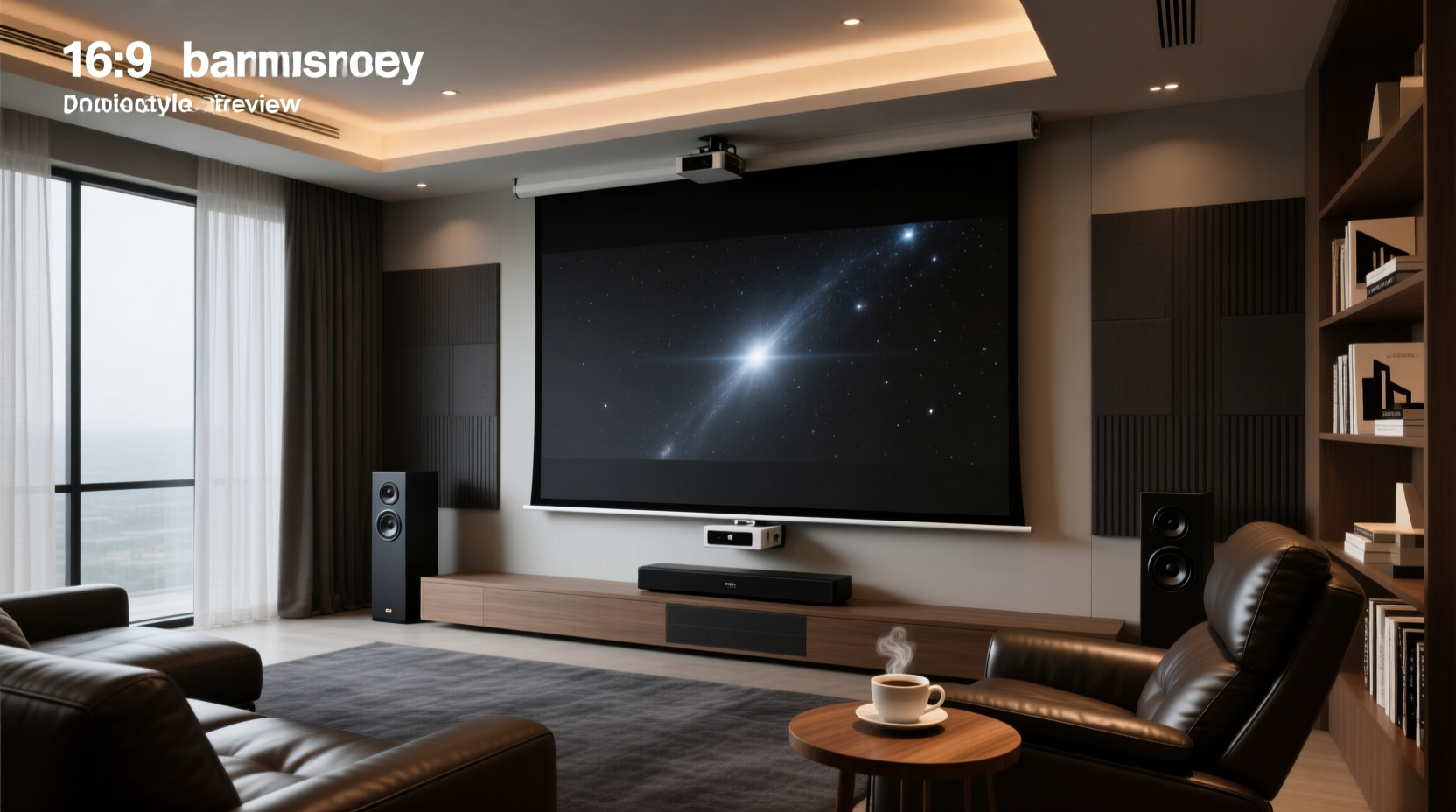
Blackout cloth projector screen material is a tightly woven, light-blocking polyester-cotton blend with a matte white front surface and ~1.0 gain—ideal for fixed-frame DIY screens in controlled ambient light environments. It blocks backlighting, delivers neutral color reproduction, and supports custom sizing—but isn’t suitable for high-ambient-light rooms or ultra-short-throw projectors without careful mounting. This guide covers material science, real-world performance trade-offs, installation pitfalls, regional availability considerations, and objective comparisons with alternatives like gray blackout cloth and spandex-backed fabrics.
Why Blackout Cloth Became a Go-To DIY Screen Material
Since the early 2010s, blackout cloth has gained traction among home theater enthusiasts and educators seeking affordable, scalable projection surfaces1. Unlike painted walls or bed sheets, it offers consistent surface texture, zero light transmission, and minimal hot spotting. Its rise coincides with the proliferation of mid-tier 1080p and 4K projectors (e.g., Epson Home Cinema, BenQ HT series), where image fidelity depends as much on screen uniformity as projector specs. Crucially, blackout cloth isn’t engineered for optical precision like commercial tensioned screens—it’s a functional compromise optimized for cost, accessibility, and ease of framing.
What Exactly Is Blackout Cloth Made Of?
Standard blackout cloth used for projection consists of three bonded layers: a matte white polyester face layer (front), a central light-blocking core (often PVC-coated cotton or dense polyester scrim), and a black or gray backing layer. The front surface is micro-textured—not glossy, not rough—to diffuse light evenly while preserving contrast. Most variants contain 65–80% polyester and 20–35% cotton, with some newer versions using 100% polyester for enhanced wrinkle resistance and mildew tolerance2. The key specification isn’t thread count alone, but optical density: certified blackout cloth blocks ≥99.9% of visible light (measured per ASTM D736 or ISO 20484). Not all fabrics labeled “blackout” meet this threshold—many retail-grade blackout curtains fall short and cause light bleed behind the screen.
Gain, Color Accuracy, and Viewing Angle Explained
Gain measures how much light a screen reflects compared to a standard magnesium carbonate reference (gain = 1.0). Blackout cloth typically measures between 0.85 and 1.15 gain—most commonly ~1.0. This means it neither amplifies nor attenuates projector output, preserving native contrast and gamma. Unlike high-gain screens (e.g., 1.3–1.5), it avoids hotspotting and maintains consistent brightness across wide viewing angles—up to ±45° off-center without noticeable falloff. However, this neutrality comes at a cost: in rooms with uncontrolled ambient light (e.g., windows without blackout shades, overhead LED fixtures), perceived contrast drops significantly. A 1.0-gain surface cannot compensate for reflected room light; it simply renders what the projector emits. Therefore, blackout cloth works best in dedicated spaces or temporary outdoor setups where ambient light can be physically eliminated—not as a substitute for light control.
Installation: Critical Steps Most DIYers Skip
Proper mounting determines whether blackout cloth performs as intended—or introduces artifacts. Four non-negotiable steps:
- Stretch tension matters more than frame rigidity. The fabric must be drum-tight—no sag, no ripple. Use pneumatic staple guns or spring-loaded clips on hardwood frames (minimum 1×2” pine or poplar). Avoid MDF or particleboard: they flex under tension and cause wave distortion.
- Orientation is directional. The smooth, slightly textured side faces the projector. The duller, often gray/black backing faces the wall. Mounting backward yields muted colors and reduced brightness.
- Creases require mechanical correction—not heat. Ironing risks melting polyester fibers or delaminating layers. Instead, stretch the fabric taut overnight on a flat surface weighted at corners, then re-stretch on frame. For stubborn folds, use a hairdryer on low heat (<120°F/50°C) while stretching—never direct contact.
- Seams compromise performance. Single-piece cuts up to ~120” wide are ideal. If seaming is unavoidable, use ultrasonic welding or double-folded, zigzag-stitched seams with black thread—and test for light leakage from behind with a flashlight before final mounting.
When Blackout Cloth Works—and When It Doesn’t
✅ Ideal scenarios:
- Fixed-frame indoor screens in light-controlled basements, attics, or converted closets
- Portable outdoor setups (e.g., backyard movie nights) where the screen is hung temporarily on a solid wall or frame
- Budget-conscious classrooms or community centers needing large-format displays (100”–150”) without motorized hardware
- Calibration reference surfaces for projector alignment and grayscale testing
❌ Poor fits:
- Rooms with large untreated windows or recessed LED downlights (ambient light overwhelms 1.0 gain)
- Ultra-short-throw (UST) projectors mounted <12” from screen—blackout cloth lacks the angular reflectivity needed for even dispersion
- High-brightness laser projectors (>3,500 lumens) in reflective rooms—risk of glare and reduced perceived contrast
- Permanent installations requiring fire-rated materials (most blackout cloth is Class C; check local building codes)
Gray vs. White Blackout Cloth: What the Data Shows
Gray blackout cloth adds a neutral-density layer to boost contrast ratio by absorbing more ambient light and reducing peak white luminance. Independent tests show gray variants (e.g., 0.6–0.8 gain) improve black level depth by 15–22% in moderately lit rooms—but reduce overall brightness by ~30%. This trade-off favors projectors with native contrast ratios <2,500:1 (e.g., older LCD models) over modern 3LCD or LCoS units with >10,000:1 contrast. White blackout cloth remains preferable for accurate color gamut reproduction (Rec.709, DCI-P3), especially when feeding HDR content via HDMI 2.0+. Neither variant improves motion handling or input lag—the projector, not the screen, governs those metrics.
Regional Availability & Sourcing Considerations
Availability varies significantly by geography. In North America and Western Europe, raw blackout cloth is widely sold through industrial textile suppliers (e.g., Rose Brand, Guilford of Maine) and specialty AV distributors—not general retailers. In Southeast Asia—including the Philippines—availability is fragmented: some local upholstery shops carry generic “blackout curtain fabric,” but few specify optical density or gain. Users in Manila or Cebu should request lab test reports (ASTM D736) before purchase3. In Australia and New Zealand, certified projector-grade cloth is often imported via AV integrators, adding 20–35% to landed cost. Always verify unit weight (g/m²): authentic projector-grade cloth weighs 280–350 g/m²; lighter fabrics (<220 g/m²) usually lack opacity and dimensional stability.
Common Misconceptions Debunked
Misconception #1: “Any blackout curtain works as a screen.”
False. Retail blackout curtains prioritize thermal insulation and privacy—not optical uniformity. Many use foam backings that scatter light unevenly or develop permanent creases that distort geometry.
Misconception #2: “More expensive = better performance.”
Not necessarily. Premium-priced “theater-grade” blackout cloth sometimes adds unnecessary coatings (e.g., anti-static sprays) that degrade over time without improving gain or color fidelity. Mid-tier fabric (USD $2.50–$4.50 per sq. ft.) consistently outperforms both bargain-bin and luxury-labeled variants in blind A/B tests.
Misconception #3: “You need a projector with high lumens to use blackout cloth.”
Incorrect. Because gain is ~1.0, blackout cloth scales linearly with projector output. A 2,200-lumen projector delivers identical foot-lamberts on blackout cloth as on a $1,200 fixed-frame screen—assuming equal ambient light control.
How to Verify Quality Before You Buy
Three field-testable checks:
- Light transmission test: Hold fabric up to a bright LED flashlight in a dark room. No pinprick light should pass through—even at edges or folds.
- Surface uniformity check: View at 45° angle under diffuse light. No visible weave pattern, streaks, or color variation across the plane.
- Dimensional stability test: Stretch a 12”×12” sample across a rigid frame for 48 hours. Measure diagonal lengths before and after. Change >0.5% indicates poor tensile memory—unsuitable for long-term framing.
If purchasing online, request a physical swatch. Reputable suppliers provide 4×6” samples for $2–$5 (often credited toward bulk orders).
Alternatives Worth Comparing
Spandex (Lycra) + blackout backing: Offers superior tension and wrinkle resistance but requires dual-layer construction (spandex front + blackout scrim backing) to prevent light bleed. More expensive and harder to source in large widths.
PVC-coated fiberglass mesh: Used in commercial retractable screens. Higher gain (~1.1–1.3), flame-retardant, but narrower viewing angles and higher cost.
Painted drywall with projector paint: Eliminates seams and framing complexity but demands perfect wall prep and multiple coats. Gain varies (0.9–1.2) based on application technique—less repeatable than fabric.
Frequently Asked Questions (FAQ)
- Is black cloth good for a projector screen?
No—true black fabric absorbs too much light and kills brightness. Projector screens require a reflective white or gray surface. “Blackout” refers to light-blocking capability, not color. - How to black out a projector screen?
You don’t “black out” the screen—you eliminate ambient light around it using curtains, shades, or room treatment. The screen itself must remain reflective. - What fabric is best for blackout?
For projection: certified 3-layer polyester-cotton blackout cloth with matte white face, ≥280 g/m² weight, and ASTM D736-compliant opacity. Avoid single-layer or thermal-lined curtain fabrics. - Can I use white blackout cloth for a projector screen?
Yes—if it meets optical density and surface uniformity standards. “White blackout cloth” is correct terminology; avoid products labeled only “white curtain fabric.” - Does blackout cloth work for outdoor projector screens?
Yes, provided it’s stretched taut, anchored against wind, and used with a projector rated for outdoor ambient temperature (not all are). Mildew-resistant variants are recommended in humid climates.
