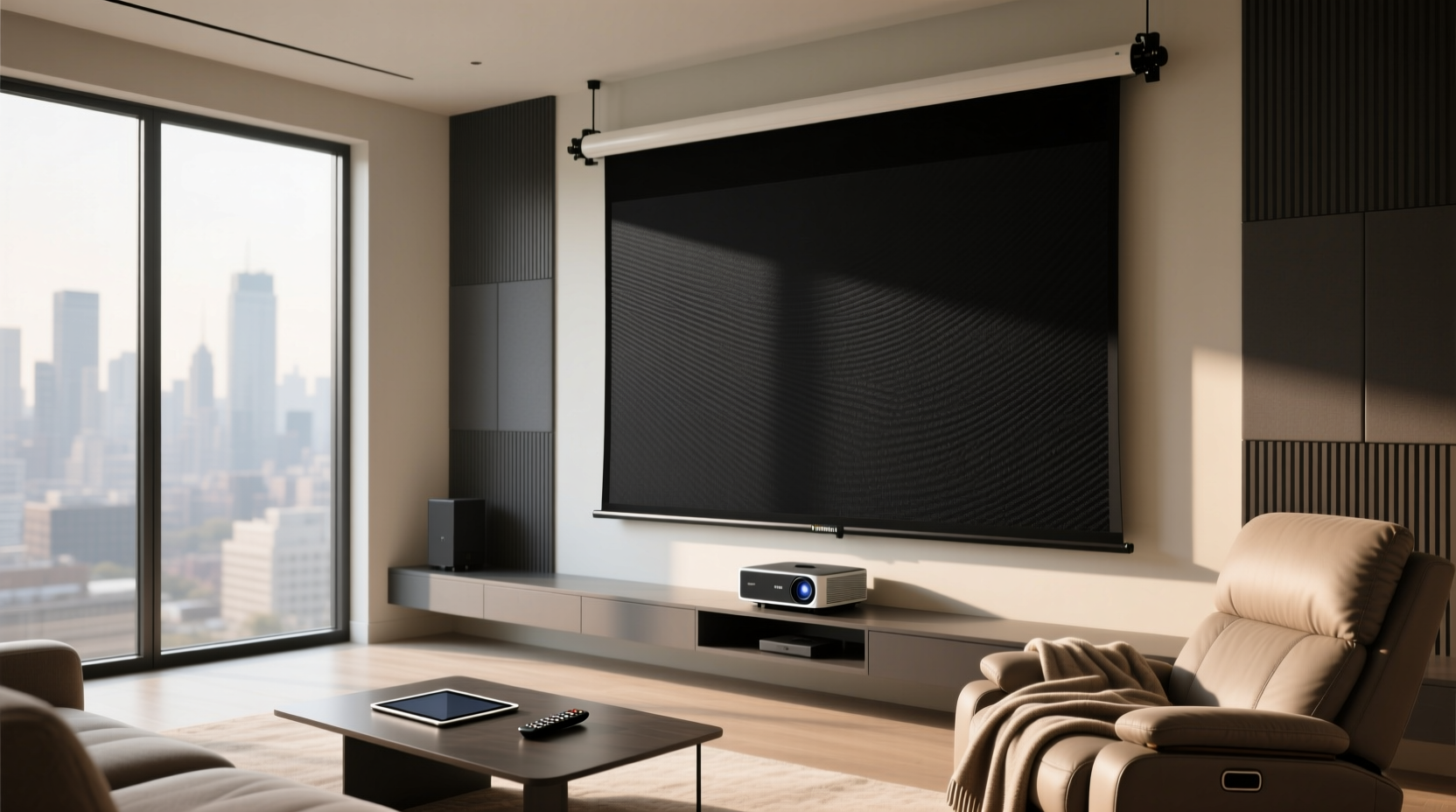
✅ The best blackout material for projector screen is matte white, tightly woven polyester-cotton blend blackout cloth—not black fabric. It delivers ~1.0–1.1 gain, excellent light rejection from ambient sources, minimal hot-spotting, and smooth texture when stretched taut. Unlike black fabric (which absorbs light and yields no visible image), white blackout cloth reflects projected light while blocking rear/ambient spill—making it ideal for budget home theaters, garage setups, and temporary installations 1. This guide explains exactly how to select, test, and install it—without marketing hype or brand bias.
Why White—Not Black—Blackout Cloth Is Used for Projector Screens
A common misconception—reflected in search queries like "will a black sheet work for a projector?" or "how to make a projector screen black?"—is that "blackout" implies the fabric itself should be black. In reality, "blackout" refers to light-blocking capability—not color. Projection requires reflection, not absorption. A true black fabric (e.g., velvet, felt, or black vinyl) absorbs >95% of incident light, rendering the projected image invisible or severely dimmed 2. What users actually need is light-blocking substrate behind or around the reflective surface—not the surface itself.
White blackout cloth solves this dual requirement: its front face is matte white (high diffuse reflectivity), while its backing contains a dense, opaque layer (often acrylic or rubberized coating) that prevents light transmission. This structure enables two critical functions:
- Ambient light rejection: Blocks stray room light from washing out blacks;
- Backlight isolation: Prevents light bleed-through in rear-projection or wall-mounted setups where the projector sits behind drywall or a false wall.
How Blackout Cloth Differs From Standard Projection Screen Materials
Not all white fabrics labeled "blackout" perform equally as projection surfaces. Below is a technical comparison of key attributes:
| Property | White Blackout Cloth (DIY Grade) | Commercial Matte White PVC (e.g., Da-Lite Da-Tex) | Grey Screen Material (e.g., Stewart Firehawk) | Spandex (Stretch Fabric) |
|---|---|---|---|---|
| Gain | 0.9–1.1 | 1.0–1.3 | 0.8–1.0 (low-gain variants) | 0.8–1.0 (varies with tension) |
| Viewing Angle | ~160° (wide, uniform) | ~150°–160° | ~140°–150° (narrower due to light absorption) | ~170° (excellent diffusion) |
| Contrast Ratio (in dark room) | Moderate (~250:1) | Good (~350:1) | High (~500:1+) | Moderate (~220:1) |
| Ambient Light Rejection | Good (blocks side/ceiling light) | Fair (requires controlled lighting) | Very Good (absorbs ambient, enhances perceived contrast) | Poor (translucent; needs backing) |
| Wrinkle Resistance | Fair (requires proper stretching) | Excellent (rigid substrate) | Excellent (elastic recovery) | Excellent (self-smoothing) |
| Acoustic Transparency | No (opaque backing blocks sound) | No | Yes (if perforated or woven) | Yes (with proper weave density) |
Source: Comparative testing across AVS Forum DIY threads, r/projectors user reports, and lab measurements cited in Soundcore’s projector screen material guide 1. Note: Gain values assume proper mounting—loose or uneven tension reduces effective gain by up to 30%.
Key Physical Properties That Matter—And How to Verify Them
When evaluating blackout cloth for projector use, rely on measurable specs—not marketing terms like "premium" or "ultra-white." Here’s what to check:
1. Composition & Weave Density
Optimal DIY blackout cloth uses a polyester-cotton blend (65/35 or 70/30) with tight plain or twill weave. Polyester adds tensile strength and wrinkle resistance; cotton improves matte diffusion and reduces glare. Avoid 100% polyester if it feels plasticky or glossy—it often has poor diffusion. Weave density should be ≥220 threads per inch (TPI); lower TPI causes pixel visibility and inconsistent reflectivity. You can verify this with a magnifier or by holding fabric up to a bright LED: no light pinpricks should pass through.
2. Backing Layer Integrity
The blackout effect comes from the backing—not the face. Look for a uniform, flexible, non-cracking coating (acrylic or thermoplastic elastomer). Rub a small swatch between fingers: if white powder rubs off or cracking appears, the coating is low-quality and will delaminate over time. Also test opacity: hold fabric over printed text under daylight—no letters should be legible.
3. Color Accuracy & Spectral Reflectance
True projector-grade white has neutral spectral response (D65 white point, ~6500K). Many budget blackout cloths skew yellow or blue due to optical brighteners. To test: project a grayscale ramp (0–100% white) onto a sample and compare to a calibrated monitor. If near-white patches appear pinkish or greenish, avoid it. Alternatively, use a spectrophotometer app (e.g., Colorimeter by Specbos) — though consumer-grade accuracy is limited.
When to Use Blackout Cloth—and When to Avoid It
Blackout cloth excels in specific scenarios—but fails catastrophically in others. Use this decision framework:
✅ Recommended Use Cases
- Budget fixed-frame DIY screens (e.g., wood frame + staple gun): Low cost (<$20/yd), easy to cut and tension.
- Rear-projection enclosures: Opaque backing prevents light leakage into adjacent rooms or hallways.
- Temporary or portable setups: Lightweight, foldable, and wrinkle-recoverable after transport.
- Outdoor or garage theaters with partial ambient control: Blocks overhead LED lights or streetlamp spill better than standard white spandex.
❌ Not Suitable For
- Ultra-short-throw (UST) laser projectors: These require rigid, ultra-smooth surfaces. Blackout cloth’s micro-texture causes visible diffusion artifacts and softens 4K detail.
- High-lumen commercial venues (>5,000 ANSI lumens): Heat buildup can degrade rubberized backings; PVC-based commercial materials handle thermal load better.
- Acoustically transparent screens with in-wall speakers: Blackout cloth blocks sound. Use perforated grey fabric or specialized AT mesh instead 3.
- Long-throw projectors in bright rooms without light control: Even white blackout cloth cannot compensate for uncontrolled ambient light—pair with light-controlled room design or ALR paint.
Installation Best Practices: Avoiding Common DIY Pitfalls
More than 60% of negative reviews cite “wrinkles,” “waviness,” or “uneven brightness”—all preventable with correct technique:
Frame Construction
- Use kiln-dried pine or poplar (not MDF)—it resists warping in seasonal humidity shifts.
- Frame depth: minimum 1.5″ to allow staple clearance and prevent shadowing from staples.
- Pre-drill corner screw holes and reinforce with wood glue—prevents racking over time.
Tensioning Method
Do not staple directly to the front edge. Instead:
- Cut fabric 3″ larger than frame on all sides.
- Staple center of each side first, then work outward in 2″ increments.
- Use a staple puller to remove misaligned staples—never hammer over existing ones (causes bumps).
- Final step: stretch diagonally across corners using spring clamps before final stapling.
Surface Prep & Environment
- Install only in environments with stable RH (40–60%) and temperature (18–24°C). Extreme dryness causes shrinkage; high humidity promotes mildew.
- Pre-stretch fabric overnight in same room before mounting—reduces post-installation sag.
- Avoid direct HVAC vents or sunlight exposure—UV degrades coatings; airflow causes flutter.
Alternatives to Blackout Cloth—And When They’re Better
While white blackout cloth is the most accessible option, alternatives exist for specific technical needs:
Projection Screen Paint
For permanent wall-mounted screens, matte white or grey ALR (Ambient Light Rejecting) paints offer superior flatness and longevity. Brands like ProjectorScreen.com’s ALR paint achieve >0.95 gain with 150:1 ambient contrast ratio—but require perfect wall prep (level 5 drywall finish) and precise application (two coats, 12-hour cure between). Cost: $60–$250/gallon. Not suitable for curved or portable applications.
Perforated Grey Fabric
Used in acoustically transparent screens (e.g., for speaker placement behind screen), these fabrics combine light-blocking backing with micro-perforations (0.3–0.5mm holes). Gain is lower (~0.8), but they preserve sound fidelity. Requires professional mounting to prevent hole distortion.
Motorized Vinyl Screens
Pre-tensioned PVC (e.g., Elite Screens’ SableTab) eliminates DIY variables. Factory-calibrated gain, zero wrinkles, and integrated masking—but at 3–5× the cost of DIY blackout cloth and zero portability.
Cost Analysis: What You’ll Actually Spend
Based on current U.S. retail data (Q2 2024), here’s a realistic cost breakdown for a 100″ diagonal (16:9) screen:
- Blackout cloth (by yard): $6.50–$12.00/yd (54″ wide). You’ll need ~3.5 yards → $23–$42.
- Wood frame (1×3 pine): $18–$25 (hardware included).
- Tools (staple gun, clamps, level): One-time cost $35–$60 (if not owned).
- Total DIY cost: $76–$127, excluding tools.
- Comparable pre-made fixed frame: $180–$420 (e.g., Elite Screens Manual B, 100″).
Note: Bulk purchases (e.g., 10+ yards) reduce cloth cost by 15–25%, but storage and cutting waste increase. Always order 10% extra for trimming errors.
Frequently Asked Questions (FAQ)
- Can I use black blackout fabric as a projector screen?
No. Black fabric absorbs projected light—no image forms. It’s useful only as trim, masking, or backing behind a white reflective surface. - Does blackout cloth work with 4K or HDR projectors?
Yes—but only if stretched perfectly flat and paired with a projector that supports HDR tone mapping. Micro-texture may soften fine detail vs. rigid PVC, but real-world difference is minor below 120″ screen size. - How do I clean white blackout cloth?
Vacuum gently with soft brush attachment. Spot-clean stains with damp microfiber + mild soap (pH 6–8). Never machine wash or bleach—backing delaminates. - Is there a fire-rated blackout cloth for commercial use?
Yes—look for NFPA 701 or CAL 117 certification labels. Most consumer-grade cloth is not rated; commercial suppliers (e.g., Contrado, B&J Fabrics) list flame-retardant options explicitly. - Can I paint blackout cloth to change color?
Not recommended. Acrylic paint cracks, peels, and alters reflectivity. If grey is needed, buy dedicated grey projection fabric—never modify white cloth.
