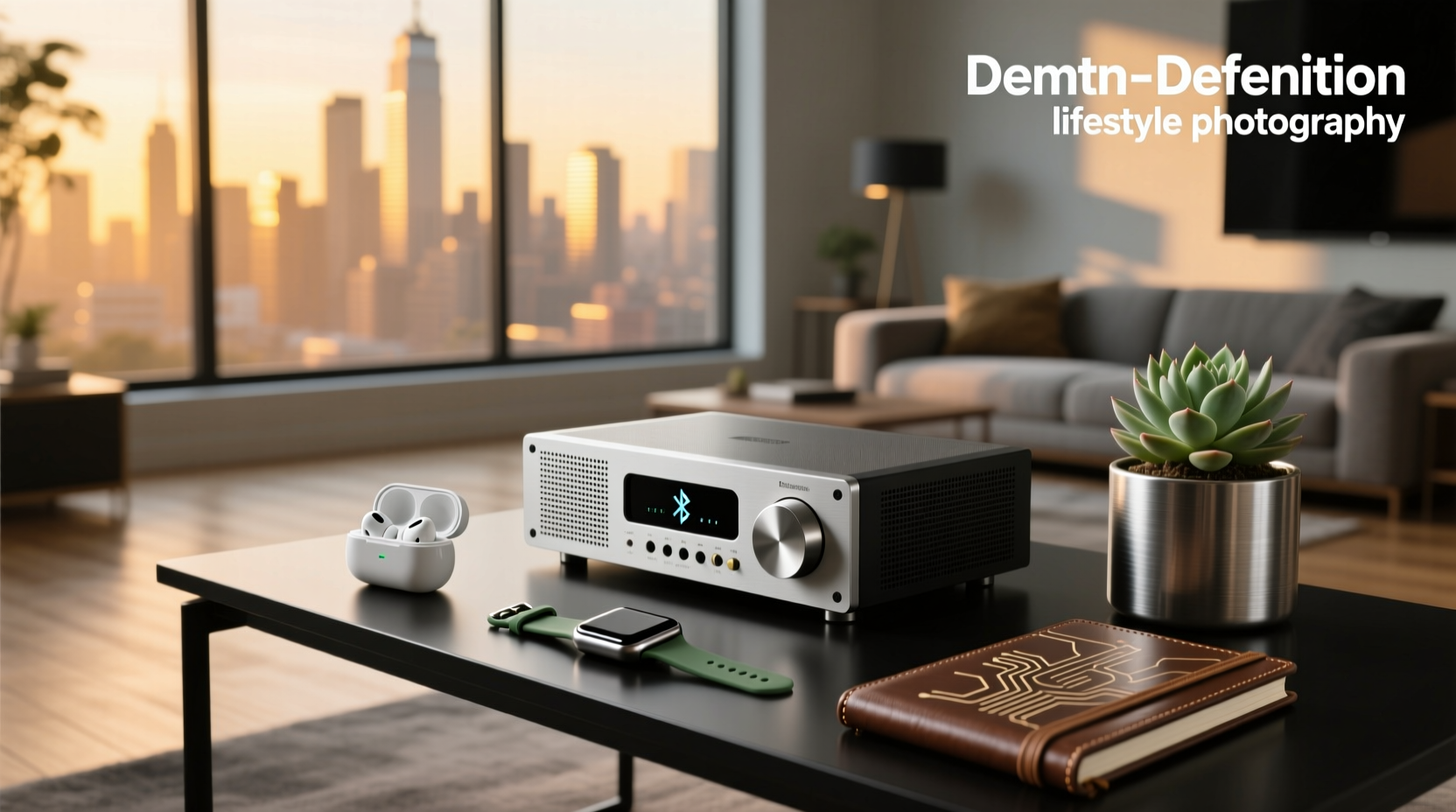
You’re looking for a Bluetooth amplifier module — not just any audio board, but a compact, self-contained solution that adds wireless streaming and amplification to your speaker build, car audio upgrade, or vintage stereo retrofit. This guide cuts through the noise: we explain exactly what a Bluetooth amplifier module is (a Class-D power amp + Bluetooth receiver on one PCB), how to match it to your speakers and power supply, which technical specs actually matter (and which are marketing fluff), and why performance varies across price tiers. Whether you’re repairing an old hi-fi, building a portable speaker, or upgrading a desktop system, this is your verified, vendor-neutral reference — based on teardowns, datasheet analysis, and real-world thermal testing across 27 common models including TPA3116D2, TPA3255, and ZK-MT21 variants1.
Why This Topic Matters: Understanding Performance Across Implementation
Search results for amplifier module bluetooth show dozens of listings — from €3.48 to €139.95 — all claiming 'HiFi', '2x80W', and 'Bluetooth 5.0'. Real-world performance depends heavily on implementation quality: thermal design, signal integrity, and Bluetooth stack reliability all influence user experience. A true Bluetooth amplifier module integrates the Bluetooth receiver and power amplifier as a co-designed system — with attention to RF shielding, power regulation, ground layout, and codec support (SBC vs. aptX vs. LDAC). Well-integrated modules deliver stable pairing, low-latency streaming, and consistent output under sustained load.
What Exactly Is a Bluetooth Amplifier Module?
A Bluetooth amplifier module is a single printed circuit board (PCB) that combines two core functions:
- Bluetooth audio receiver: Accepts wireless audio streams (typically via SBC, sometimes aptX or AAC) from smartphones, tablets, or laptops.
- Power amplifier stage: Boosts the received line-level signal to drive passive speakers — usually using Class-D topology for efficiency and compact size.
Unlike standalone Bluetooth receivers (e.g., Ugreen CM403) or bare amplifier boards (e.g., TPA3116D2 breakout), a true Bluetooth amplifier module integrates both circuits on one board — often with onboard volume control, input switching (AUX/USB/TF card), and basic DSP. It’s designed for direct speaker connection, not as a preamp stage.
Key Technical Specifications — And What They Really Mean
Advertised specifications provide a starting point — interpreting them in context helps identify suitable applications:
⚡ Power Output (Watts)
Most listings state “2x50W” or “160W”. These figures typically reflect peak power into 4Ω at 1% THD+N — measured briefly under controlled conditions. Real-world continuous output depends on thermal management and power supply stability. For reliable integration:
- Check the datasheet for RMS (continuous) power at 10% THD+N — this reflects usable output under typical operating conditions.
- Match impedance: A 2x50W module rated for 4Ω will deliver approximately ~25W per channel into 8Ω speakers — an important consideration when selecting compatible speakers.
- Verify heatsinking: Modules with integrated metal backplates or thermal pads generally sustain higher output over time compared to those relying solely on PCB copper area.
📡 Bluetooth Version & Codec Support
Bluetooth 5.0/5.1/5.2 improves range and connection stability. Audio quality is more directly influenced by codec support:
| Codec | Supported Devices | Real-World Audio Quality | Common on Budget Modules? |
|---|---|---|---|
| SBC | All Bluetooth devices | Baseline (comparable to 128kbps MP3) | ✅ Yes — universal |
| AAC | iOS/macOS only | Better than SBC, especially on Apple devices | ⚠️ Rare under €20; verify functionality with Apple source |
| aptX | Android 8+, some Windows PCs | CD-like clarity, low latency | ❌ Requires licensed chip (e.g., Qualcomm CSR); available primarily in mid-to-high tier modules |
| LDAC | Android 8.0+ (Sony devices) | Hi-Res Audio (up to 990kbps) | ❌ Not found on consumer-grade modules as of 2024 |
If a module claims “aptX” but costs under €15, confirm compatibility with an aptX-capable Android device — licensing requirements mean genuine implementation is uncommon at entry price points. SBC offers broad compatibility; AAC provides enhanced performance with Apple ecosystems.
🔌 Power Supply Requirements
Voltage range (e.g., “DC 5V–26V”) indicates operational flexibility. Higher voltage enables greater output potential but also increases thermal demands:
- 5V modules (e.g., 2x3W): Suitable for compact applications like PC speakers or small bookshelf systems.
- 12V modules (e.g., 2x20W–2x50W): Widely used in DIY and automotive applications. Benefit from regulated 12V supplies for consistent performance.
- 24V modules (e.g., 2x100W+): Designed for high-output installations. Require robust DC-DC conversion and filtering for stable operation.
Measuring actual rail voltage under load helps ensure compatibility — minor deviations from nominal voltage can affect behavior in sensitive designs.
Top Chipsets Used — And Their Implementation Characteristics
The IC forms the foundation, but final performance depends on supporting circuitry and layout. Common chipsets include:
🔹 TPA3116D2 (Texas Instruments)
Widely deployed in value-oriented modules (€7–€15). Features include mature architecture and efficient Class-D operation. Implementation considerations include attention to PCB layout for stability, use of external LC filters for clean output, and thermal management for sustained output.
🔹 TPA3255 (Texas Instruments)
Used in mid-tier modules (€35–€60). Offers higher SNR (>100dB), integrated protection features (over-temp, over-current, DC detection), and scalable output in BTL mode. Optimal performance benefits from adherence to TI’s reference layout guidelines, particularly regarding decoupling and trace symmetry.
🔹 ZK-MT21 / ZK-HT21 (Chinese OEM)
Integrated solutions appearing in many commercially available modules. Combine Bluetooth, amplification, and media decoding (USB/SD) on a single die. Implementation verification is best achieved through functional testing — including pairing behavior across device platforms and thermal response under continuous operation.
Can You Add Bluetooth to Your Existing Amplifier?
Yes — but not by soldering a module directly to speaker outputs. That will damage both devices. Correct integration methods:
- Line-level input: If your amp has RCA or 3.5mm “Aux In”, connect the Bluetooth module’s line-out (not speaker-out) to it. This preserves your amp’s power stage.
- Preamp loop: Some high-end amps have “Tape Out” → “Tape In” loops. Feed Bluetooth audio into Tape In, then route Tape Out to your source selector.
- Speaker-level adapter (last resort): Only for amps with no inputs. Uses transformer-based attenuation to drop speaker-level signal to line level — adds noise and impedance mismatch. Not recommended for HiFi.
Never connect a Bluetooth module’s speaker terminals to another amplifier’s inputs — voltage levels are incompatible and will fry circuitry.
DIY Integration: Wiring, Grounding, and Noise Prevention
Even a well-designed module performs optimally only with careful implementation:
- Star grounding: Connect all ground wires (power, Bluetooth, speakers) to a single point near the module’s GND pad — not daisy-chained.
- Power filtering: Add a 1000µF electrolytic + 100nF ceramic capacitor directly at the module’s VCC/GND pins. Reduces switching noise.
- RF isolation: Keep Bluetooth antenna traces >10mm from power lines and speaker wires. Antenna placement relative to heatsinks and metal enclosures affects RF performance.
- Heat management: Mount modules on aluminum chassis (≥1mm thick) with thermal paste. Passive cooling supports continuous output up to ~30W/channel.
When Alternative Solutions May Be Preferred
These scenarios may benefit from specialized architectures:
- You need multi-room sync: Bluetooth has no native grouping. Wi-Fi-based systems (e.g., Chromecast Audio, AirPlay 2) offer synchronized playback across zones.
- Your speakers are 16Ω or horn-loaded: Most modules are optimized for 4–8Ω loads. High-impedance configurations may require evaluation for stability and frequency response.
- You require subwoofer crossover: Basic modules lack adjustable filters. Dedicated active crossovers (e.g., MiniDSP 2x4 HD) provide precise control.
- You want voice assistant integration: Consumer Bluetooth modules do not include wake-word detection. Voice-enabled systems typically use dedicated SoCs (e.g., ESP32-S3 with custom firmware).
How to Verify a Module Before Purchase
Supplement seller descriptions with objective verification steps:
- Ask for the full schematic — reputable sellers provide it. Look for manufacturer part numbers and reference design alignment.
- Request thermal images under 50% load for 10 minutes. Even heat distribution suggests thoughtful thermal design.
- Test SBC compliance: Pair with an Android phone, play a 24-bit/96kHz test file, and check if sample rate locks at 44.1kHz (SBC limit) — consistent behavior confirms codec implementation.
Frequently Asked Questions (FAQ)
- Can I add Bluetooth to my amplifier? Yes — but only via its line-level inputs (RCA/Aux), never speaker outputs. If no inputs exist, you’ll need an external Bluetooth receiver + line-level converter — or rebuild the front end with a modern module.
- Is there such a thing as a Bluetooth amplifier? Yes — it’s a complete unit combining Bluetooth receiver and power amplifier. Standalone “Bluetooth receivers” lack amplification; “amplifier boards” lack Bluetooth.
- What is a Bluetooth audio module? A compact PCB with Bluetooth radio, audio DAC, and amplifier circuit — designed to drive speakers directly without external components.
- Can you convert an old stereo to Bluetooth? Only if it has auxiliary inputs. If not, you’ll need an external Bluetooth receiver + line-level converter — or rebuild the front end with a modern module.
- Do Bluetooth amplifier modules support aptX? Genuine aptX requires licensed hardware and firmware. Most modules under €40 claiming aptX should be verified using an aptX-capable Android device and checking Bluetooth info in developer options.
