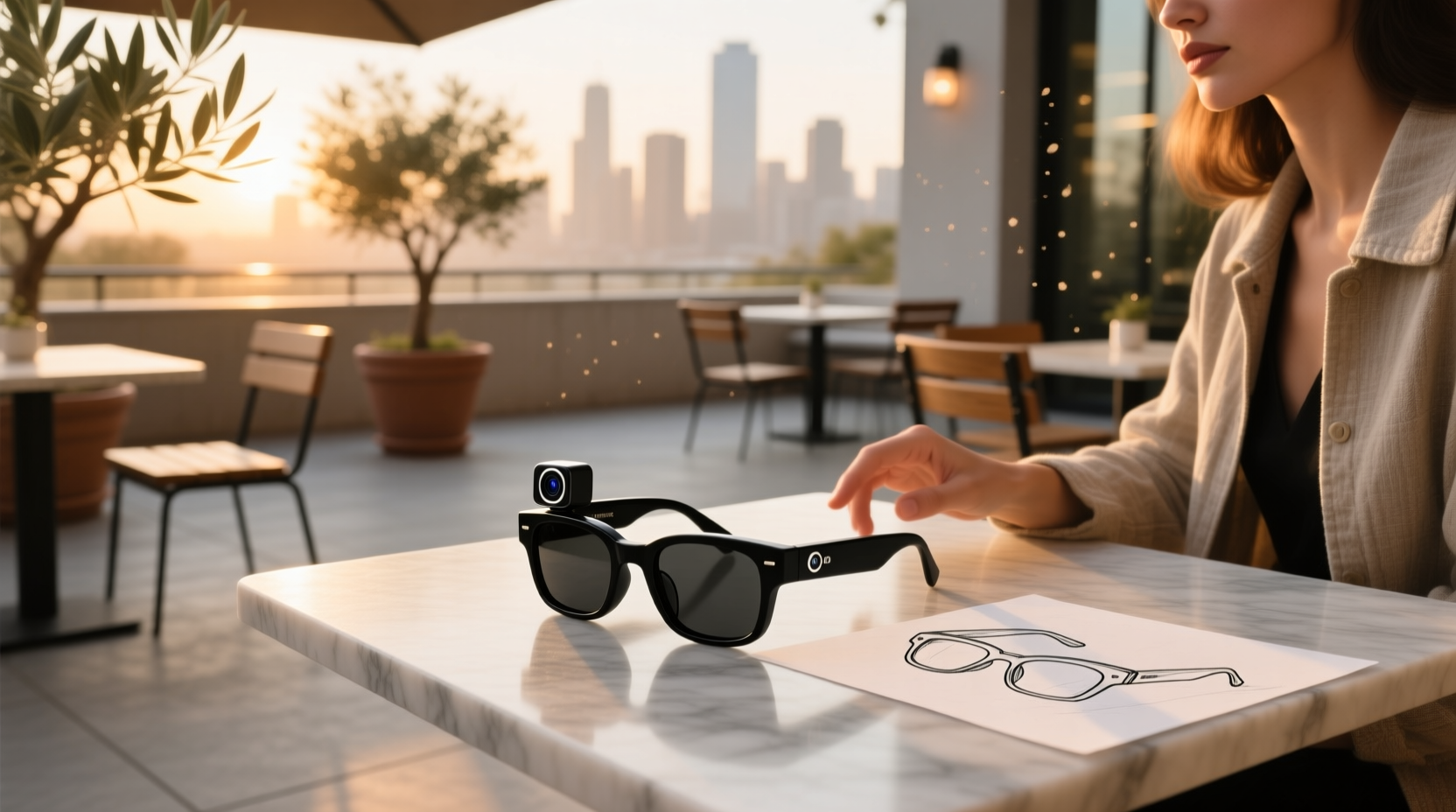
Bluetooth camera glasses are wearable devices that integrate a camera, microphone, speaker, and Bluetooth radio into eyewear frames—enabling hands-free photo/video capture, voice-controlled AI functions (like translation or ChatGPT), and smartphone-connected audio playback 1. Unlike Ray-Ban Meta smart glasses—which focus on display and audio—most budget Bluetooth camera glasses prioritize recording over AR visuals, offering 1080P video, built-in storage (typically 4–32GB), and AI-powered features like real-time language translation or voice-to-text transcription 2. However, performance varies drastically by chipset, firmware maturity, and thermal management—not just specs listed in product titles. This guide cuts through marketing claims to help you assess actual utility, legal boundaries, compatibility limits, and realistic expectations before buying.
How Bluetooth Camera Glasses Actually Work (Not Just What They Claim)
At their core, Bluetooth camera glasses function as a paired peripheral—not standalone computers. Most rely on a companion Android/iOS app for setup, preview, file transfer, and firmware updates. The Bluetooth connection (typically Bluetooth 5.0 or 5.2) handles two primary data paths: audio streaming (for calls/music) and control signaling (to start/stop recording, adjust settings). Video and photo files, however, are almost never streamed live over Bluetooth due to bandwidth constraints; instead, they’re stored locally on embedded eMMC or microSD (if supported) and synced later via USB or Wi-Fi 3.
The camera module is usually a fixed-focus CMOS sensor (commonly 8MP or 12MP resolution, though effective output rarely exceeds 1080P due to lens quality and processing limitations). Audio input uses one or two MEMS microphones—often with basic noise suppression but no active ANC. Output is delivered either through open-ear bone conduction drivers (which vibrate the temporal bone) or tiny dynamic speakers mounted near the ear canal. Bone conduction avoids blocking ambient sound—a safety advantage for cycling or walking—but sacrifices bass response and volume clarity in noisy environments.
Key Technical Specifications That Matter (and Which Ones Don’t)
When evaluating Bluetooth camera glasses, focus on these five measurable attributes—not headline numbers:
- Battery endurance under real load: Advertised “90-minute recording” assumes 720P, no AI processing, and room temperature. In practice, 1080P video + continuous translation drains most sub-$100 models in 45–65 minutes. Look for independent test reports citing runtime at 1080P/30fps with Bluetooth active 4.
- Thermal throttling behavior: Compact frames lack heatsinks. After ~20 minutes of continuous recording, many units reduce frame rate or shut down to prevent overheating. Check user reviews mentioning “recording stops mid-use” or “glasses get hot near temples.”
- Microphone pickup range and directionality: Most entry-level models pick up clear speech only within 1–1.5 meters and struggle with crosswind or traffic noise. Dual-mic setups with beamforming (found in higher-end OEM modules) improve intelligibility—but are rarely disclosed in spec sheets.
- App reliability and update frequency: Firmware bugs—like failed Bluetooth reconnection after sleep mode or corrupted MP4 files—are common in low-cost models. Verify whether the manufacturer publishes changelogs or has released ≥3 firmware updates in the past 12 months.
- Storage architecture: “32GB built-in” often means soldered eMMC with no expansion slot. If footage fills storage, you must offload via USB-C cable—no wireless sync. Models supporting microSD (e.g., some G300-series variants) offer flexibility but may limit write speed to Class 10 (≈10MB/s), causing dropped frames at high bitrates.
Legal & Ethical Boundaries: Where Recording Is Risky (or Illegal)
Ownership of Bluetooth camera glasses is legal in all major markets—but how and where you use them carries significant legal exposure. In the U.S., federal law permits video recording in public spaces without consent, but audio recording without all-party consent is illegal in 12 states (including California, Florida, and Pennsylvania) 2. Even in one-party consent states, covert audio capture in private settings (e.g., workplaces, restrooms, medical offices) violates state wiretapping statutes and employer policies.
Internationally, rules differ sharply: Germany bans covert recording entirely under §201 StGB; the UK requires Data Protection Act 2018 compliance for any personal data capture; and Thailand’s Personal Data Protection Act (PDPA) mandates explicit consent before filming identifiable individuals in non-public contexts 2. Crucially, “I didn’t know it was recording” is not a legal defense—manufacturers’ default-on recording modes (e.g., auto-start when powered) increase liability risk. Always verify if your device includes a physical shutter switch or LED recording indicator that meets local transparency requirements.
Compatibility Reality Check: iPhone vs. Android, OS Updates, and App Limitations
While most Bluetooth camera glasses claim “iOS & Android compatibility,” real-world interoperability depends on three layers: Bluetooth profile support, app functionality, and OS permission handling.
iOS restricts background Bluetooth access for third-party apps unless explicitly granted. As a result, many glasses cannot maintain stable connections during screen-off states—causing missed call alerts or delayed voice command responses. Android offers more flexibility, but recent versions (Android 12+) enforce stricter location permissions for Bluetooth scanning, requiring users to manually enable “Location” for the companion app—even if GPS isn’t used.
Additionally, app stores frequently remove or delist companion apps for low-volume devices. Search the exact model name + “companion app APK” or “iOS app store link” before purchase. If no official app exists on Apple App Store or Google Play, assume reliance on unofficial or outdated binaries—with security and stability risks.
Use Case Fit: When These Glasses Deliver Value (and When They Don’t)
Bluetooth camera glasses serve specific niches well—but fail as general-purpose replacements for phones or action cams. Consider them only if your workflow matches one of these validated scenarios:
- Field documentation for tradespeople: Electricians, HVAC technicians, or inspectors benefit from first-person POV logging of equipment labels, wiring layouts, or safety checks—especially when hands are occupied with tools. Battery life and ruggedness matter more than resolution here.
- Language-constrained professional interactions: Sales reps or customer service staff working across language barriers can use real-time translation features during face-to-face meetings—provided both parties consent and the glasses support offline translation packs (not cloud-only).
- Assistive recording for memory support: Users with mild cognitive impairment or ADHD may use short clip capture (<30 sec) to reinforce verbal instructions (“What did the pharmacist say about dosage?”). Audio fidelity and one-touch activation are critical.
They are not suitable for: vlogging (poor stabilization, no manual focus), surveillance (low-light performance is weak), music listening (bone conduction lacks bass depth), or long-form interviews (battery and thermal limits apply).
Common Misconceptions Debunked
Misconception #1: “AI translation works like Google Translate in real time.”
Reality: On-device translation (common in $50–$150 models) supports only 3–5 languages with latency >1.5 seconds and frequent misrecognitions for accents or technical terms. Cloud-dependent models require constant data connectivity—and introduce privacy risks for sensitive conversations.
Misconception #2: “1080P means broadcast-quality video.”
Reality: Most units use heavily compressed H.264 encoding at ≤12Mbps bitrate with fixed exposure. Low-light footage shows severe noise, motion blur is pronounced without optical stabilization, and color science is uncalibrated—making them unsuitable for content creation.
Misconception #3: “Bluetooth calling sounds as clear as a headset.”
Reality: Microphone placement (behind the ear, not near mouth) and lack of dedicated echo cancellation mean callers often report muffled or distant audio—especially outdoors. Test call quality in windy conditions before relying on them professionally.
What to Verify Before Purchase (A Practical Checklist)
Before ordering, confirm these six points—each backed by verifiable evidence, not marketing copy:
- Firmware version history: Visit the brand’s official website or AliExpress store page and check for dated firmware release notes. Absence of updates since 2023 signals abandoned development.
- Actual field-of-view (FOV): Spec sheets list “120° FOV”—but this is often diagonal, not horizontal. Request sample footage showing a standard doorframe at 2m distance. True usable horizontal FOV should be ≥85° for natural framing.
- MicroSD support confirmation: Some listings say “expandable storage” but omit that the slot is disabled in firmware. Search Reddit or XDA Developers forums for your exact model number + “microSD enabled.”
- USB-C data transfer speed: Not all USB-C ports support data—some are power-only. Confirm the port is USB 2.0 (480Mbps) or faster by checking teardown videos or spec tables.
- Weight distribution test: Units >55g cause pressure behind ears during >60-minute wear. Check product weight in grams—not “lightweight” claims—and compare to standard prescription frames (typically 35–45g).
- Return policy clarity: Reputable sellers specify return windows, restocking fees, and whether opened units qualify. Avoid listings with vague phrasing like “contact us for returns.”
Frequently Asked Questions (FAQ)
- Can Bluetooth camera glasses record audio legally in my country?
- No universal answer applies. Audio recording legality depends on your jurisdiction’s consent laws (one-party vs. all-party) and context (public vs. private space). Consult local legal guidance before use—especially for workplace or healthcare applications.
- Do these glasses work with Zoom or Teams for video calls?
- No. Bluetooth camera glasses do not appear as webcam sources in desktop conferencing apps. They lack UVC (USB Video Class) driver support. Only smartphones can access their camera feed via the companion app.
- Why does my Bluetooth camera glasses disconnect after 10 minutes?
- This typically indicates aggressive power-saving firmware or Bluetooth stack instability. Try disabling “auto-sleep” in the app, updating firmware, or pairing with a different phone. Persistent disconnections suggest hardware-level radio calibration issues.
- Are there waterproof Bluetooth camera glasses?
- Few models exceed IPX4 (splash-resistant). None meet IP67/IP68 standards. Rain exposure risks internal condensation and sensor fogging. Avoid use in heavy rain or high-humidity environments unless explicitly rated.
- Can I use them for live streaming to YouTube or TikTok?
- Not natively. Streaming requires HDMI or USB-C video output—unsupported by current Bluetooth camera glasses. Some users route phone-screen mirroring through companion apps, but latency exceeds 3 seconds and degrades quality.
