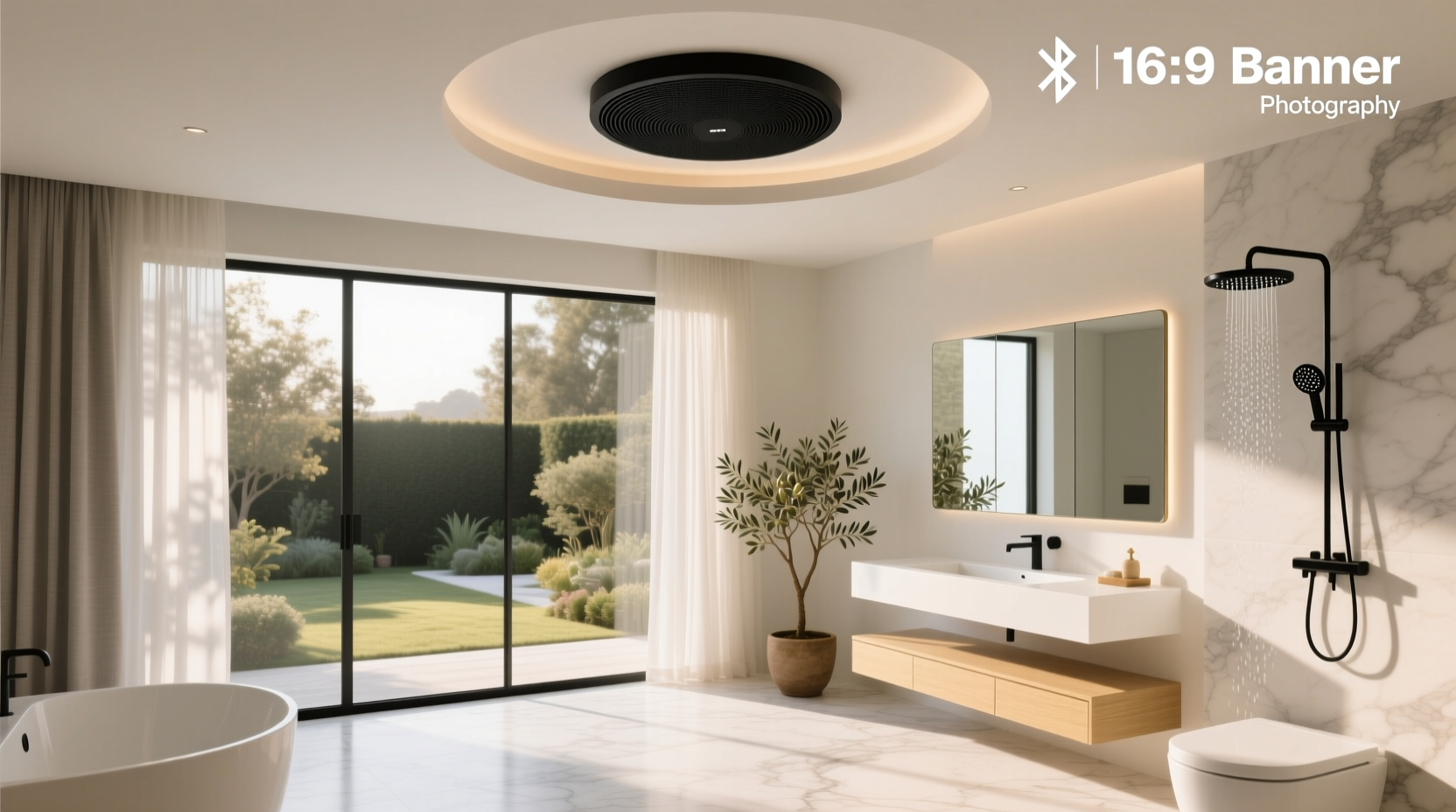
Yes — you can install Bluetooth ceiling speakers in bathrooms — but only if they’re IP44-rated or higher, powered via a fused spur by a licensed electrician, and designed as all-in-one active units (not passive). Passive ceiling speakers + external Bluetooth amps are not suitable for permanent installation in wet zones due to electrical safety requirements. This guide explains exactly what makes a Bluetooth ceiling speaker suitable for bathroom use — covering ingress protection, electrical certification (AS/NZS 3000), installation constraints, real-world sound performance, and how to verify compliance before purchase. We focus on verified technical specs and regulatory standards — because proper specification and installation ensure long-term safety, reliability, and performance.
Why Bathroom Ceiling Speakers Are Different From Regular Bluetooth Speakers
Bathrooms are classified as wet locations under the Australian/New Zealand Wiring Rules (AS/NZS 3000:2018). That means any electrical device installed inside Zone 1 (the area above the bath or shower up to 2.25 m) or Zone 2 (0.6 m beyond the bath/shower perimeter) must meet strict safety criteria1. Standard Bluetooth speakers — even those labeled “water-resistant” — are not designed for permanent ceiling mounting in these zones. Their power supplies, Bluetooth modules, and internal amplifiers lack the required insulation, enclosure sealing, and earth leakage protection.
Unlike portable shower speakers (e.g., UE Wonderboom 4 or Soundcore Select 4GO), which rely on battery power and IPX7 submersion resistance, ceiling-mounted units draw mains power. That introduces two critical considerations:
- Electrical safety design — certified insulation, grounding, and enclosure integrity are essential;
- Environmental resilience — sustained humidity exposure requires robust materials and sealing to maintain long-term performance.
This is why certified bathroom ceiling speakers use dedicated mains-powered designs — and why “Bluetooth-enabled” reflects a feature, not a safety classification.
IP Rating: What ‘IP44’ Really Means (and Why IPX7 Is Irrelevant)
The IP (Ingress Protection) rating is the single most important spec — but it’s widely misunderstood. An IP code has two digits: first digit = solid particle protection, second digit = liquid ingress protection.
For bathroom ceiling speakers, IP44 is the minimum acceptable rating:
- First digit ‘4’: Protection against solid objects >1 mm (e.g., tools, wires — prevents accidental contact with live parts);
- Second digit ‘4’: Protection against water splashed from any direction (tested at 10 L/min for 5 min at 180 kPa pressure).
IP44 is sufficient for Zones 1 and 2 — but not for direct spray or steam immersion. It does not mean “showerproof” or “steamproof.” IPX7 (submersion up to 1 m for 30 min) applies to portable devices — not fixed mains-powered installations. No compliant in-ceiling speaker carries IPX7 because its testing protocol assumes non-mains operation and removable enclosures.
Manufacturers like Lithe Audio and Weconic explicitly state IP44 compliance on product datasheets2. Units that list only “water-resistant” or “moisture-tolerant” should be evaluated carefully — these terms describe general environmental tolerance, not formal certification.
Active vs. Passive: Why Only Active Units Belong in Bathrooms
This is where installation planning plays a key role. There are two fundamental types:
| Type | Power Source | Bluetooth Module Location | Bathroom Compliance Status | Design Consideration |
|---|---|---|---|---|
| Active (All-in-One) | Mains-powered, built-in Class D amplifier & Bluetooth 5.0 receiver | Encapsulated inside sealed speaker housing | ✅ Compliant if IP44+ and installed per AS/NZS 3000 | Integrated design simplifies installation and maintains consistent environmental protection |
| Passive + External Amp | Speaker: passive; Amp: separate mains unit (often under sink or in ceiling void) | In external amp — not rated for wet zones | ❌ Requires careful zoning assessment and additional compliance documentation | Offers flexibility in component selection but demands coordinated certification and installation planning |
Passive speakers (e.g., Yamaha NS-IC600 or Polk Audio RCi series) require an external amplifier — which must be located outside regulated wet zones. When installed in accordance with AS/NZS 3000, passive systems can meet compliance requirements through appropriate enclosure ratings, conduit sealing, and zone-appropriate placement. Active units integrate everything — eliminating exposed low-voltage runs and keeping electronics within the rated enclosure.
Electrical Installation: You Need a Licensed Electrician — No Exceptions
Per AS/NZS 3000 Clause 3.9.3.1, all fixed equipment in bathrooms must be connected via a fused isolator (spur) located outside the bathroom — typically in the hallway or adjacent room. The spur must include:
- A 10 A or 16 A fuse (matching circuit rating);
- An RCD (Residual Current Device) with ≤30 mA trip threshold;
- A visible isolation switch (not just a circuit breaker).
The speaker’s power cable must enter the ceiling cavity through a conduit-sealed entry point, not a standard ceiling rose cut-out. Professional installation ensures adherence to regulatory requirements and supports long-term system reliability. Retailers such as Bunnings Warehouse and MJS Electrical Supplies emphasize professional installation guidance on product pages3, reflecting industry best practices for safety and compliance.
Sizing & Acoustics: 4″ vs. 6.5″ — What Actually Matters in Small Spaces
Bathroom size directly impacts speaker selection. Most residential bathrooms are ≤2.5 m × 2.5 m — making low-frequency output less critical than clarity and dispersion.
- 4-inch models (e.g., Lithe Audio BT5, Weconic 4") offer tighter dispersion, reduced bass resonance, and fit standard 100 mm downlight cut-outs. Ideal for powder rooms or ensuites ≤4 m².
- 6.5-inch models (e.g., Lithe Audio BT65, Weconic 6.5") deliver fuller midrange and usable bass down to ~65 Hz — beneficial in larger bathrooms (>6 m²) but prone to boominess if mounted too close to tile walls or ceilings.
Crucially: driver size ≠ output quality. A well-engineered 4" active unit with a 25 W Class D amp and waveguide tweeter often outperforms a poorly tuned 6.5" unit with 60 W peak power but no DSP correction. Look for frequency response graphs — not wattage claims. Real-world measurements show most bathroom-rated units roll off below 80 Hz, making deep bass irrelevant.
Bluetooth Limitations You Must Accept
Bluetooth functionality in ceiling speakers operates within defined technical parameters:
- Antenna placement: Internal Bluetooth antennas are shielded by metal speaker baskets and ceiling plasterboard — reducing effective range to ~6–8 m line-of-sight;
- Multi-room capability: Most units support independent pairing; advanced synchronization requires Wi-Fi or proprietary mesh protocols available in select high-end models;
- Voice assistant integration: Built-in microphones are not included in IP44-rated units due to sealing requirements — however, external voice control via smartphone or compatible hub remains fully supported.
If multi-room audio is essential, consider a central Wi-Fi streamer (e.g., Bluesound Node) feeding an IP44-rated amplifier in a dry zone — then running speaker cable to active ceiling units. This approach offers flexibility while maintaining compliance.
Price Reality Check: Understanding Certification Value
Units priced under $200 AUD may vary in certification transparency. Genuine IP44 certification requires independent lab testing (e.g., SGS or Intertek) and includes thermal cycling, humidity soak, and pressure wash validation.
At the $150–$250 tier, brands like Weconic and Power Dynamics publish full test summaries. Above $400, Lithe Audio provides downloadable IP44 certificates and AS/NZS 3000 compliance statements. When evaluating products, request the test report from the seller — verified documentation supports informed purchasing decisions.
Installation Checklist: 7 Steps Before You Buy
Verify these *before* ordering — not after:
- Confirm your bathroom’s Zones 1 and 2 boundaries using AS/NZS 3000 Figure 3.9.3.1;
- Check ceiling cavity depth — most active units need ≥110 mm clearance;
- Locate nearest accessible fused spur location outside the bathroom;
- Measure cut-out diameter — 4" units need 100–105 mm; 6.5" need 165–170 mm;
- Request the IP test report from the seller — not just a marketing sheet;
- Confirm the unit includes fire-rated back-box options if installed above habitable rooms;
- Ensure your electrician agrees to sign off — many require full compliance documentation prior to installation.
Common Misconceptions Debunked
- “Bluetooth 5.0 = better range in bathrooms” — False. Version number affects data throughput and latency, not RF penetration. Plasterboard attenuation is identical across BT 4.2/5.0/5.3.
- “I can use a regular ceiling speaker with a Bluetooth receiver box” — Requires evaluation of the receiver’s IP rating and installation location — only units rated for wet zones and installed per AS/NZS 3000 are compliant.
- “Steam won’t hurt it if it’s IP44” — Partially true. IP44 protects against splashes — not saturated steam. Long-term exposure above 60°C degrades adhesives and drivers. Ventilation remains critical.
- “More watts = louder sound” — Misleading. Sensitivity (dB @ 1W/1m) matters more. A 25 W/89 dB unit outperforms a 60 W/84 dB unit at typical listening distances.
Alternatives Worth Considering
If ceiling installation feels too complex, consider these code-compliant alternatives:
- IP65-rated Bluetooth ceiling lights (e.g., LED fixtures with integrated 10 W speakers) — installed like standard lights, no extra spur needed;
- Wall-mounted IP44 Bluetooth speakers (e.g., Sonos Era 100 with weatherproof grille) — placed outside Zone 1, angled into space;
- Waterproof portable speakers on suction mounts — for renters or temporary use (but not permanent installation).
Each option offers distinct advantages depending on space, budget, and usage needs — all while meeting relevant safety and performance expectations.
Frequently Asked Questions
- Can I install a Bluetooth ceiling speaker myself?
No. AS/NZS 3000 mandates licensed electrician installation for all fixed bathroom equipment. Professional installation ensures compliance, safety, and insurance validity. - Do I need two speakers for stereo sound in a bathroom?
Not necessarily. Most bathrooms are too small for stereo imaging. A single well-placed active speaker delivers clearer speech and music than two poorly synced units. - Will Bluetooth disconnect when I run hot water?
Steam itself doesn’t disrupt Bluetooth — but rapid temperature/humidity shifts can cause condensation inside non-IP44 units, leading to intermittent faults. IP44 units handle this reliably. - Can I connect these to Spotify Connect or Apple AirPlay?
No. These require Wi-Fi and cloud authentication — impossible in sealed, Bluetooth-only active units. Use native Bluetooth pairing only. - How long do bathroom ceiling speakers last?
With proper ventilation and IP44 compliance, 7–10 years is typical. Failure usually starts with tweeter distortion (humidity damage) or amp shutdown (thermal stress).
