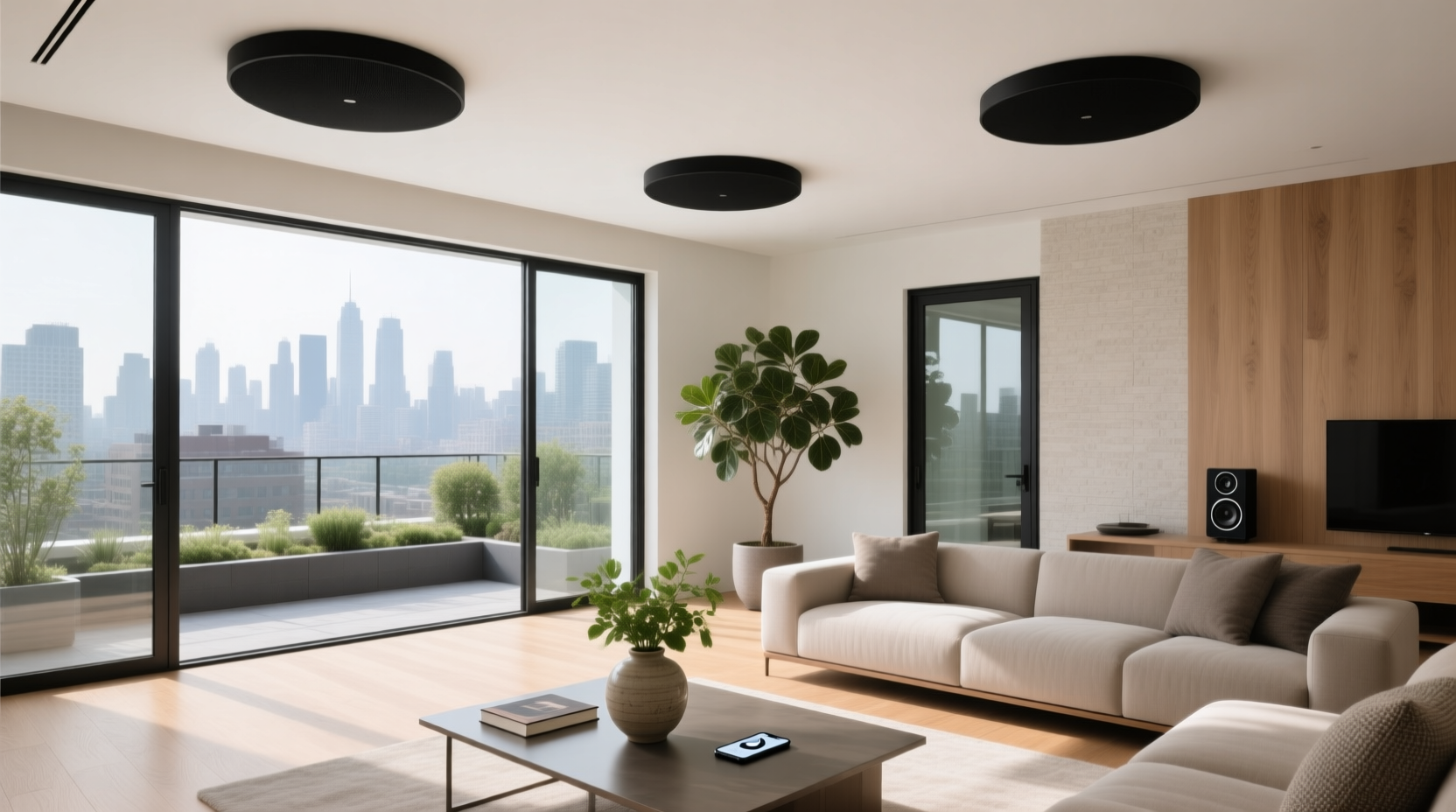
Bluetooth ceiling speakers deliver true wireless convenience for whole-room audio—but only if you understand their technical boundaries. Unlike traditional wired in-ceiling models requiring an external amplifier and complex cabling, Bluetooth-enabled units integrate amplification, DSP, and wireless receivers into a single flush-mount enclosure. They’re ideal for retrofitting kitchens, bathrooms, or bedrooms where running speaker wire is impractical 1. However, they’re not universally suitable: Bluetooth 5.0+ offers ~33 ft (10 m) reliable range in open spaces—but walls, metal ductwork, and Wi-Fi congestion can cut effective coverage by 40–60%. Latency remains ~100–200 ms—making them unsuitable for lip-sync-critical TV audio unless paired with aptX Low Latency or proprietary codecs. This guide cuts through marketing claims to clarify what works, what doesn’t, and how to verify specs before installation.
How Bluetooth Ceiling Speakers Actually Work (Not Just Marketing)
True Bluetooth ceiling speakers are active (powered) systems: each unit contains a built-in Class D amplifier, Bluetooth receiver (typically Bluetooth 5.0 or 5.2), digital signal processor (DSP), and speaker drivers—all housed within a single backbox designed for recessed mounting. This contrasts sharply with passive in-ceiling speakers that require external amplification and separate Bluetooth adapters—a configuration often mislabeled as "Bluetooth ceiling speakers" in e-commerce listings 2.
Key functional components:
- Bluetooth Module: Determines pairing stability, codec support (SBC, AAC, aptX), and multi-point capability. Most consumer-grade models use SBC-only, limiting fidelity versus wired alternatives.
- Integrated Amplifier: Ranges from 10W to 600W peak per unit—but RMS output (the sustained power) is typically 30–50% lower. A 600W peak rating ≠ 600W continuous output.
- DSP Tuning: Compensates for acoustic challenges of ceiling placement (e.g., high-frequency roll-off, bass cancellation). Not all models include user-adjustable EQ; many rely on fixed factory tuning.
- Enclosure Design: Backbox depth, baffle material, and grille sealing impact low-frequency response and moisture resistance—critical for bathroom or covered patio use.
Real-World Performance: What Specs Don’t Tell You
Manufacturers list impressive numbers—but real-world deployment reveals consistent limitations:
📶 Range & Interference Are Highly Contextual
Bluetooth’s theoretical 33-ft range assumes line-of-sight, no obstructions, and minimal RF noise. In practice:
- One drywall partition reduces reliable range to ~15–20 ft.
- Metal HVAC ducts or plumbing pipes cause multipath interference, leading to dropouts during streaming.
- 2.4 GHz Wi-Fi networks (especially crowded apartment buildings) degrade connection stability. Dual-band routers don’t solve this—Bluetooth operates exclusively in the 2.4 GHz band.
Actionable verification step: Before purchase, test your intended source device (phone, tablet, laptop) at the ceiling location using a Bluetooth signal strength app (e.g., nRF Connect). If RSSI falls below −70 dBm, expect instability.
⏱️ Latency Makes or Breaks TV & Video Sync
Standard Bluetooth audio has inherent latency due to packet encoding, transmission, and decoding. Measured end-to-end delay averages:
| Codec | Avg. Latency | TV Sync Suitability |
|---|---|---|
| SBC (default) | 150–250 ms | ❌ Noticeable lip-sync drift |
| AAC (iOS/macOS) | 120–180 ms | ⚠️ Marginal for close viewing |
| aptX Low Latency | 40–80 ms | ✅ Acceptable for most setups |
Crucially, both source device and speaker must support the same low-latency codec. No consumer Bluetooth ceiling speaker currently supports aptX Adaptive or LDAC—so Android users gain no advantage over iOS here.
🔊 Sound Quality: Why It’s Not Just About Wattage
Higher wattage ratings rarely translate to better fidelity. Critical factors include:
- Driver Quality: Polypropylene cones dominate budget models; Kevlar or woven fiberglass appear in premium units but add cost without guaranteeing improvement if DSP tuning is poor.
- Dispersion Pattern: Ceiling speakers project sound downward. A 90° dispersion angle covers ~100 sq ft; 120° reaches ~200 sq ft—but wider angles reduce on-axis volume and increase ceiling reflection artifacts.
- Bass Response: 4” and 5.25” drivers struggle below 80 Hz. Even 6.5” models rarely extend past 60 Hz cleanly. Adding a dedicated subwoofer (wired or wireless) is strongly advised for full-range listening 3.
Installation: Simpler Than Wired—But Not Plug-and-Play
While eliminating amplifier racks and speaker cable runs, Bluetooth ceiling speakers introduce new constraints:
🔌 Power Is Non-Negotiable
Every active ceiling speaker requires a dedicated 120V AC circuit connection behind the ceiling. Unlike passive speakers (which run on low-voltage amp output), these units draw 15–30W continuously—even in standby. Key implications:
- No battery operation exists for safety and thermal reasons (UL/CE certification prohibits it).
- Each speaker needs its own junction box and NM-B cable run—meaning electrician labor costs remain significant.
- Power-over-Ethernet (PoE) is not supported; PoE delivers only 15.4–90W depending on standard, insufficient for amplifiers and incompatible with ceiling speaker form factors.
📐 Mounting Requirements: Depth & Clearance Matter
Backbox depth ranges from 3.5” to 6.5”. Critical checks before cutting holes:
- Verify joist spacing (16” or 24” on-center) matches speaker mounting brackets.
- Confirm ≥2” clearance above insulation—compressed insulation degrades thermal management and voids warranties.
- For fire-rated ceilings, use only UL-listed backboxes with integral fire-stopping collars.
📱 Pairing & Multi-Room Limitations
Most Bluetooth ceiling speakers operate as independent endpoints—not synchronized zones. To play the same audio across multiple rooms:
- You cannot natively group two Bluetooth speakers via Bluetooth alone (Bluetooth 5.x doesn’t support true multi-point audio streaming).
- Workarounds exist (e.g., third-party apps like AmpMe or Bose Connect), but introduce additional latency and reliability issues.
- True multi-room sync requires Wi-Fi-based systems (e.g., Sonos, Bluesound) or proprietary mesh protocols—not Bluetooth.
When to Choose Bluetooth vs. Alternatives
Bluetooth ceiling speakers solve specific problems—but aren’t universal upgrades. Use this decision matrix:
| Your Primary Need | Bluetooth Ceiling Speaker? | Better Alternative |
|---|---|---|
| Retrofitting a single room without running wires | ✅ Yes—ideal use case | — |
| Whole-home synchronized audio | ❌ No—no native grouping | Wi-Fi multi-room system (e.g., Denon HEOS, Yamaha MusicCast) |
| Lip-sync critical TV audio | ❌ Avoid unless aptX LL confirmed | Optical or HDMI ARC/eARC soundbar + wired surrounds |
| High-fidelity music listening | ⚠️ Limited—SBC/AAC compression affects detail | Wired passive speakers + high-res streamer (e.g., Bluesound Node) |
Common Misconceptions—Debunked
❌ "Bluetooth ceiling speakers work like smart speakers (e.g., Echo, HomePod)"
No. They lack microphones, voice assistants, or cloud services. They function solely as wireless receivers—no wake words, no routines, no software updates beyond rare firmware patches.
❌ "I can pair any Bluetooth device—including my TV's built-in Bluetooth"
Many TVs transmit Bluetooth audio but don’t receive it. Even if your TV supports Bluetooth output, its implementation may be limited to headphones—not speakers—and often lacks aptX support. Always verify the TV’s Bluetooth profile (A2DP Sink vs. Source) in its service menu or manual.
❌ "More watts = louder and better sound"
Wattage indicates headroom—not efficiency or clarity. A well-tuned 20W speaker with high-sensitivity drivers (≥90 dB @ 1W/1m) outperforms a poorly tuned 100W unit in real rooms. Sensitivity and impedance (typically 4Ω or 8Ω) matter more than peak power.
What to Check Before Buying (A Verification Checklist)
Don’t rely on product page claims. Verify these five points:
- Amplifier Type: Confirm it’s Class D (efficient, cool-running) — not outdated Class AB (runs hot, larger footprint).
- Bluetooth Version & Codec: Look for Bluetooth 5.0+ and explicit mention of aptX or AAC support—not just “Bluetooth enabled.”
- IP Rating: For bathrooms or covered patios, IP44 or higher is mandatory (resists splashing water). IP20 = indoor-dry only.
- Grille Material: Paintable aluminum grilles withstand humidity better than plastic. Avoid magnetic grilles—they interfere with driver magnets.
- Warranty & Support: Reputable brands offer ≥2-year warranties with accessible technical documentation (e.g., frequency response graphs, impedance curves).
Frequently Asked Questions
- Can I use Bluetooth ceiling speakers with my existing home theater receiver?
Only if the receiver has Bluetooth transmit capability (rare). Most receivers receive Bluetooth—not transmit. You’d need a Bluetooth transmitter connected to the receiver’s preamp outputs. - Do Bluetooth ceiling speakers support voice assistants like Alexa or Google Assistant?
No. They lack microphones, processing hardware, and cloud connectivity. Voice control requires a separate smart speaker or display in the same room. - Can I install them in a drop ceiling?
Yes—but only with models designed for T-bar grid mounting (e.g., specific Herdio or Lithe Audio variants). Standard recessed models require solid drywall or plywood backing. - Is there a way to reduce Bluetooth latency for TV use?
Short of buying aptX LL-compatible gear, no. Turning off Bluetooth enhancements (like AVRCP) in your source device settings may shave 10–20 ms—but results vary by device. - How do I clean Bluetooth ceiling speaker grilles?
Use a soft brush attachment on a vacuum cleaner. Never spray liquids directly—moisture ingress damages internal electronics. For stubborn dust, wipe with a microfiber cloth slightly dampened with distilled water.
