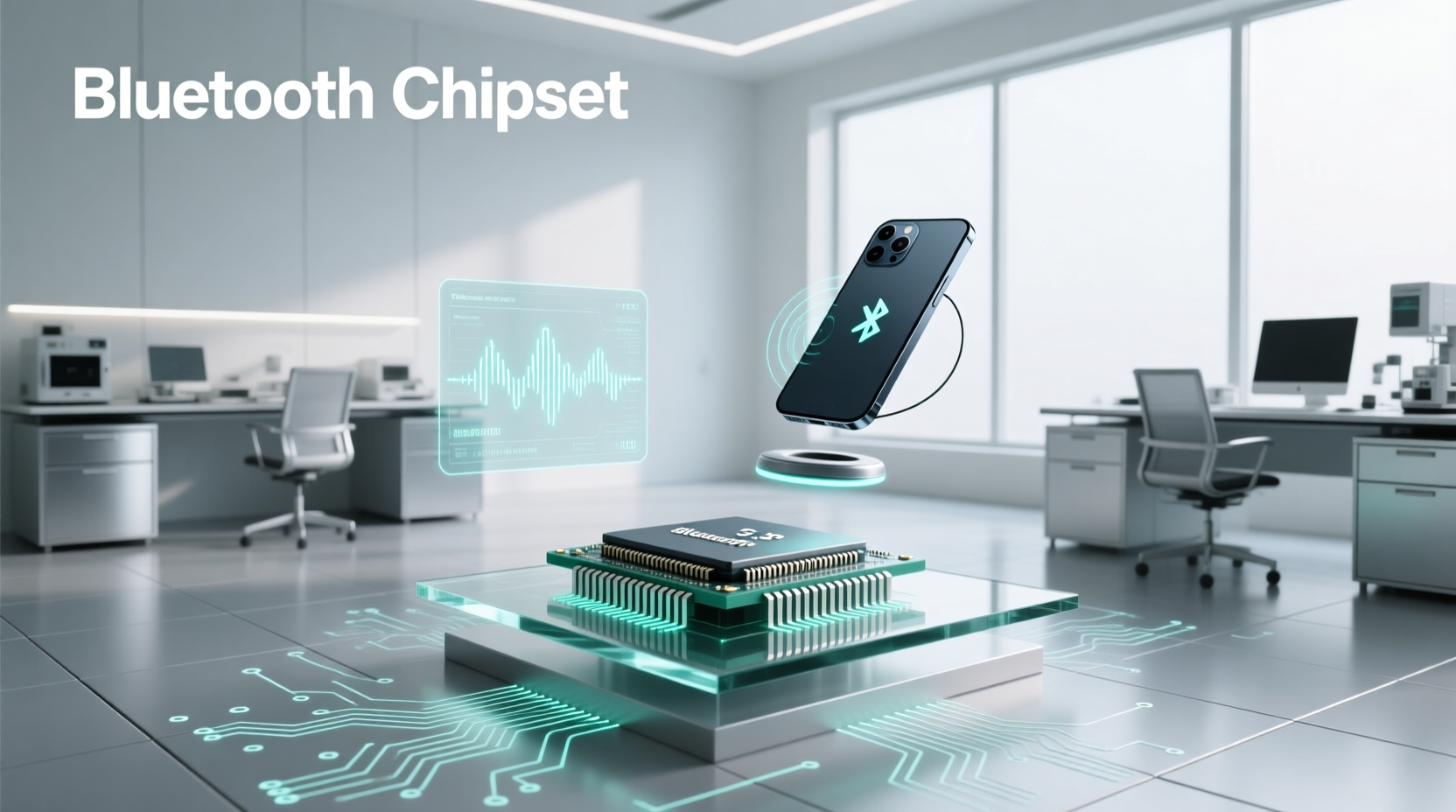
When you search for bluetooth chipset, you’re likely trying to understand what’s inside your wireless earbuds, smartwatch, USB adapter, or custom PCB—not just buy a part. A bluetooth chipset is the foundational integrated circuit (IC) that handles both the radio-frequency (RF) transmission and the baseband protocol stack—enabling two-way, low-power, short-range communication in the 2.4 GHz ISM band1. Unlike plug-and-play modules or dongles, chipsets are bare ICs—designed for engineers, OEMs, and advanced hobbyists integrating Bluetooth at the silicon level. Whether you’re evaluating chips for medical sensors, audio streaming, or industrial telemetry, key differentiators include Bluetooth version (e.g., 5.3 vs. 5.4), dual-mode (BR/EDR + BLE) support, power efficiency (measured in μA/MHz), built-in security (e.g., hardware root-of-trust), and integration level (standalone controller vs. full System-on-Chip with MCU, memory, and DSP). This guide cuts through marketing claims to help you compare chipsets objectively—based on datasheet facts, not vendor slides.
What Exactly Is a Bluetooth Chipset? (Not a Module, Not a Dongle)
A bluetooth chipset refers specifically to the core semiconductor die—the physical silicon IC—that implements the Bluetooth specification at the hardware level. It typically includes:
- RF transceiver: Handles analog signal modulation/demodulation and antenna interface
- Baseband controller: Executes link-layer logic (e.g., packet formatting, error correction, frequency hopping)
- Protocol stack processor (in SoCs): Runs host-side software (HCI, L2CAP, ATT, GAP/GATT) or offloads it to an external MCU
- Optional peripherals: ADCs, GPIOs, crypto accelerators, USB/UART/SPI interfaces
This is distinct from a bluetooth module (a pre-certified PCB with chipset + crystal + antenna + passive components) or a bluetooth adapter (a complete USB or PCIe product ready for end users)2. If you're sourcing for mass production, certification timelines, or ultra-low-power design, you need chipset-level insight—not retail packaging.
Why Chipset Choice Matters More Than You Think
Many assume Bluetooth is commoditized—“it just works.” But chipset selection directly impacts five non-negotiable engineering outcomes:
- Battery life: BLE chipsets like Nordic’s nRF54L series achieve sub-1 μA deep-sleep current; older chips draw 2–5× more, cutting wearable runtime by weeks3.
- Audio latency & fidelity: Qualcomm’s QCC3031 integrates aptX Adaptive and dual-mic ANC processing on-die—whereas generic BLE SoCs require external DSPs and introduce 50–100 ms added delay.
- Regulatory compliance cost: Chipsets with pre-certified RF layouts (e.g., Silicon Labs’ EFR32BG26) reduce FCC/CE testing time by 6–8 weeks versus discrete RF designs.
- Security posture: Hardware-enforced secure boot (e.g., Silicon Labs Secure Vault) prevents firmware tampering—a critical requirement for HIPAA-compliant medical sensors.
- Development velocity: SoCs with integrated Arm Cortex-M cores (e.g., STMicro BLUENRG-232) eliminate external MCU bring-up; bare controllers (e.g., TI CC2564) require full stack porting.
Main Types of Bluetooth Chipsets (and When to Use Each)
Chipsets fall into three functional categories—each suited to specific design constraints:
1. Standalone Baseband Controllers 🧠
Examples: Texas Instruments CC2564C, Broadcom BCM20736S
Best for: Cost-sensitive, high-volume products where the main MCU already handles application logic and protocol stack.
Trade-offs: Requires external flash/RAM, RF layout expertise, full Bluetooth SIG qualification, longer time-to-market. Suitable for teams with dedicated RF engineering resources.
2. Bluetooth SoCs (System-on-Chip) ⚙️
Examples: Nordic nRF52840, Silicon Labs EFR32BG26, ST BLUENRG-232
Best for: Most new embedded designs—especially battery-powered IoT, wearables, and smart home sensors.
Advantages: Integrated MCU (Arm Cortex-M), flash, RAM, and RF in one package. Many include hardware crypto engines and sleep modes under 1 μA. Pre-qualified RF sections simplify PCB design.
Key spec to verify: Does the SoC support concurrent multi-role operation (e.g., acting as both central and peripheral)? Not all do—critical for mesh gateways or dual-mode beacons.
3. Audio-Dedicated SoCs 🔊
Examples: Qualcomm QCC3031/QCC5141, WUQI Micro WQ7033, NXP NXH3675
Best for: Wireless speakers, TWS earbuds, hearing aids, and automotive infotainment.
Differentiators: On-chip audio codecs (aptX, LDAC, LC3), dedicated DSP for ANC/beamforming, I²S/TDM/SLIMbus interfaces, and LE Audio support (including Auracast broadcast). Designed for real-time audio applications requiring stable clock recovery and low-latency buffers.
Bluetooth Version & Protocol Support: Beyond the Marketing Number
“Bluetooth 5.4” on a datasheet doesn’t guarantee equal capability across vendors. Here’s what to inspect:
| Feature | Bluetooth 5.0 | Bluetooth 5.3 | Bluetooth 5.4 | What It Actually Means for Designers |
|---|---|---|---|---|
| LE Audio support | No | LC3 codec only | Full Auracast™ broadcast, multi-stream sync, broadcast encryption | If building public-address or assistive listening systems, 5.4 is mandatory. 5.3 suffices for basic stereo headphones. |
| Connection Subrating | No | Yes | Enhanced (lower latency, better coexistence) | Reduces average current in periodic sensor reads—extends coin-cell life by ~30% over 5.0. |
| PACS/ASE support | No | Yes | Yes (with improved robustness) | Required for interoperable LE Audio device configuration—verify SIG listing status before finalizing BOM. |
| Periodic Advertising Sync Transfer (PAST) | No | No | Yes | Enables seamless handoff between scanners—critical for asset tracking in dense environments. |
Always cross-check with the Bluetooth SIG official specifications—not vendor summaries. Versions matter most when interoperability is required (e.g., healthcare devices certified to ISO/IEC 11073).
Power Consumption: The Real-World Metric That Defines Usability
Manufacturers often quote “0.5 μA deep sleep”—but that’s meaningless without context. Ask:
- What peripherals remain active? Does the spec assume RTC + GPIO wakeup only—or also ADC sampling every 10 seconds?
- What voltage range? Current doubles when operating at 1.7 V vs. 3.0 V. Verify test conditions match your battery discharge curve.
- Is it measured with or without flash retention? Retaining 256 KB of firmware in RAM during sleep adds ~3 μA—often omitted from headline numbers.
For comparison: Nordic’s nRF54L achieves 0.7 μA in System OFF mode *with* RAM retention and GPIO wakeup; Silicon Labs EFR32BG26 is 1.2 μA under identical conditions3. That 0.5 μA difference translates to ~9 months of extra runtime on a CR2032 cell.
Security: Why Hardware Root-of-Trust Isn’t Optional Anymore
With Bluetooth-enabled medical devices and industrial controllers, firmware integrity is non-negotiable. Chipsets vary widely in security architecture:
- Software-only secure boot (e.g., early nRF52): Designed for development flexibility; production deployment requires fuse configuration for enhanced protection.
- Hardware-locked debug access (e.g., nRF5340, EFR32BG26): JTAG/SWD disabled after first boot unless cryptographically signed command is issued—providing strong defense against unauthorized access.
- Secure element co-packaged (e.g., NXP KW45B): Dedicated tamper-resistant enclave for key storage and attestation—supporting compliance with standards such as PCI PTS or FIPS 140-2 Level 3.
Verify whether the chipset supports secure firmware updates over-the-air (OTA)—not just signed images, but encrypted transport and rollback protection. These capabilities help mitigate common attack vectors in connected devices.
Audio-Specific Chipset Considerations: Latency, Codecs & ANC
Don’t assume “Bluetooth 5.0+” guarantees good audio. Critical audio-specific specs:
- End-to-end latency: Measured from source PCM input to analog output. QCC3031 achieves ≤70 ms (aptX Adaptive); generic BLE SoCs with software audio stacks exceed 200 ms—unusable for video sync.
- Codec support matrix: aptX HD requires licensed IP; LC3 (LE Audio) is royalty-free but needs SIG certification. LDAC support demands >1 Mbps bandwidth—only viable on 5.2+ with LE Isochronous Channels.
- ANC processing capability: Hybrid FF+FB (feedforward + feedback) requires dual ADC inputs and real-time DSP. WUQI WQ7033 integrates RISC-V CPUs + NPU for this; many SoCs offer flexible integration paths for ANC subsystems.
For true wireless stereo (TWS), verify ear-to-ear synchronization support—some chipsets support industry-standard protocols, while others provide optimized proprietary implementations for enhanced performance within compatible ecosystems.
How to Choose the Right Bluetooth Chipset: A Step-by-Step Decision Framework
Follow this objective checklist before selecting:
- Define your primary use case: Is it data telemetry (BLE only), voice streaming (BR/EDR + LE), or multi-channel audio (LE Audio)? Eliminates 60% of irrelevant options.
- Check regulatory deadlines: FCC ID submission requires full RF test reports. Chipsets with pre-certified reference designs (e.g., Silabs BGM220 modules) cut approval time from 12 to 4 weeks.
- Validate toolchain maturity: Does the vendor provide production-ready SDKs (not just evaluation demos)? Are there known issues with Zephyr RTOS or FreeRTOS porting?
- Review long-term availability: Check product longevity statements. Nordic guarantees 10+ years for nRF52; many established vendors offer extended supply commitments for industrial-grade parts.
- Calculate total BOM cost: A $1.20 chipset may require $0.80 in external components (crystal, balun, flash) and $15k in RF validation—versus a $2.50 SoC with integrated RF and pre-certified layout.
Common Misconceptions About Bluetooth Chipsets
- “Higher Bluetooth version = better range”: Range depends on antenna design, output power (dBm), and sensitivity—not version number. A Bluetooth 4.2 chip with +10 dBm output outperforms a 5.4 chip at +4 dBm.
- “All BLE chipsets support mesh networking”: Only chipsets with sufficient RAM (>64 KB) and flash (>512 KB) can run Bluetooth Mesh stack. nRF52833 qualifies; nRF52810 does not.
- “USB Bluetooth adapters use ‘chipsets’ you can upgrade”: These contain sealed modules—not field-replaceable ICs. Driver updates affect host stack, not the underlying radio.
- “Open CPU modules are more flexible”: They offer design flexibility and are commonly used in prototyping and certain commercial applications where customization is prioritized alongside appropriate engineering validation.
Frequently Asked Questions (FAQ)
Q: Can I replace the Bluetooth chipset in my laptop or smartphone?
A: No. Consumer devices use permanently soldered, multi-die packages (e.g., Wi-Fi + Bluetooth combo chips like Broadcom BCM4390). Physical replacement is technically infeasible and voids warranty.
Q: What’s the difference between a Bluetooth chipset and a Bluetooth module?
A: A chipset is the raw silicon IC; a module integrates that IC with antenna, crystal, passives, and shielding on a PCB—and carries FCC/CE certification. Modules save 6–12 months of RF validation.
Q: Do I need Bluetooth SIG qualification if I use a pre-certified chipset?
A: Yes. Chipset certification covers only the radio subsystem. Your final product must undergo end-product testing (radiated emissions, SAR, interoperability) under your own FCC ID.
Q: How do I evaluate Bluetooth chipsets from various suppliers for commercial use?
A: Consider documentation completeness, long-term supply commitments, security features, ecosystem support (SDKs, tools, community), and alignment with your target certifications (e.g., FCC, CE, HIPAA, ISO 13485). Many suppliers offer evaluation kits and technical support to assist in early-stage validation.
Q: How do I verify Bluetooth 5.3 or 5.4 compliance?
A: Check the Bluetooth SIG Qualification Listing Database for the exact part number—not just the family name. Only listed products have passed interoperability testing.
