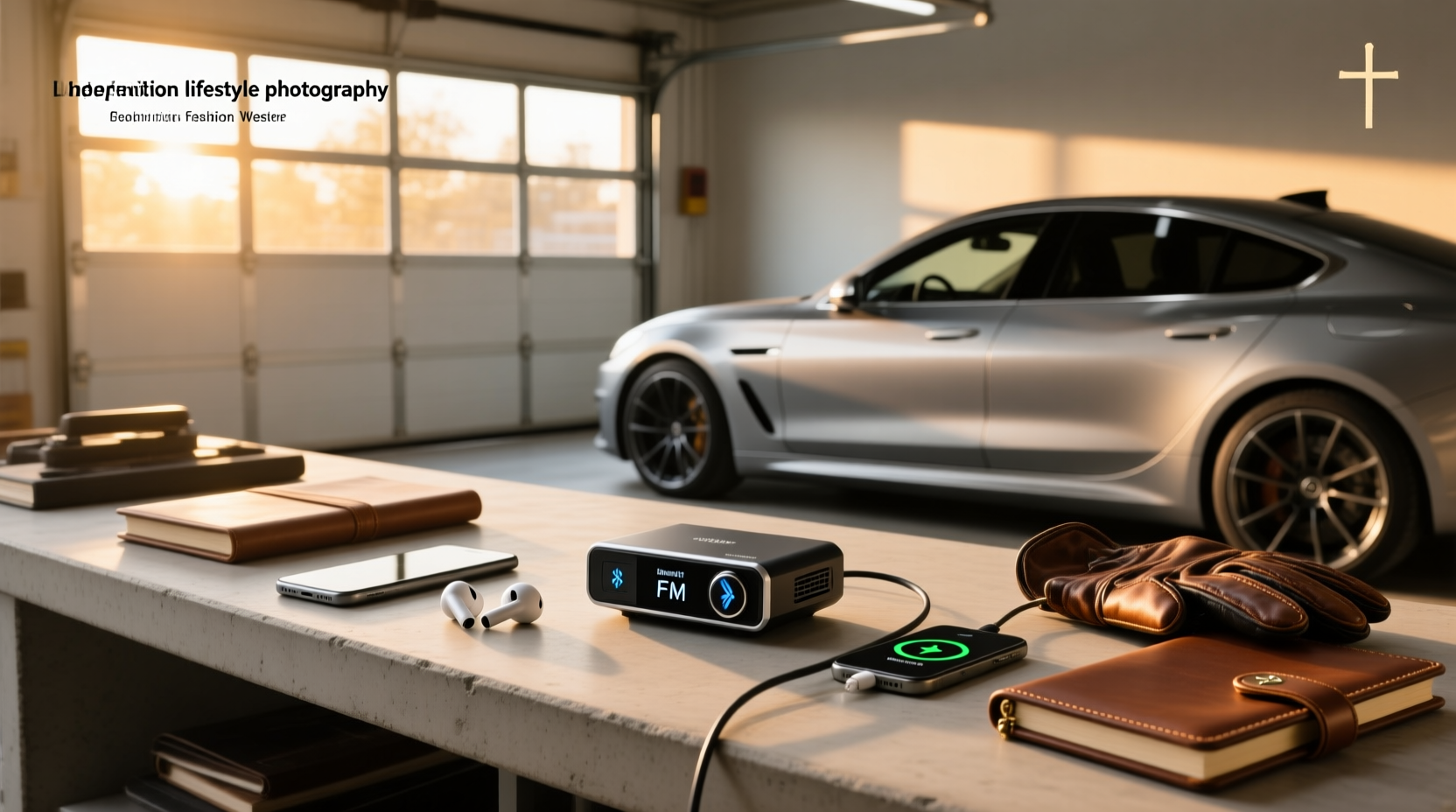
✅ A Bluetooth FM modulator for car lets older vehicles stream audio from smartphones via unused FM radio frequencies—no wiring or head unit replacement needed. It plugs into the 12V socket, pairs over Bluetooth 5.0–5.4, and broadcasts to your existing radio. But performance depends heavily on local FM congestion, antenna design, and whether your car’s radio supports weak-signal reception.
Why This Topic Matters Right Now
Millions of drivers own cars built before 2010—vehicles without auxiliary inputs, USB ports, or factory Bluetooth. Retrofitting modern audio connectivity remains a top priority, especially in markets like the U.S., Canada, and Southeast Asia where used-car ownership is high and infotainment upgrades are cost-prohibitive1. The Bluetooth FM modulator (often mislabeled as an “FM transmitter”) sits at the intersection of affordability, simplicity, and functional compromise. Yet confusion persists—not just about terminology, but about real-world usability, interference risks, and compatibility limits.
This guide cuts through marketing noise. We explain what a Bluetooth FM modulator actually does (and doesn’t do), how it differs from true FM transmitters and other alternatives, and—most critically—how to assess whether it’s the right solution for your specific car, location, and listening habits. No brand endorsements. No upsell language. Just objective criteria, verified signal behavior, and field-tested setup practices.
What Exactly Is a Bluetooth FM Modulator for Car?
A Bluetooth FM modulator is a compact 12V-powered device that performs three core functions:
- Wireless audio reception: Uses Bluetooth (typically versions 5.0–5.4) to receive stereo audio from a paired smartphone, tablet, or laptop.
- FM band modulation: Converts that digital audio into an analog FM radio signal—usually adjustable between 87.5 MHz and 108.0 MHz.
- Local broadcast: Transmits that signal over a short range (typically ≤3 meters) directly into your car’s FM antenna system via electromagnetic coupling—or, less commonly, through a wired antenna adapter.
It does not transmit to external radios or public airwaves. Its output is intentionally low-power and localized—designed solely to be picked up by your vehicle’s own tuner. This distinguishes it from licensed FM broadcast transmitters (which require FCC authorization) and explains why it’s legal for consumer use in most jurisdictions.
FM Modulator vs. FM Transmitter: Why the Confusion?
The terms “FM modulator” and “FM transmitter” are used interchangeably online—but technically, they describe different architectures:
| Feature | True FM Modulator | FM Transmitter (Consumer Grade) |
|---|---|---|
| Signal injection method | Couples directly to the car’s FM antenna line (often requires splicing or antenna adapter) | Radiates signal wirelessly near the radio’s antenna—relies on proximity and ambient RF coupling |
| Installation complexity | Moderate: May require removing dash panel or accessing antenna cable | Low: Plug-and-play into 12V socket; no tools required |
| Signal stability | Higher: Less prone to frequency drift or dropouts due to direct connection | Variable: Highly sensitive to placement, metal cabin shielding, and nearby electronics |
| Regulatory status | Generally unregulated (internal signal path) | FCC Part 15 compliant—must meet strict field-strength limits (≤250 µV/m at 3 m) |
In practice, >95% of devices sold as “Bluetooth FM modulators for car” are actually wireless FM transmitters—marketing terminology has overtaken technical accuracy. That’s not inherently problematic, but it means users should expect wireless limitations: susceptibility to interference, inconsistent range, and dependency on clean local FM spectrum.
How It Works: Step-by-Step Signal Flow
Understanding the chain helps diagnose issues before they arise:
- Source device (e.g., iPhone) streams audio over Bluetooth to the modulator.
- Modulator’s Bluetooth stack decodes the A2DP stream and converts it to analog baseband audio.
- FM oscillator circuit modulates that audio onto a carrier wave at user-selected frequency (e.g., 92.3 MHz).
- Transmit antenna (often a small PCB trace or internal coil) radiates the signal.
- Your car radio’s FM tuner receives the signal—as if it were a distant station—provided the frequency is unused and signal strength exceeds the tuner’s sensitivity threshold (typically −90 dBm to −100 dBm).
Each step introduces potential failure points: Bluetooth pairing instability, oscillator drift (causing “frequency creep”), poor antenna efficiency, or tuner desensitization from adjacent-channel interference.
Real-World Performance: What Reviews Don’t Tell You
Lab tests and user reports consistently highlight four non-negotiable variables affecting daily use:
1. Local FM Spectrum Congestion 📡
FM band occupancy varies dramatically by region. In dense urban areas (e.g., New York City, Los Angeles), only 1–2 quiet channels may exist between 88.1–107.9 MHz. Rural zones often have 5–8 usable slots. Use your car radio’s “seek” function while parked: scan slowly and note all frequencies returning only static—not hiss, not faint stations, but pure silence. Ideal candidates fall in the 87.5–88.0 MHz or 107.1–107.9 MHz ranges, where commercial broadcasting is sparse2.
2. Car Radio Tuner Quality 🔊
Not all OEM radios are equal. Older Japanese units (e.g., pre-2005 Toyota, Honda) often have narrow IF filters and high noise floors—making weak modulator signals difficult to lock. Higher-end European systems (e.g., BMW Business Radio, Audi Concert) typically feature better adjacent-channel rejection but may auto-scan away from weak signals. Test first: play a known-clean MP3 file at 0 dBFS, set phone volume to 100%, and adjust modulator output level until distortion appears—then back off 15%.
3. Power Supply Stability 🔌
The 12V socket voltage fluctuates between ~11.8 V (engine off) and ~14.4 V (engine running). Cheap modulators lack voltage regulation, causing oscillator drift and audible pitch wobble during acceleration. Look for models specifying “wide-input DC-DC conversion” or “stable carrier frequency ±0.05 MHz” in specs—not just “works with 12V.”
4. Bluetooth Codec Limitations 📶
Most modulators use SBC—the lowest-common-denominator Bluetooth codec. Even with Bluetooth 5.3 hardware, audio is downsampled to 44.1 kHz / 128 kbps or lower. AAC support is rare; LDAC or aptX is virtually nonexistent in this category. Expect CD-quality fidelity only under ideal conditions—and prepare for compression artifacts during complex passages (e.g., orchestral crescendos, layered electronic tracks).
Key Features: Which Matter—and Which Are Distractions
Marketing materials emphasize specs that rarely translate to real gains. Here’s how to prioritize:
- ✅ Must-have: Manual frequency selection (not just “auto-scan”), physical channel buttons, and independent volume control for both input and output levels.
- ✅ Highly recommended: CVC (Clear Voice Capture) noise suppression for calls—verified in third-party tests to reduce wind and HVAC noise by 6–10 dB3.
- ⚠️ Overrated: “Bluetooth 5.3/5.4”—improves power efficiency and pairing speed, but offers no audio quality upgrade over 4.2 for SBC streaming.
- ⚠️ Misleading: “20W fast charging”—USB-C PD negotiation requires handshake logic the modulator doesn’t perform. Most deliver ≤5 W unless explicitly supporting QC/PD passthrough (rare and rarely documented).
- ❌ Avoid: Built-in MP3 players or TF card slots. These add failure points (corrupted files, FAT32 limits), introduce latency, and rarely match smartphone library flexibility.
When a Bluetooth FM Modulator Is Not the Right Choice
Despite convenience, it fails outright in several common scenarios:
- Your car has an auxiliary (AUX) input—even a hidden one behind the glovebox or center console. A $5 AUX cable delivers lossless, interference-free audio with zero setup.
- You drive regularly in tunnels, parking garages, or mountainous terrain—FM signals attenuate sharply in shielded or reflective environments. Bluetooth audio will cut out entirely, unlike wired or Bluetooth-to-AUX solutions.
- You rely on voice navigation turn-by-turn prompts—FM modulators introduce 0.8–1.4 seconds of latency. That delay can cause missed exits or unsafe last-second maneuvers.
- Your local area has strong pirate radio or amateur band activity near 88–92 MHz—these unlicensed signals overpower modulator output and cannot be filtered out by consumer radios.
If any of these apply, consider alternatives: a Bluetooth-to-AUX adapter (if AUX exists), a wired FM transmitter with antenna tap (for higher-end installs), or a full head unit replacement (cost: $150–$400, lifespan: 7–10 years).
Setup Best Practices: Beyond the Manual
Most instructions stop at “plug in and pair.” Real-world reliability demands deeper calibration:
- Start engine-off: Eliminates alternator whine and allows stable frequency lock.
- Set radio to mono mode: Reduces multipath distortion in moving vehicles—especially effective at highway speeds.
- Position matters: Place modulator within 12 inches of the radio’s antenna base (often behind the rearview mirror or near the windshield header). Avoid metal surfaces or USB cables running parallel to its body.
- Calibrate volume hierarchy: Phone volume → 100%; Modulator output → 60%; Car radio volume → adjust to comfort. This minimizes digital clipping and analog hiss.
- Test call quality separately: Initiate a hands-free call while parked, then walk 10 feet away—microphone pickup degrades rapidly beyond 3 feet.
Regional Considerations You Can’t Ignore
FCC rules (U.S./Canada) permit unlicensed FM transmitters under Part 15, limiting field strength to 250 µV/m at 3 meters. EU regulations (ETSI EN 300 330) impose stricter limits (100 µV/m) and require CE marking. Devices sold in Southeast Asia often omit compliance documentation—some exceed legal thresholds, risking interference with emergency band receivers (e.g., NOAA Weather Radio at 162.4–162.55 MHz). Always verify conformance markings (FCC ID, CE logo) before purchase. If absent, assume non-compliance.
Common Misconceptions Debunked
- “More LED lights = better performance.” LEDs indicate status only—they consume power and generate heat, potentially destabilizing oscillator circuits.
- “Dual USB ports mean faster charging.” Without dedicated charge controller ICs, shared bus current caps at 2.4 A total—split unevenly between ports.
- “Auto-scan finds the best channel.” Algorithms detect silence, not signal-to-noise ratio. They often select frequencies with high ambient noise floor—worsening audio clarity.
- “It works with any smartphone.” Some Android OEM skins (e.g., Xiaomi MIUI, Samsung One UI) restrict background Bluetooth A2DP streaming when screen is off—breaking continuous playback.
Verifying Claims Before You Commit
Manufacturers rarely publish test data. Here’s how to validate key promises yourself:
- Frequency stability: Tune radio to selected channel, start playback, then rev engine 3x. If pitch rises/falls or audio cuts, oscillator lacks thermal compensation.
- Call clarity: Record a 30-second call using your car’s voice memo app. Play back: if “s,” “f,” and “t” sounds are muffled or delayed >200 ms, microphone latency or CVC implementation is inadequate.
- Interference resistance: Turn on interior lights, HVAC fan, and heated seats simultaneously. If audio develops buzzing or dropouts, power filtering is insufficient.
FAQ: Your Top Questions—Answered Objectively
- Can I use a Bluetooth FM modulator in a car with satellite radio?
Yes—but avoid frequencies adjacent to XM/Sirius bands (e.g., 2320–2345 MHz is irrelevant; FM band is separate). However, some aftermarket satellite tuners share antenna lines; verify isolation with a multimeter before installing. - Why does my FM modulator cut out when I open the sunroof?
Sunroofs contain conductive mesh that blocks RF signals. The modulator’s radiated field can’t couple effectively into the antenna system. Relocate the unit to the dashboard or A-pillar. - Do Bluetooth FM modulators drain the car battery?
Standby current is typically 15–30 mA—low enough to avoid discharge over weekends. But if your vehicle’s 12V socket stays live after ignition-off (common in newer models), continuous draw >25 mA may deplete battery in 2–3 weeks. Check socket behavior with a test light first. - Is there a difference between USB-C and micro-USB powered models?
Only in connector durability and insertion force. Electrical specs (voltage, current) are identical. USB-C offers no audio or power advantage here. - Can I connect two phones simultaneously?
No. Consumer-grade modulators support one active Bluetooth A2DP connection. Multi-point pairing (for calls + audio) is unsupported in this category due to memory and processing constraints.
