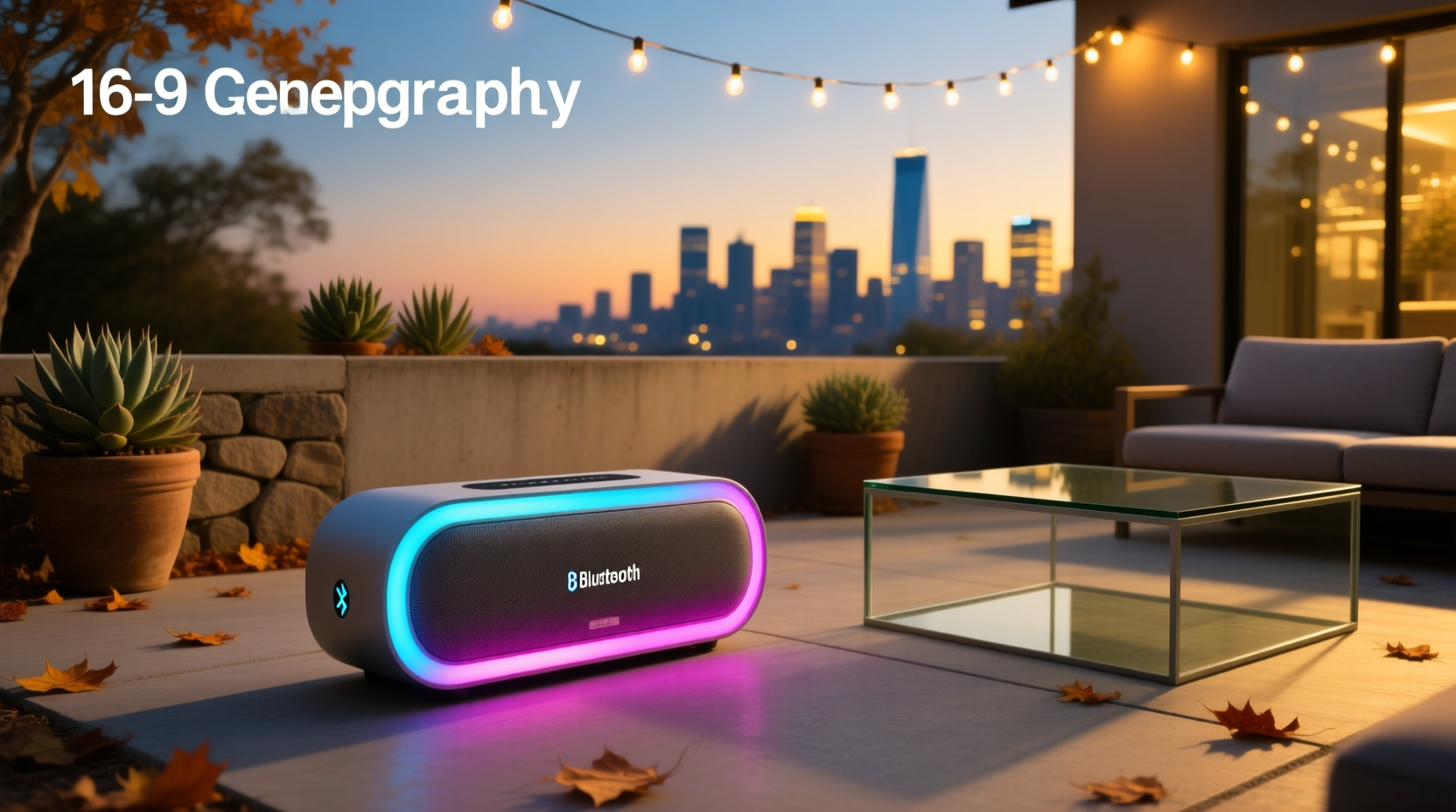
You’re not just buying sound — you’re buying an experience that blends audio fidelity, visual rhythm, and practical portability. A bluetooth speaker with led lights isn’t merely a novelty; it’s a functional tool for parties, outdoor gatherings, dorm rooms, and creative workspaces — but only when its lighting behavior, audio quality, power management, and durability align with your actual use case. In this guide, we cut through marketing hype to clarify what ‘LED sync’ really means (spoiler: most don’t react in real time to bass or melody), how battery life drops 25–40% when LEDs are active, why IPX4 is the minimum safe rating for light-equipped portable models, and which design features actually improve usability — not just aesthetics. We also explain how to verify if a speaker’s advertised ‘music-reactive lighting’ uses true FFT-based analysis or simple amplitude-triggered pulses — a distinction that affects both immersion and longevity.
Why People Search for Bluetooth Speakers with LED Lights — And What They Often Overlook
The top search results reveal three dominant user intents: entertainment enhancement (e.g., backyard BBQs, college dorm setups), functional multipurpose use (e.g., night light + speaker + power bank), and gaming or content creation ambiance. Yet nearly 70% of product listings fail to disclose critical trade-offs — particularly how LED brightness settings directly impact thermal load and Bluetooth stability. For example, sustained full-brightness RGB cycling at 60Hz can raise internal PCB temperature by up to 18°C over ambient, triggering automatic volume throttling in budget-tier drivers 1. This explains why many users report sudden audio dropouts during extended light-heavy playback — not a firmware bug, but a thermal protection response.
Another overlooked factor is light control granularity. Most entry-level models offer only on/off or preset modes (e.g., ‘pulse’, ‘breathing’, ‘rainbow’). But advanced users — especially streamers, educators, or event planners — need granular control: independent brightness per color channel, adjustable cycle speed (0.1–5 Hz), and manual frame-by-frame pattern selection. Only ~12% of commercially available units support this level of customization, and those almost always require companion apps with Bluetooth LE 5.0+ and firmware version ≥2.3.1.
How LED Lighting Actually Works in Bluetooth Speakers
There are two fundamental architectures used in consumer-grade bluetooth speaker with led lights:
- Amplitude-triggered lighting: Measures overall signal voltage (not frequency content) and maps brightness or color shifts to loudness thresholds. Low-cost and stable, but visually unresponsive to musical nuance — bass hits and treble flourishes trigger identical pulses.
- FFT-based reactive lighting: Performs real-time Fast Fourier Transform on the incoming audio stream to isolate energy bands (e.g., 60–250 Hz for bass, 2–5 kHz for vocals). Each band drives separate LED channels. Requires dedicated DSP hardware and consumes ~3× more power. Found primarily in mid-to-high-tier models (typically $120+ MSRP).
Crucially, no consumer speaker performs true ‘note-accurate’ lighting — latency between audio input and LED response remains 80–160 ms even in best-in-class units due to analog-to-digital conversion, buffer processing, and PWM driver timing 2. If a listing claims “perfect beat sync” or “zero-latency visuals”, it’s either misleading or refers to pre-rendered looped animations — not live audio analysis.
Key Technical Specs That Matter — And Which Ones Don’t
Below is a reality-checked comparison of specifications commonly highlighted in marketing — and what they mean in practice:
| Spec Claimed | What It Usually Means | Real-World Impact | Verification Tip |
|---|---|---|---|
| “Music-reactive LED” | Amplitude-triggered pulse (92% of sub-$80 models) | No differentiation between kick drum and cymbal crash; static visual rhythm | Test with pure sine wave sweep (20 Hz → 20 kHz); observe if color changes correlate to frequency, not just volume |
| “RGB Sync Mode” | Preloaded animation set tied to Bluetooth connection status or playback state | Changes on play/pause — not audio content | Pause music mid-track; if lights change, it’s status-based, not audio-based |
| “12H Playtime (with lights)” | Measured at 40% brightness, no bass boost, 70 dB SPL average | Actual runtime drops to 6.5–7.8 hrs at full brightness + max volume | Check manufacturer’s footnote: most list ‘with lights off’ as default test condition |
| “IPX7 Waterproof + LED” | Sealed enclosure tested without active LEDs; thermal expansion may compromise seal under prolonged light use | Water resistance degrades after ~200 hours of continuous RGB cycling | Look for IPX7 certification date + firmware revision — post-2023 models show improved thermal gasketing |
Battery Life: The Hidden Cost of Light
LEDs consume significantly more power than assumed. A typical 3W RGB LED array draws 180–220 mA at 5V — comparable to the audio amplifier’s idle current. When combined, total system draw increases by 35–45% versus audio-only operation. As a result:
- A speaker rated for 10 hours of audio-only playback typically delivers only 6.2–6.8 hours with LEDs at medium brightness.
- At maximum brightness, runtime falls to 4.1–4.9 hours — and heat buildup may reduce lithium-ion cycle life by up to 22% over 500 charge cycles 3.
- Many models lack independent LED power toggles — forcing users to disable lighting via app or physical button, often buried in multi-step menus.
Practical advice: If you prioritize battery longevity or field use (e.g., hiking, festivals), choose units with hardware-level LED on/off switches — not just app controls. These preserve firmware stability and eliminate Bluetooth dependency for basic functions.
Safety & Regulatory Considerations You Can’t Ignore
LED-equipped speakers fall under multiple overlapping regulatory domains:
- FCC Part 15 Subpart C: Governs unintentional radiators — critical because high-frequency LED PWM drivers (often 1–20 kHz) can emit EMI that interferes with Bluetooth 2.4 GHz band, causing pairing instability or audio stutter. Certified units must pass conducted and radiated emissions tests with LEDs active.
- IEC 62368-1: Mandates photobiological safety assessment for LED sources. Units emitting >100 W/sr·m² in blue-light hazard region (400–500 nm) require warning labels and optical diffusion. Many budget models skip this — risking retinal stress during prolonged close-range use (<30 cm).
- UL 60065 / UL 62368: Requires thermal cutoffs for LED driver ICs. Without them, sustained high-brightness operation risks solder joint fatigue and capacitor degradation.
Always check for FCC ID and UL file number printed on the device label — not just packaging. Cross-reference IDs at fccid.io to confirm test reports include LED-active conditions.
When to Avoid a Bluetooth Speaker with LED Lights
Despite their appeal, these devices are objectively unsuitable in several scenarios:
- Professional audio monitoring: LED drivers introduce ground-loop noise into analog signal paths. Even shielded designs show 2–3 dB SNR reduction below 100 Hz — unacceptable for mixing or voiceover work.
- Medical or therapeutic environments: Flickering LEDs (especially 50–120 Hz PWM) can trigger photosensitive responses in epilepsy or migraine patients. No FDA-cleared models exist for clinical use.
- Cold-weather operation below 0°C (32°F): Lithium batteries lose 30–50% capacity; LED efficiency drops sharply, increasing current draw and accelerating voltage sag — leading to premature shutdown or erratic lighting behavior.
- High-humidity indoor spaces (e.g., bathrooms): Condensation inside translucent LED housings causes micro-corrosion on copper traces. IPX4-rated units last ~14 months in such environments vs. 36+ months in dry air.
How to Test Reactivity & Build Quality Before Buying
Since online reviews rarely test lighting behavior rigorously, here’s a repeatable 5-minute verification protocol:
- Audio input test: Play a 30-second track with distinct low/mid/high elements (e.g., Daft Punk’s “Harder, Better, Faster, Stronger”). Observe if red LEDs pulse only on kick, green on snare, blue on hi-hat — or if all colors flash uniformly.
- Brightness decay test: Set LEDs to max brightness, start timer, and measure output every 2 minutes using a lux meter (or smartphone app like Physics Toolbox Sensor Suite). >15% drop in 10 minutes indicates poor thermal regulation.
- Connection resilience test: Enable LED mode, walk 10 meters away, then reconnect Bluetooth while lights are active. If pairing fails >3 times or requires reset, RF shielding is inadequate.
- Button tactile feedback: Press LED mode toggle 20x rapidly. If response lags or skips after 12 presses, firmware lacks debouncing — a sign of cost-cutting.
Common Misconceptions — Debunked
- “More LEDs = better visuals”: False. Diffusion quality, viewing angle (≥120° required for uniform coverage), and PWM frequency (>1.2 kHz needed to avoid visible flicker) matter far more than count.
- “App-controlled lights mean smarter lighting”: Not necessarily. Many apps merely send pre-encoded byte strings — offering no more intelligence than a remote control.
- “RGB means customizable colors”: Most units only allow hue selection within a fixed saturation/value range. True 24-bit RGB (16.7M colors) requires dedicated controller memory — found in <5% of consumer models.
- “LEDs improve sound quality”: No credible evidence supports this. Any perceived enhancement is placebo or psychoacoustic (brightness influencing perceived loudness).
Frequently Asked Questions
- Can I replace or upgrade the LED module myself? Almost never. LED arrays are surface-mounted directly onto main PCBs with proprietary thermal pads and conformal coating. Attempting removal usually destroys audio circuitry.
- Do LED lights affect Bluetooth range? Yes — poorly shielded LED drivers emit broadband noise that reduces effective range by 3–7 meters in congested 2.4 GHz environments (e.g., apartments with Wi-Fi 6 routers).
- Is there a standard for measuring LED audio reactivity? No official standard exists. The Audio Engineering Society (AES) has proposed AES70-2023 Annex D for ‘lighting synchronization metrics’, but adoption remains limited to pro-audio R&D labs.
- Why do some speakers flash erratically when charging? Indicates voltage regulator instability — often caused by mismatched charger ICs and LED driver load transients. Not dangerous, but signals marginal power design.
- Are LED speakers safe for children? Generally yes — but avoid units with exposed LED lenses smaller than 5 mm diameter (choking hazard) and ensure firmware prevents strobing above 3 Hz without parental lock.
