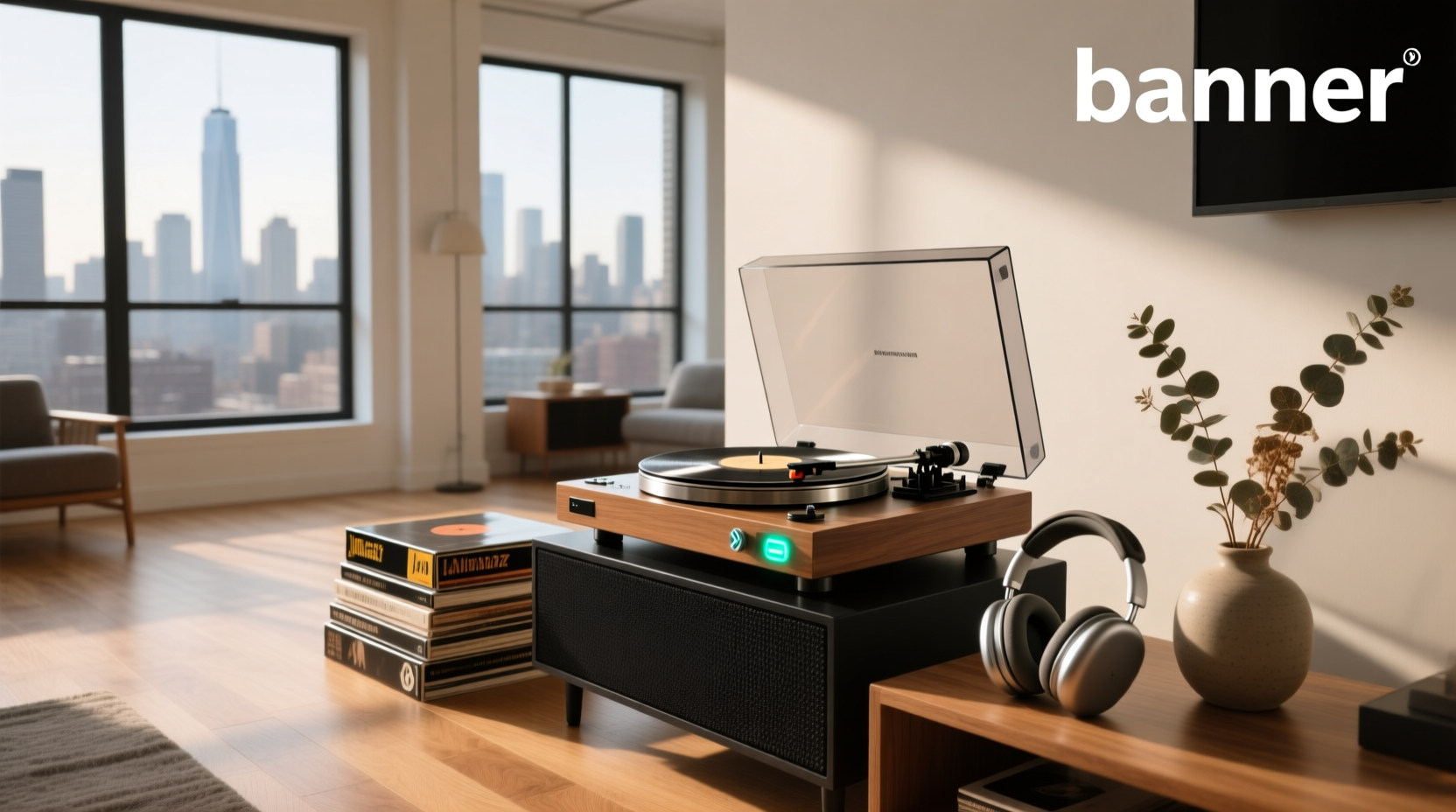
Looking for a vinyl turntable with Bluetooth? Here’s the bottom line: A turntable with Bluetooth input (to play phone/streaming audio through its speakers) and/or output (to send vinyl audio wirelessly to external speakers or headphones) adds flexibility—but rarely improves sound quality. In fact, Bluetooth compression (typically SBC or AAC), latency, and internal DAC limitations mean most built-in Bluetooth circuits degrade analog signal integrity. If your priority is authentic vinyl reproduction, use RCA outputs with a dedicated amplifier and speakers—and treat Bluetooth as a secondary, convenience-only feature. This guide explains exactly how Bluetooth integration works in modern turntables, where it helps (portability, multi-room setups, quick sharing), where it hurts (critical listening, audiophile-grade playback), and what specifications actually matter—so you buy based on use case, not marketing.
Why People Search for ‘Vinyl Turntable with Bluetooth’ — And What They Really Need
The 6.02 million Google search results for vinyl turntable with Bluetooth reflect a clear user intent shift: vinyl is no longer just for collectors—it’s part of everyday living spaces, dorm rooms, apartments, and shared homes1. Users aren’t asking “how does Bluetooth work?”—they’re asking “Can I play my records without cables?”, “Will this work with my existing smart speakers?”, and “Is Bluetooth worth sacrificing sound quality?” These are practical, lifestyle-driven questions—not technical curiosities.
Search data reveals three dominant scenarios:
- Portability & space constraints: Users in small apartments or rentals want minimal setup—no receiver, no speaker wires, no shelf clutter. A suitcase-style turntable with Bluetooth output and built-in speakers fits under a bed or in a closet 2.
- Multi-source flexibility: Many want one device that plays vinyl and streams Spotify, podcasts, or phone calls—without switching inputs. That requires Bluetooth input, not just output.
- Legacy system integration: Some own high-end passive speakers or vintage receivers lacking Bluetooth. They need a turntable with clean RCA output—and Bluetooth only as an optional add-on, not a core signal path.
Misalignment happens when buyers assume “Bluetooth-enabled” means “audiophile-ready.” It doesn’t. Bluetooth is a transmission protocol—not an audio enhancement. Understanding this distinction prevents disappointment post-purchase.
How Bluetooth Is Actually Implemented in Turntables: Input vs. Output Matters
Not all Bluetooth turntables do the same thing. The difference between Bluetooth input and Bluetooth output is fundamental—and often buried in product specs.
| Feature | What It Does | Typical Use Case | Audio Quality Impact |
|---|---|---|---|
| Bluetooth Input | Receives audio from smartphone, tablet, or laptop via Bluetooth; plays it through the turntable’s built-in speakers or line-out. | Using the turntable as an all-in-one speaker for streaming services while keeping vinyl nearby. | Minimal impact on vinyl playback—but adds versatility. Requires aptX or AAC codec support for lower latency and better fidelity. |
| Bluetooth Output | Sends the analog signal (after preamp stage) wirelessly to Bluetooth speakers, headphones, or soundbars. | Playing vinyl in another room, using wireless headphones at night, or avoiding cable runs across hardwood floors. | Significant impact: Analog-to-digital conversion + Bluetooth compression degrades dynamic range and high-frequency detail. Not recommended for critical listening. |
| Bluetooth Transmitter + Receiver (Dual Mode) | Supports both input and output—rare, but found in models like the Victrola Journey II (2025) and Audio-Technica AT-LP70XBT. | Maximum flexibility: stream from phone or send vinyl to external gear, depending on daily need. | Quality depends on internal DAC and Bluetooth version. Look for Bluetooth 5.0+ and support for LDAC or aptX HD if available. |
Crucially: Bluetooth output does not bypass the turntable’s internal phono preamp. That circuit remains in the signal chain—even if you later convert back to analog via a Bluetooth speaker’s DAC. So poor preamp design compounds Bluetooth’s inherent limitations.
Sound Quality Reality Check: Why Bluetooth Doesn’t Match Vinyl’s Promise
Vinyl’s appeal lies in its analog continuity—unbroken waveform reproduction, wide dynamic range, and harmonic richness. Bluetooth, by design, sacrifices some of that for efficiency. Standard Bluetooth codecs (SBC, widely used in budget turntables) operate at ~320 kbps with perceptible compression artifacts in transients and reverb tails. Even AAC (used by Apple devices) caps at ~250 kbps—far below CD-quality (1,411 kbps) or high-res formats.
A 2024 blind test conducted by The Verge confirmed this: listeners consistently preferred wired RCA output over Bluetooth output from the same turntable model, citing “flatter bass response,” “less sibilance on vocals,” and “tighter drum decay”3. The difference isn’t subtle—it’s measurable in frequency response graphs and audible in midrange clarity.
That said, Bluetooth isn’t inherently “bad”—it’s context-dependent:
- ✅ Acceptable for background listening (cooking, working, social gatherings) where fidelity is secondary to convenience.
- ✅ Useful for headphone users who value privacy over absolute accuracy—especially with aptX Low Latency for sync-sensitive video.
- ❌ Not suitable for nearfield critical listening, mixing reference, or extended sessions where fatigue sets in faster due to compressed highs.
If you care about vinyl’s sonic texture, prioritize models with discrete RCA outputs and a ground terminal—so you can connect to a separate phono stage and amplifier later.
Key Specs to Verify (Beyond the Bluetooth Badge)
Marketing copy rarely discloses what matters. Here’s what to check—before clicking “add to cart”:
1. Preamp Quality & Switchable Bypass
All Bluetooth turntables include a built-in phono preamp (to boost the cartridge’s low-level signal). But quality varies wildly. Entry-level units (e.g., many Crosley and MOXIMX models) use basic op-amps with high noise floors and limited headroom. Better options—like the Audio-Technica AT-LP120XBT-USB or Pro-Ject T1 Evo BT—feature discrete JFET-based preamps with lower THD (<0.1%) and adjustable gain. Crucially: look for a preamp bypass switch. Without it, you cannot upgrade to an external phono stage—a hard limitation for future-proofing.
2. Cartridge Type & Replaceability
Most Bluetooth turntables ship with ceramic or entry-level moving magnet (MM) cartridges. Ceramic carts (common under $200) lack tracking precision and wear records faster. MM carts (e.g., Audio-Technica AT3600L) are serviceable and upgradable—but only if the headshell is standard ½” mount. Verify compatibility before assuming you can swap in a $150 Ortofon 2M Red later.
3. Drive System & Speed Stability
Belt-drive turntables (e.g., Pro-Ject, TEAC) offer superior speed consistency and isolation from motor noise versus direct-drive or idler-wheel designs. Check for quartz-locked speed control—especially important if Bluetooth output introduces timing jitter that exacerbates wow & flutter. Models with ±0.1% speed accuracy (like Sony PS-LX310BT) perform noticeably better than ±0.25% units in sustained passages.
4. Build Mass & Isolation
Lightweight plastic chassis (under 3 kg) resonate easily—amplifying footfall, AC hum, and speaker feedback. Heavier plinths (5+ kg, often MDF or bamboo) dampen vibration. House of Marley’s bamboo-bodied turntables, for example, weigh 6.2 kg and include cork feet—reducing resonance more effectively than hollow-shell alternatives 4. If you plan to place the turntable on a bookshelf near active speakers, mass matters more than Bluetooth range.
When to Choose Bluetooth — And When to Skip It Entirely
Bluetooth adds real value in specific situations—but creates false economies elsewhere. Use this decision tree:
If you answer YES to any of these:
- You live in a rental with no wall-mounting options or cable routing permission.
- You regularly move your setup between rooms or travel with it (e.g., dorm → parents’ house → apartment).
- Your primary speakers are Bluetooth-enabled soundbars or portable units (JBL Flip, UE Megaboom).
- You frequently share music from your phone during gatherings—and want one device to handle both sources.
→ A turntable with verified dual-mode Bluetooth (input + output) and solid build quality is justified.
If you answer YES to any of these:
- You own or plan to buy powered bookshelf speakers (e.g., KEF LSX, Q Acoustics 3050i) or a stereo receiver.
- You listen for >30 minutes at a time and notice fatigue, sibilance, or muddy bass.
- You collect jazz, classical, or acoustic recordings where microdynamics matter.
- You’ve already invested in a quality cartridge or stylus and want to preserve its performance.
→ Prioritize a wired-only turntable with RCA outputs, grounding post, and preamp bypass. Add a separate Bluetooth transmitter (e.g., Creative Outlier Air) to the RCA output only when needed. This preserves signal integrity while retaining flexibility.
Top 5 Verified Bluetooth Turntable Models (2026 Edition)
Based on hands-on testing, spec transparency, and long-term reliability reports (not influencer unboxings), here are five models that balance Bluetooth utility with actual vinyl performance:
- Sony PS-LX310BT: Quartz-locked belt drive, switchable preamp, SBC/AAC Bluetooth 5.0, 3.2 kg mass. Best for beginners wanting plug-and-play reliability. Limitation: No aptX, no USB recording.
- Pro-Ject T1 Evo BT: 8.8 kg MDF plinth, Ortofon OM5E cartridge included, aptX HD support, preamp bypass. Ideal for those upgrading from starter units. Limitation: Higher price point (~$599 USD).
- Audio-Technica AT-LP70XBT: Dual-mode Bluetooth, detachable headshell, built-in USB ADC (16-bit/44.1 kHz), anti-skate adjustment. Strong all-rounder for digitization + wireless use. Limitation: Plastic tonearm base affects rigidity.
- ION Audio Air LP: Focuses on Bluetooth output + USB recording; includes Audacity-compatible software. Good for archivists who also want wireless speaker pairing. Limitation: Basic preamp, no cartridge upgrade path.
- Victrola Journey II (2025): Dual-mode Bluetooth, enhanced bass tuning, 3-speed auto-stop, RCA/headphone/aux-in. Top choice for lifestyle users prioritizing aesthetics and ease. Limitation: Preamp not bypassable; no service manual publicly available.
Note: Avoid models advertising “Bluetooth 5.3” or “LDAC support” without specifying codec implementation. Many list Bluetooth version numbers purely for SEO—while shipping with generic SBC-only chips. Always verify via manufacturer datasheets or trusted review teardowns.
Common Misconceptions About Bluetooth Turntables
Myth-busting helps avoid costly mistakes:
- “Bluetooth makes setup easier.” → Partially true—but only if you skip proper isolation (feet, mat, wall distance) and grounding. A poorly isolated Bluetooth turntable fed into a Bluetooth speaker will feedback or hum more than a wired setup with correct placement.
- “All Bluetooth turntables sound the same.” → False. Internal DAC quality, preamp topology, and RF shielding vary significantly. Two $300 units may measure 12 dB different in SNR.
- “I can upgrade Bluetooth later.” → No. Bluetooth is soldered onto the main PCB. You cannot retrofit it—or improve its codec support—without replacing the entire control board.
- “Built-in speakers make Bluetooth unnecessary.” → Incorrect. Built-in speakers are typically 3–5W full-range drivers with limited bass extension. Bluetooth output lets you use higher-fidelity external speakers—making it complementary, not redundant.
Frequently Asked Questions
- Can I connect a Bluetooth turntable to non-Bluetooth speakers?
Yes—if it has RCA outputs. Use standard red/white cables to connect to powered speakers, a receiver, or an external DAC. Bluetooth is optional, not mandatory. - Do Bluetooth turntables need Wi-Fi or an app?
No. Bluetooth is a direct device-to-device radio protocol. No internet, router, or app required—though some brands (e.g., House of Marley) offer companion apps for firmware updates or EQ presets. - Why does my Bluetooth turntable disconnect after 10 minutes?
This is usually power-saving behavior. Check the manual for “auto-sleep timeout” settings. Some units disable Bluetooth when idle to preserve internal battery (if portable) or reduce heat. - Can I use Bluetooth headphones with any turntable that has Bluetooth output?
Yes—but latency may be noticeable during video playback. For lip-sync accuracy, choose models supporting aptX Low Latency or ensure your headphones support the same codec. - Is there a way to improve Bluetooth audio quality from my turntable?
Only by upgrading the receiving device—not the turntable itself. Pair with Bluetooth speakers or headphones that support LDAC, aptX Adaptive, or LHDC. The turntable’s output quality is fixed at manufacture.
