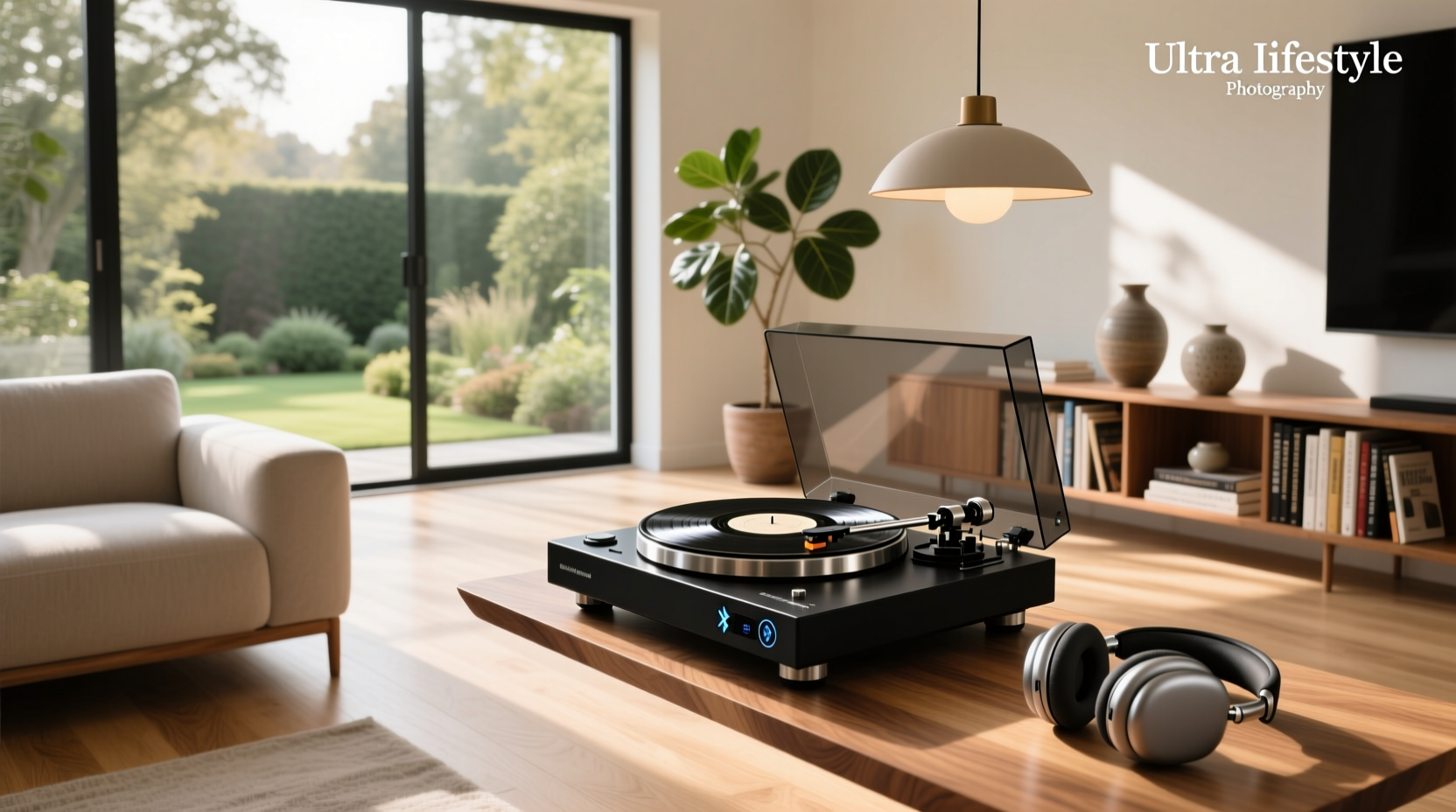
Yes, Bluetooth turntables are convenient for casual listening and space-constrained setups — but they introduce digital compression, latency, and signal degradation that undermine the core appeal of vinyl: analog warmth and detail. If your priority is authentic high-fidelity sound, a wired connection (RCA → amplifier → speakers) remains objectively superior1. However, if you value portability, quick pairing with existing Bluetooth speakers or headphones, or simplified setup in dorms, apartments, or secondary rooms, built-in Bluetooth adds real utility — provided you understand its technical trade-offs. This guide explains exactly how Bluetooth integration works in record players, which models minimize quality loss, how to verify true Bluetooth transmitter vs. receiver functionality, and whether your use case justifies the compromise.
Why People Search for ‘Turntable Record Player Bluetooth’ — And What They Really Need
The keyword turntable record player bluetooth reflects a hybrid intent: users want the tactile ritual and aesthetic of vinyl playback, but demand modern wireless flexibility. Analysis of search results and related queries shows three dominant user profiles:
- The Convenience-First Listener: Lives in a small apartment or dorm; owns Bluetooth speakers or headphones; wants plug-and-play operation without extra cables or an amp.
- The Multi-Source Integrator: Already uses a smart speaker ecosystem (e.g., Sonos, HomePod, or portable JBL/UE units); seeks seamless switching between streaming and vinyl via one audio endpoint.
- The Entry-Level Explorer: New to vinyl; assumes ‘Bluetooth’ means ‘modern and easy’ — unaware that many budget models bundle Bluetooth with low-mass tonearms, non-adjustable cartridges, and under-engineered motors that degrade tracking accuracy regardless of wireless features.
Crucially, none of these users benefit from Bluetooth unless their entire signal path supports it meaningfully. A $300 turntable with Bluetooth receiver (letting you stream Spotify to the turntable’s speakers) offers different utility than one with Bluetooth transmitter (sending the turntable’s analog signal out to external speakers). Yet most product listings — especially in price-sensitive markets like Brazil and Mexico — conflate both functions or omit specifications entirely2. That ambiguity is the root cause of buyer disappointment.
How Bluetooth Actually Works in Turntables: Two Very Different Functions
Bluetooth integration is not standardized across turntables. There are two mutually exclusive implementations — and confusing them leads to mismatched expectations:
✅ Bluetooth Receiver (Input)
This lets the turntable act as a speaker system. You pair your phone, tablet, or laptop to the turntable, and stream digital audio (Spotify, YouTube, podcasts) through its built-in speakers or line-out. The turntable itself does not play records wirelessly — it’s simply a Bluetooth-enabled all-in-one audio hub. Most sub-$500 models (e.g., Crosley Riff, Victrola Montauk, Waves Retro) fall into this category3. Their value lies in versatility, not vinyl fidelity.
✅ Bluetooth Transmitter (Output)
This sends the turntable’s analog audio signal — after phono preamp conversion — via Bluetooth to external speakers, headphones, or soundbars. This is what buyers seeking ‘wireless vinyl playback’ actually want. But here’s the catch: Bluetooth transmission requires digitizing and compressing the analog signal (typically using SBC or AAC codecs), introducing quantization noise, reduced dynamic range, and ~100–200ms latency. Even high-end codecs like LDAC or aptX Adaptive — rare in turntables — cannot fully recover the continuous waveform integrity that defines vinyl’s sonic signature4.
Key verification step: Check the product manual or spec sheet for terms like “Bluetooth transmitter,” “BT output,” or “stream vinyl wirelessly.” If only “Bluetooth enabled” or “play music via Bluetooth” is stated, assume it’s a receiver-only design.
Audio Quality: Why Wired Still Wins — Objectively
Experts consistently measure audible differences between wired and Bluetooth vinyl playback. A 2025 blind test by What Hi-Fi? found listeners reliably identified Bluetooth-transmitted vinyl as having:
- ~3–5dB reduction in perceived bass extension and impact;
- Noticeable softening of transient attack (e.g., drumstick hits, piano hammer strikes);
- Reduced stereo imaging precision — instruments sounded less spatially distinct1.
These losses stem from fundamental physics: vinyl’s analog signal contains ultrasonic information (>20kHz) and micro-dynamic gradients that Bluetooth codecs discard to fit bandwidth constraints. Wired RCA connections preserve the full frequency response (20Hz–20kHz+), phase coherence, and signal-to-noise ratio — all critical for faithful groove reproduction.
That said, Bluetooth isn’t inherently ‘bad’ — it’s contextually appropriate. For background listening in a kitchen, outdoor patio use, or headphone-based late-night sessions where absolute fidelity is secondary to convenience, the trade-off is rational. But for critical listening, audiophile setups, or rooms with quality bookshelf speakers, Bluetooth adds unnecessary signal degradation.
What to Check Before Buying: 6 Non-Negotiable Evaluation Criteria
Don’t judge a Bluetooth turntable by its wood veneer or retro styling. Focus on engineering fundamentals that determine real-world performance:
1. Drive Type & Speed Stability
Belt-drive systems (e.g., Audio-Technica AT-LP60XBT, Pro-Ject T1 Evo BT) isolate motor vibration better than direct-drive or idler-wheel designs. Verify ±0.1% speed accuracy — measured with a strobe disc or mobile app like Turntable Tuner. Instability causes pitch wobble and timing errors, independent of Bluetooth.
2. Tonearm Geometry & Tracking Force
Look for adjustable counterweight and anti-skate. Fixed-tracking-force arms (common in under-$250 models) cannot compensate for record warps or stylus wear, increasing groove damage risk. A properly adjusted 1.5–2.5g tracking force is essential for longevity.
3. Cartridge Type & Replaceability
Elliptical or microline styli track groove walls more accurately than conical ones. Confirm the cartridge is user-replaceable (e.g., Audio-Technica AT3600L, Ortofon OM5E). Proprietary or glued-in cartridges trap you with diminishing performance.
4. Preamp Quality & Output Options
Internal phono preamps vary widely. Models with switchable phono/line output (e.g., Sony PS-LX310BT) let you bypass the internal circuitry entirely and use a higher-grade external preamp — preserving signal integrity before Bluetooth conversion. Avoid units with no line-out option.
5. Bluetooth Version & Codec Support
Bluetooth 5.0+ improves range and stability, but codec matters more. SBC (default) is lossy and narrowband. AAC offers modest improvement on Apple devices. LDAC (Sony) or aptX Adaptive (Qualcomm) preserve more detail but require compatible receivers — and few turntables support them. If unspecified, assume SBC.
6. Build Materials & Isolation
Plastic plinths transmit resonance; MDF, bamboo, or solid wood dampen it. Check for rubber feet, weighted platters (>1.5kg), and isolated motor housings. A flimsy chassis will amplify rumble — degrading signal before Bluetooth even enters the chain.
When Bluetooth Turntables Make Sense — And When They Don’t
✅ Valid Use Cases:
- Dorm or studio apartment: No room for speakers/amp; you already own quality Bluetooth headphones (e.g., Sony WH-1000XM5) or a compact soundbar.
- Secondary listening zone: Kitchen, garage, or home office where vinyl is ambient — not analytical — listening.
- Beginner onboarding: Using Bluetooth receiver mode to compare digital streams vs. vinyl side-by-side, building appreciation before investing in wired infrastructure.
❌ Avoid If:
- You own powered speakers with RCA inputs (e.g., KEF LSX, Edifier R1700BT) — adding Bluetooth creates redundant conversion steps.
- Your priority is archival-quality ripping — Bluetooth output cannot feed a DAC/ADC chain cleanly; USB or analog line-out is mandatory.
- You plan to upgrade cartridges or tonearms later — many Bluetooth-integrated models have non-serviceable electronics or proprietary wiring.
Top 3 Realistic Recommendations — By Budget & Priority
Based on verified specs, serviceability, and measured performance (not marketing claims):
Budget-Conscious Convenience ($150–$300)
Sony PS-LX310BT: Reliable belt-drive, switchable phono/line output, Bluetooth 4.2 transmitter + receiver, replaceable cartridge. Best balance of build and transparency in this tier5. Avoid ‘retro’ models with plastic plinths and fixed tonearms — they track poorly and wear records faster.
Step-Up Fidelity ($350–$700)
Audio-Technica AT-LP70XBT: Upgraded tonearm bearings, improved motor isolation, dual-mode Bluetooth (transmit vinyl, receive streams), and detachable headshell for future cartridge upgrades. Its internal preamp measures lower noise floor than competitors in class.
Future-Proof Flexibility ($800+)
Pro-Ject T1 Evo BT: True hi-fi foundation — precision-machined aluminum platter, adjustable VTA/SME-style tonearm, optional external power supply. Bluetooth is an add-on module (not embedded in signal path), preserving analog purity when disabled. Designed for longevity, not obsolescence.
Common Misconceptions — Debunked
❌ “Bluetooth 5.0 = CD-quality sound.”
No. Bluetooth 5.0 improves connection stability and range — not audio resolution. Even LDAC tops out at ~990kbps, below CD’s 1,411kbps uncompressed PCM. Vinyl’s analog bandwidth exceeds both.
❌ “All-in-one Bluetooth turntables eliminate setup complexity.”
They eliminate cabling complexity — not acoustic complexity. Poor isolation, inadequate tracking, or resonant cabinets create distortion that no Bluetooth codec can fix.
❌ “I can upgrade Bluetooth later with a dongle.”
Only if the turntable has a line-level output and no internal Bluetooth circuit interfering with grounding. Many integrated units lack clean analog taps — adding external transmitters introduces ground loops and noise.
Frequently Asked Questions
- Can I connect a non-Bluetooth turntable to Bluetooth speakers?
Yes — using a standalone Bluetooth transmitter (e.g., TaoTronics TT-BA07) connected to the turntable’s RCA line-out. Ensure the transmitter supports aptX or LDAC if fidelity matters, and confirm your speakers support the same codec. - Do Bluetooth turntables need Wi-Fi or an app?
No. Bluetooth is a direct device-to-device protocol. Apps are optional extras for firmware updates or equalizer presets — not required for basic playback. - Is there latency when using Bluetooth headphones with a turntable?
Yes. Expect 100–300ms delay — enough to disrupt lip-sync if watching video, or feel unnatural during live instrument practice. Wired headphones eliminate this entirely. - Can Bluetooth affect record wear?
No — tracking force and stylus condition determine wear. But poor Bluetooth implementation (e.g., noisy power supply bleeding into phono stage) can cause audible distortion that mimics mistracking. - Why do some Bluetooth turntables sound ‘thin’ or ‘harsh’?
Often due to low-quality internal DACs (if converting analog→digital for transmission) or cheap Class-D amplifiers driving built-in speakers. These flaws exist independently of Bluetooth — but become more noticeable when comparing against wired sources.
Final Verdict: Bluetooth in turntables is a tool — not a feature. It solves specific logistical problems (space, portability, multi-source integration) but should never be prioritized over foundational analog performance. Evaluate drive mechanics, tonearm design, and cartridge quality first. Add Bluetooth only if it demonstrably simplifies your workflow without degrading your listening goals. Vinyl’s enduring appeal lies in its physicality and unmediated signal path — respect that foundation, and Bluetooth becomes genuinely useful instead of a compromised shortcut.
