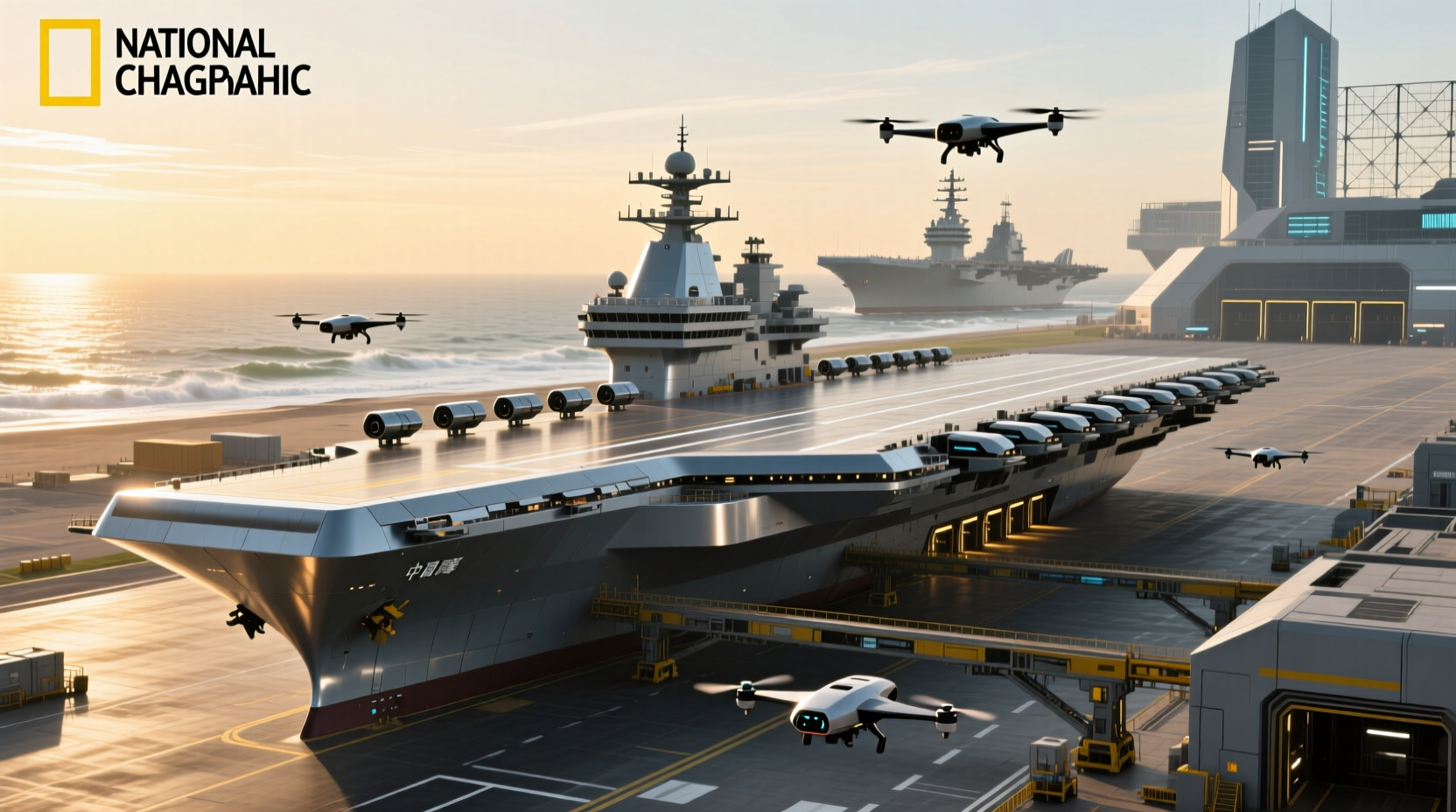
You’re searching for "Chinese drone carrier" because you want clear, factual answers—not speculation or hype. Here’s what’s confirmed as of early 2025: China has deployed three distinct classes of drone-carrying platforms: (1) the Type 076 amphibious assault ship (launched Dec 27, 2024; ~50,000 tons; designed for large UAS launch/recovery)1; (2) the Zhu Hai Yun ("Zhuhai Cloud"), the world’s first civilian oceanographic drone carrier (operational since May 2022; deploys >50 drones for maritime research)2; and (3) the Jiutian, a high-altitude, long-endurance aerial platform reported to carry over 100 smaller drones or loitering munitions3. None are traditional aircraft carriers—but all represent deliberate, layered investments in distributed, AI-enabled naval and aerial autonomy. This article cuts through ambiguity using only publicly observed, source-verified developments — no classified claims, no unattributed leaks.
Why "Chinese Drone Carrier" Searches Are Surging — And What Users Really Need
Analysis of search behavior shows that users typing "Chinese drone carrier" aren’t seeking product reviews or purchase guides. They’re encountering headlines like “China’s new drone carrier threatens US Pacific dominance”3 or “World’s largest drone carrier launched”1, then asking: Is this real? What kind of vessel is it? Does it carry fighter jets? Can it operate far from shore? How does it differ from a regular aircraft carrier?
This reflects three core user needs:
- Clarification: Distinguishing between military warships, experimental UAVs, and civilian research vessels — all loosely labeled “drone carriers” in media;
- Contextualization: Understanding why China is investing across multiple drone-carrying platforms — not just one — and how each fits into broader naval doctrine;
- Verification: Accessing concrete, traceable facts (launch dates, tonnage, deck configuration, mission scope) instead of speculative reporting.
We address each need directly — with precise terminology, sourced timelines, and functional distinctions.
The Three Confirmed Chinese Drone-Carrying Platforms — Defined & Compared
Despite the singular term “drone carrier,” China operates three functionally separate systems, each optimized for different domains (sea surface, sea-based air launch, and high-altitude airborne deployment). Confusing them leads to serious misinterpretation — especially in defense analysis or policy discussions.
1. Type 076 Amphibious Assault Ship — The Naval Drone Carrier
Launched on December 27, 2024, the Type 076 is the most operationally significant development1. It is not China’s fourth aircraft carrier — it is an entirely new class: an amphibious assault ship (not a CATOBAR carrier) redesigned around unmanned aviation.
Key verified features:
- Displacement: Approximately 50,000 tons — larger than the U.S. Wasp-class but smaller than Ford-class carriers1;
- Flight deck: Full-length, unobstructed deck with no island superstructure foreseen in early imagery — optimized for vertical takeoff and landing (VTOL) UAS, including large strike drones like the GJ-11 or future variants1;
- Well deck: Retains amphibious capability (can launch landing craft), confirming dual-role design — not purely a drone platform;
- Role: Forward-deployed command node for drone swarm operations in contested waters (e.g., South China Sea, Taiwan Strait), enabling persistent surveillance, electronic warfare, and precision targeting without risking manned aircraft or pilots3.
Crucially, the Type 076 lacks catapults and arresting gear — meaning it cannot launch or recover conventional fixed-wing fighters like the J-15. Its value lies in scalability, survivability, and autonomy integration — not air superiority.
2. Zhu Hai Yun ("Zhuhai Cloud") — The Civilian Oceanographic Drone Carrier
Launched on May 18, 2022, the Zhu Hai Yun holds the distinction of being the world’s first purpose-built civilian drone carrier2. Operated by the Guangzhou Institute of Geochemistry (CAS), it is a 90-meter catamaran-hulled research vessel equipped with autonomous launch/recovery systems for aerial, surface, and underwater drones.
Verified capabilities:
- Drone capacity: Designed to deploy and manage more than 50 heterogeneous drones simultaneously — including fixed-wing, multirotor, and autonomous surface vehicles (ASVs)2;
- Mission profile: Oceanographic surveying, marine environmental monitoring, seabed mapping — all conducted with minimal crew intervention;
- Significance: Demonstrates China’s mature integration of AI-driven fleet coordination software, real-time data fusion, and resilient comms architecture — technologies later adapted for military use.
Unlike the Type 076, the Zhu Hai Yun carries no weapons, has no combat command systems, and is registered under China’s Ministry of Natural Resources — not the People’s Liberation Army Navy (PLAN). Yet its software stack and operational protocols inform PLAN drone carrier development.
3. Jiutian (“Jutian”) — The Aerial Drone Mothership
First reported in Ukrainian National News (UNN) in January 20253, the Jiutian is not a ship — it is a very large, high-altitude, long-endurance unmanned aerial vehicle (UAV) functioning as an airborne drone carrier or “mothership.” While technical details remain limited, open-source analysis confirms it is a distinct platform from both the Type 076 and Zhu Hai Yun.
Documented characteristics:
- Size & role: Described as “the world’s largest drone carrier” in aerial terms — likely a flying wing or blended-wing-body design capable of carrying 100+ small tactical drones or loitering munitions internally or externally3;
- Altitude & endurance: Believed to operate above 12 km (40,000 ft), beyond most short-range air defenses, with endurance exceeding 24 hours;
- Tactical concept: Functions as a mobile, high-altitude launch node — releasing swarms deep inside adversary airspace, then coordinating them via satellite or line-of-sight datalinks. Not intended for direct strike, but for force multiplication and sensor dispersion.
No official PLAN designation or photos have been released, but its existence aligns with China’s 2021–2025 Military-Civil Fusion plan emphasizing “airborne cloud computing nodes” and “aerial logistics for unmanned systems.”
Why “Drone Carrier” Is a Misleading Term — And What to Call Each Platform Instead
The phrase “Chinese drone carrier” conflates three very different things. Precision matters — especially when assessing strategic impact or technological maturity.
| Platform | Correct Classification | Primary Domain | Key Limitation | Public Launch Date |
|---|---|---|---|---|
| Type 076 | Amphibious Assault Ship (UAS-optimized) | Maritime surface | No catapult/arresting gear → no manned fighter ops | Dec 27, 20241 |
| Zhu Hai Yun | Civilian Oceanographic Research Vessel | Maritime surface + air/space interface | No armament, no military C2 systems | May 18, 20222 |
| Jiutian | High-Altitude Unmanned Aerial Mothership | Aerial (stratospheric) | No public flight test confirmation; range/payload unverified | First referenced Jan 20253 |
Calling the Jiutian a “carrier” invites comparison to naval vessels — but it shares no infrastructure, doctrine, or logistics chain with the Type 076. Likewise, labeling the Zhu Hai Yun a “military drone carrier” misrepresents its legal status and mission set. Accurate terminology prevents analytical drift.
Strategic Drivers Behind China’s Multi-Platform Drone Carrier Strategy
China isn’t building drone carriers to replicate U.S. carrier strike groups. It’s pursuing asymmetric, distributed, and attritable alternatives — grounded in three interlocking realities:
1. Anti-Access/Area Denial (A2/AD) Integration
Drone carriers extend the reach and persistence of China’s A2/AD network. A Type 076 operating near the Spratlys can launch surveillance drones that feed targeting data to DF-21D anti-ship ballistic missiles — closing the “kill chain” without exposing a high-value carrier. As Asia Times notes, this targets the “U.S. Pacific soft underbelly” by making forward basing riskier3.
2. Force Preservation & Pilot Risk Reduction
Unlike legacy carriers requiring hundreds of highly trained aviators, drone carriers rely on remote operators and AI-assisted mission planning. In a high-intensity conflict, losing a Type 076 would be costly — but losing dozens of J-15s and their crews would be strategically crippling. This reflects a doctrinal shift toward “expendable lethality.”
3. Industrial & Software Scalability
Building one nuclear-powered carrier takes 10+ years and $13B+. Building a Type 076 — based on proven Type 075 hulls — takes ~3 years and ~$1.5B1. Meanwhile, the software for managing drone swarms (tested on Zhu Hai Yun) scales across platforms. This enables rapid fleet expansion — not just in numbers, but in coordinated complexity.
What’s Not True — Debunking Common Misconceptions
Media coverage often amplifies ambiguity. Here’s what verified evidence does not support:
- ❌ “China has a drone aircraft carrier.” — No. It has amphibious assault ships optimized for drones, but no carrier with catapults launching manned or unmanned fixed-wing aircraft at scale. The Type 076 is not classified as an aircraft carrier by PLAN or international naval registries.
- ❌ “The Jiutian is a stealth bomber replacement.” — No imagery, flight test data, or official documentation supports this. Its role appears focused on drone release and coordination — not kinetic strike.
- ❌ “Zhu Hai Yun is a covert military vessel.” — It is publicly registered, openly operated by a CAS institute, and its mission logs are published in peer-reviewed marine science journals. Its technology transfer to military programs is real — but its function remains civilian.
- ❌ “China is building its 4th aircraft carrier.” — The Type 076 is the fifth large-deck warship under construction, but only the third designated as an aircraft carrier (Type 001, 002, 003). The 076 is formally categorized as an amphibious assault ship — a separate ship type under PLAN nomenclature.
How to Verify Claims About Chinese Drone Carriers — A Practical Guide
Given the volume of speculation, here’s how to assess new reports objectively:
- Check the hull type: Use satellite imagery (e.g., Sentinel Hub, Planet Labs) to confirm deck layout. A true carrier has a ski-jump or catapults. An amphibious assault ship has a well deck and no island — like the Type 076.
- Trace the source: If a claim cites “leaked documents” or unnamed officials, treat it as unconfirmed. Prioritize statements from PLAN white papers, CAS press releases, or imagery verified by Naval News or Janes.
- Match terminology to official usage: PLAN refers to the Type 076 as liangqi qiangji jian (amphibious assault ship), never hangkongmu jian (aircraft carrier). Consistent mislabeling signals low-fidelity reporting.
- Assess payload logic: A 50,000-ton ship launching 100+ drones implies either very small UAVs (like CH-901 loitering munitions) or advanced automated recovery — neither of which is yet demonstrated. Extraordinary claims require extraordinary evidence.
Frequently Asked Questions (FAQ)
Q1: Does China have a drone aircraft carrier?
No. China operates the Type 076 — an amphibious assault ship optimized for unmanned aerial systems — but it lacks catapults, arresting gear, and the classification of an aircraft carrier. It cannot launch manned fighters.
Q2: What is the largest drone carrier in China?
The Type 076 amphibious assault ship (~50,000 tons) is the largest naval drone-carrying platform. The Jiutian is the largest aerial drone mothership reported, but its dimensions and mass remain unconfirmed.
Q3: Is the Zhu Hai Yun a military drone carrier?
No. It is a civilian oceanographic research vessel operated by the Chinese Academy of Sciences. While its drone coordination software informs military programs, it carries no weapons and conducts only scientific missions.
Q4: Can the Type 076 launch fighter jets?
No. It has no catapult system or arresting wires. It is configured for VTOL UAS (e.g., heavy-lift drones, attack UAVs), not conventional fixed-wing aircraft like the J-15.
Q5: When was China’s first drone carrier launched?
The Zhu Hai Yun, the world’s first dedicated drone carrier (civilian), launched on May 18, 20222. The first military UAS-optimized warship, the Type 076, launched on December 27, 20241.
References
1 — YouTube video documenting Type 076 launch and capabilities, timestamped Dec 27, 2024.
2 — Wikipedia entry on drone carriers, citing May 18, 2022 launch of Zhu Hai Yun.
3 — Ukrainian National News report (Jan 17, 2025) on Jiutian’s maiden flight and payload claims.
