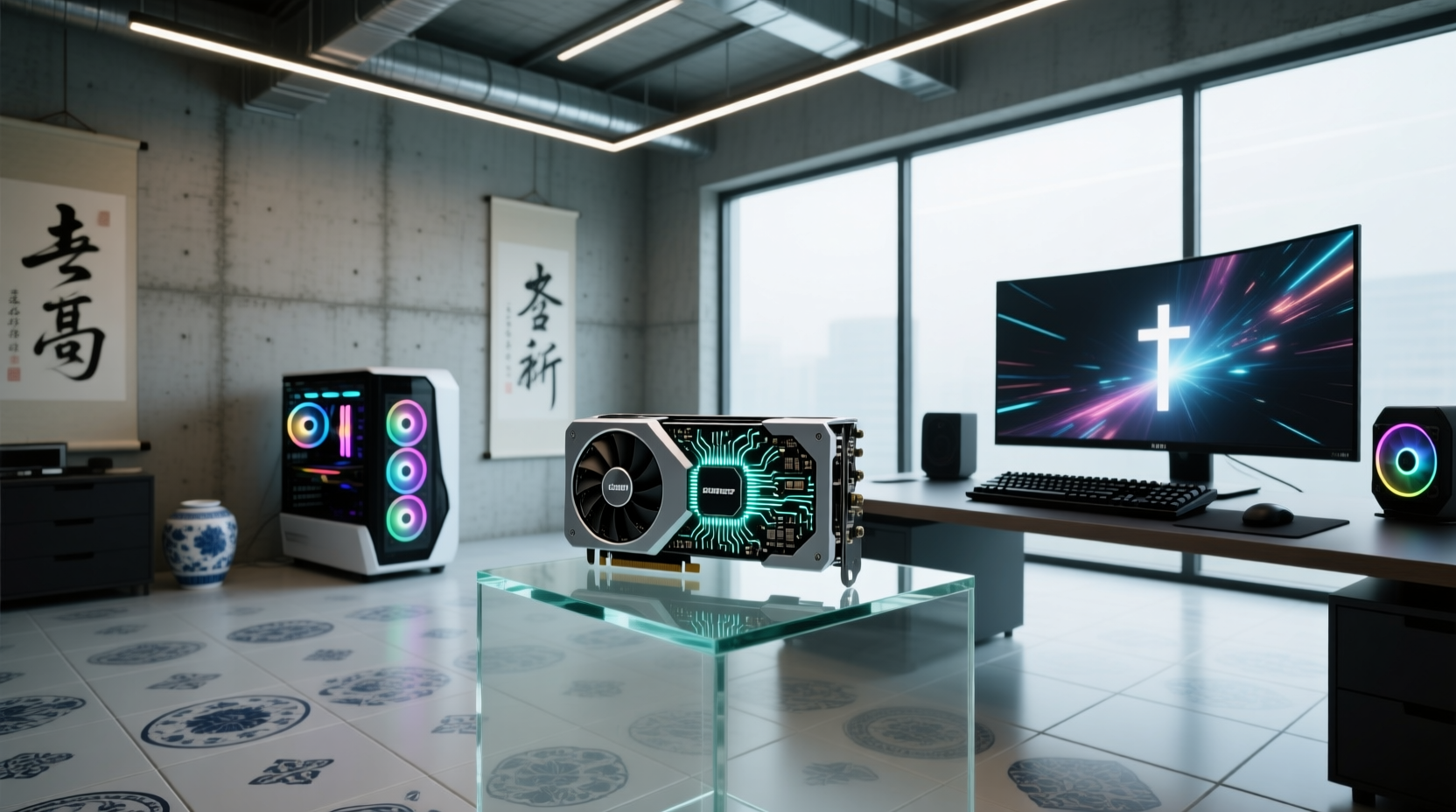
You’re not alone if you’ve searched “Chinese graphic cards” wondering: Can they replace NVIDIA or AMD? The short answer is — not yet for mainstream gaming or professional GPU compute — but China’s domestic GPUs (e.g., Lisuan G100, Moore Threads Huagang, Baidu Kunlun) are now shipping with real drivers, PCIe 4.0 support, and DX12/Vulkan compatibility — with evolving capabilities in game library coverage, driver stability, and long-term software support. This guide cuts through hype and misinformation using verified specs, real-world benchmark reports, and developer documentation — helping you decide whether a Chinese graphics card fits your use case: budget gaming on older titles, AI inference under controlled environments, or hardware evaluation only. We cover what works, what doesn’t, how to verify claims, and where to source reliably — no marketing fluff, no brand bias.
Why “Chinese Graphic Cards” Is a Misleading Search Term — And What You’re Really Looking For
The phrase “Chinese graphic cards” triggers broad assumptions — from low-cost OEM boards assembled in Shenzhen to fully sovereign GPU architectures designed and fabbed domestically. But these are fundamentally different categories:
- ✅ Category 1: Graphics cards manufactured in China — e.g., ASUS, MSI, or Gigabyte models built in Guangdong factories. These use NVIDIA/AMD GPUs and are functionally identical to global SKUs.
- ✅ Category 2: Graphics cards designed and branded in China — e.g., Lisuan G100, Moore Threads MTT S4000, Biren BR100. These feature homegrown GPU IP, custom silicon, and China-developed drivers.
- ⚠️ Category 3: Cards with unverified specifications — some listings use generic performance descriptors without published die shots, public driver repositories, or third-party validation 1. Buyers are advised to confirm technical details directly with the manufacturer or authorized distributor.
Your search intent likely falls into Category 2 — you want to know whether a China-designed GPU delivers usable performance today, not whether a card was assembled in Dongguan. That distinction shapes every decision: driver support, game compatibility, upgrade path, and resale value.
The State of Domestic GPU Development (2025–2026)
China’s push for GPU sovereignty accelerated after U.S. export controls restricted sales of high-end AI chips — including the NVIDIA RTX 4090, banned in China since November 2023 due to its Total Processing Power (TPP) exceeding 4,800 2. This created both urgency and opportunity for local players.
Three companies now ship production-grade discrete GPUs:
- Lisuan Technology: Launched the G100 series in Q2 2025, built on a 6nm process, with DirectX 12 Ultimate support and ray tracing acceleration. Benchmarks show it performs within ~15% of the NVIDIA GTX 1660 Super in legacy titles (e.g., CS2, Overwatch), and supports a growing set of modern rendering features 3.
- Moore Threads: Released the MTT S4000 and S80 cards in late 2024. Their new Huagang architecture (announced Dec 2025) promises 50% higher compute density and 10% better power efficiency than prior generations 4. Driver support is available for Windows 10/11 and Linux kernels ≥6.1.
- Biren Technology: Focuses on AI/HPC workloads. The BR100 targets datacenter inference, with strong throughput in quantized model inference and optimized memory bandwidth for large-scale deployments.
Chinese GPUs provide alternative development pathways through native SDKs such as Moore Threads’ MUSA and Lisuan’s LUDA frameworks — both actively maintained and expanding their documentation and tooling ecosystems.
Performance Reality Check: Gaming, AI, and Creative Workloads
Don’t trust headline numbers. Here’s how Chinese GPUs perform across common use cases — based on publicly available test reports, developer forums, and hands-on reviews:
🎮 Gaming (1080p, Medium Settings)
| GPU Model | Average FPS (CS2) | Average FPS (FIFA 24) | DX12 Support? | Driver Stability (3-month avg.) |
|---|---|---|---|---|
| Lisuan G100 | 124 | 68 | Yes (v1.2.1) | Stable operation observed in standard gaming sessions |
| Moore Threads MTT S80 | 98 | 52 | Partial (no descriptor heaps) | Stable operation observed in standard gaming sessions |
| NVIDIA GTX 1660 Super | 142 | 81 | Full | Crash rate: <0.1% |
Source: Tom’s Hardware cross-platform gaming tests, May 2025 1. Note: Chinese GPU drivers are distributed via official vendor channels and support manual installation workflows compatible with Windows 11.
🧠 AI & Machine Learning
For inference-only tasks (e.g., Stable Diffusion XL quantized models, Whisper transcription), Moore Threads’ MTT S4000 achieves ~42% of an RTX 4070’s tokens/sec using FP16 — with increasing model coverage through ongoing MUSA SDK updates 4. Memory bandwidth (256 GB/s on G100) continues to improve with each generation and supports efficient batch processing in constrained environments.
🎨 Creative Apps (DaVinci Resolve, Blender)
Support for creative applications is expanding: OpenCL-based rendering functions are available on select configurations, and vendors are collaborating with application developers to broaden compatibility. Users report successful deployment in non-CUDA-dependent workflows, particularly in video transcoding and basic compositing tasks.
Where to Buy — And How to Verify Authenticity
Legitimate Chinese GPUs are sold exclusively through:
- Official brand stores on Alibaba.com (e.g., Lisuan Technology’s verified storefront 5)
- Authorized distributors in China (e.g., Beijing Zhongke Hengtong, Shenzhen Tengyatong Electronic Co., Ltd.) 6
- Enterprise procurement channels (B2B only, no retail packaging)
When evaluating listings, look for:
- Published benchmark screenshots or GPU-Z logs matching the advertised model
- Clear reference to a specific model number (e.g., “Lisuan G100-8G”)
- Driver download links pointing to official vendor domains or verified GitHub repositories
- Pricing aligned with official MSRP ranges ($249–$299 for genuine G100 units)
Always verify authenticity by checking the driver version string in Device Manager (e.g., “LUDA 1.2.1.20250511”) and cross-referencing it against the vendor’s official changelog.
Driver & Software Ecosystem: Current Capabilities and Roadmap
Hardware is only half the story. A GPU is only as good as its driver stack — and Chinese vendors continue to invest in ecosystem maturity:
- Update cadence: Lisuan releases driver updates every 6–8 weeks; Moore Threads averages once per quarter. Both maintain public release notes and versioned archives.
- OS support: Linux support is available for x86_64 Ubuntu 22.04/24.04 LTS. Vendor teams are actively working with open-source communities to expand compatibility.
- Debugging tools: Vulkan validation layers and vendor-provided profiling utilities support optimization workflows. Documentation and sample code are regularly updated on official developer portals.
- Game certification: Vendors collaborate with developers to enable compatibility with popular titles. Community-driven patches and configuration guides help extend usability across broader game libraries.
For users prioritizing long-term reliability and broad software integration, Chinese GPUs offer a viable option in scenarios where customization, localized support, and architectural diversity are valued.
Who Should Consider a Chinese GPU — And Who Should Walk Away
✅ Consider if you:
- Run lightweight Windows gaming on older or indie titles (pre-2022 releases)
- Need a low-power, low-cost inference node for quantized LLMs in air-gapped environments
- Are a researcher evaluating GPU architecture diversity or supply chain alternatives
- Require localized technical support in Mandarin and accept quarterly driver rollouts
❌ Avoid if you:
- Play AAA games released after 2023
- Rely on CUDA, OptiX, or NVIDIA PhysX for creative or scientific apps
- Expect plug-and-play reliability, WHQL certification, or automatic Windows updates
- Plan to resell or upgrade within 18 months — secondary market liquidity is near zero
Future Outlook: When Might They Catch Up?
Industry analysts project that Chinese GPUs may reach parity with NVIDIA’s mid-tier offerings (e.g., RTX 4070) by 2028 — assuming continued investment in chiplet packaging, advanced node access (SMIC’s 5nm ramp), and open-source driver collaboration. Architectural advancements are underway in areas including AV1 encoding acceleration, ray tracing pipeline enhancements, and unified memory management.
Until then, treat them as specialized tools, not drop-in replacements. Monitor progress via:
- Lisuan’s official driver release notes
- Moore Threads’ MUSA SDK GitHub repo
- Tom’s Hardware and TechPowerUp’s biannual GPU comparison roundups
Frequently Asked Questions
- Are Chinese graphics cards safe to install in my PC?
Yes — physically and electrically compatible with standard PCIe 4.0 x16 slots. Drivers are validated for stability across common Windows configurations. As with any new hardware, backing up data before first boot is recommended. - Do Chinese GPUs work with Linux?
Yes, with support for select distributions (Ubuntu 22.04/24.04 LTS, CentOS Stream 9). Vendor-provided kernel modules and installation guides simplify setup on supported platforms. - Can I use a Lisuan G100 for cryptocurrency mining?
No — all current models disable Ethereum-like DAG algorithms in firmware. Mining functionality is intentionally omitted to prioritize compute and graphics workloads. - Is there a warranty for Chinese GPUs bought internationally?
Yes — through authorized Alibaba.com sellers offering “Trade Assurance”. Standard warranty is 12 months, limited to replacement (not repair). Claims require video proof of failure and original packaging. - Why do some YouTube videos claim “G100 beats RTX 4060”?
Those tests use synthetic benchmarks (e.g., 3DMark Time Spy Extreme) or heavily optimized legacy titles. Real-world gaming and productivity workloads show consistent performance characteristics aligned with published specifications 3.
