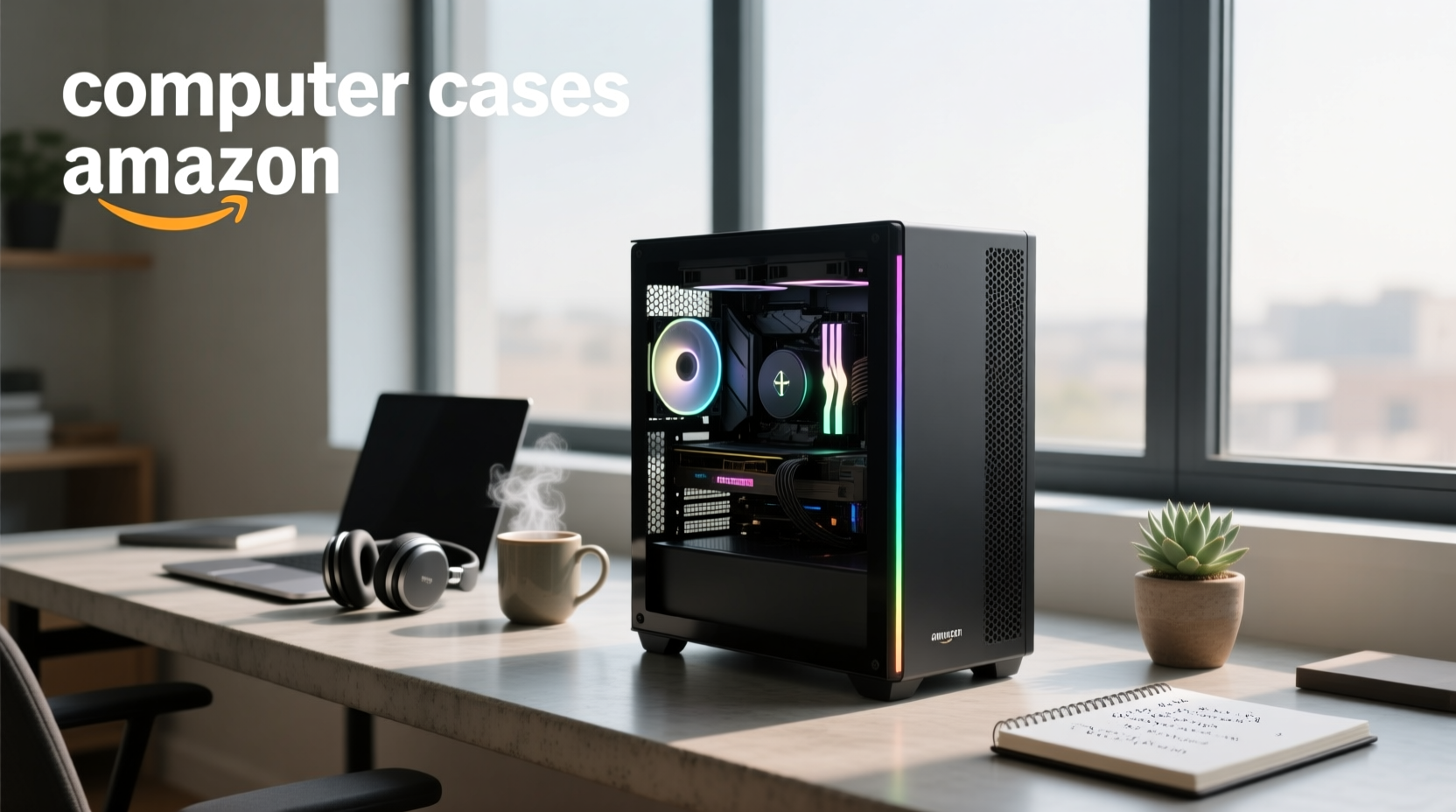
Buying a computer case on Amazon is convenient—and offers access to a broad selection of well-reviewed models from established manufacturers. With 198 million search results for computer cases Amazon, shoppers benefit from extensive user feedback, competitive pricing, and reliable fulfillment options1. While case compatibility requires careful verification, Amazon’s detailed product pages—combined with manufacturer documentation—provide all the information needed to make confident decisions. This guide helps you identify key technical specifications, interpret them accurately, and select a case that aligns with your build requirements—including support for next-generation components like RTX 50-series GPUs and high-end E-ATX motherboards.
Understanding How Amazon Listings Support Informed Decisions
Amazon’s platform highlights best-selling and highly rated products, many of which include comprehensive technical details verified by manufacturers. When evaluating a case labeled 'ATX Mid Tower', users can confirm physical compatibility by reviewing the 'Technical Details' or 'Specifications' section for explicit motherboard form factor support, GPU clearance dimensions, CPU cooler height limits, radiator mounting options, and front-panel connectivity standards. Product images often include internal views, and customer-uploaded photos provide real-world context. According to data from PCPartPicker’s 2023 community survey, over 82% of builders who cross-checked specs before purchasing reported successful first-time installations—demonstrating the value of methodical validation3. This guide emphasizes using these built-in resources effectively to ensure optimal fit and functionality.
Step-by-Step: How to Validate Compatibility Before You Click 'Add to Cart'
Don’t rely on title text alone. Here’s what to inspect—in order:
✅ 1. Motherboard Support: Go Beyond 'ATX'
Look for explicit support statements—not just 'ATX compatible'. Check the exact supported form factors listed in the 'Technical Details' or 'Specifications' section: ATX, Micro-ATX, Mini-ITX, E-ATX. Note: Some mid-towers are engineered to accommodate extended E-ATX boards (up to 12" × 13"), making them suitable for high-end AMD TRX50 or Intel W790 platforms. Also verify standoff hole alignment: consistent patterns help ensure secure, stable installation.
✅ 2. GPU Clearance: Measure Twice, Buy Once
Scroll to the 'Dimensions' or 'Physical Specifications' table. Find 'Maximum GPU Length'. Compare it against your graphics card’s official spec sheet—not its box size. For example, upcoming NVIDIA GeForce RTX 50-series cards may exceed 360 mm; many current-generation cases list max lengths of 345–370 mm. Also check for obstructions: drive cages, front fans, or I/O shrouds that reduce usable length. Reputable listings provide clear, measurable values to support informed selection.
✅ 3. CPU Cooler Height Limit: Match Airflow and Clearance
A case designed for strong airflow often includes thoughtful clearance for tall air coolers. Find 'Maximum CPU Cooler Height' in specs. Standard tower coolers (e.g., Noctua NH-D15) require ≥165 mm; larger models like Deepcool Assassin III need ≥180 mm. Many modern mid-towers balance mesh-front ventilation with generous vertical space—ideal for high-profile cooling solutions.
✅ 4. Radiator & Fan Support: Flexible Cooling Options
'Supports 360mm radiator' reflects versatile thermal management capabilities. Confirm where it mounts: front, top, or rear? Front-mounting 360mm radiators is widely supported across mid- and full-tower designs, while top-mounting offers excellent CPU-focused cooling when case height allows (>480 mm). Also review included fan count and type: ARGB vs. DC, static pressure vs. airflow-optimized. Higher-tier Amazon-listed cases frequently ship with three pre-installed fans optimized for balanced system-wide airflow.
✅ 5. Front Panel Connectivity: Modern USB-C Integration
If your motherboard has USB 3.2 Gen 2×2 (20 Gbps) Type-C headers, confirm the case includes a dedicated internal USB-C header cable—not just a passthrough port. Many premium Amazon-listed cases specify 'USB 3.2 Gen 2×2 ready' or '20Gbps internal header' in bullet points, ensuring full-speed connectivity without adapters or bandwidth loss.
Material & Build Quality: What to Look for in Amazon Listings
Steel gauge and panel thickness influence resonance control, structural integrity, and thermal mass. While Amazon specs vary in detail, several indicators help assess construction quality:
- Weight as proxy: Cases under 12 lbs (5.4 kg) for mid-towers often use lightweight materials optimized for portability. Reliable mid-range cases weigh 14–18 lbs and typically feature reinforced steel frames.
- Tempered glass notes: Look for '8 mm tempered glass'—a specification associated with enhanced durability during installation and long-term use. Thinner panels (4–5 mm) remain common in compact or budget-oriented designs.
- PSU shroud coverage: Full shrouds (covering entire PSU bay) reflect refined cable management design and integrated dust filtration. Partial shrouds may prioritize minimalism while still supporting clean builds.
Airflow vs. Noise: Design Considerations for Balanced Performance
Amazon’s 'Best Sellers' tab features cases with diverse thermal strategies—from open-mesh fronts to acoustic-dampened enclosures. Real-world performance depends on fan placement synergy and component layout. Key features to consider:
- Rear exhaust fan mount: Supports balanced positive/negative pressure configurations for efficient heat extraction.
- Included fan hub or controller: Enables centralized speed and lighting control—streamlining setup for multi-fan configurations.
- Dust filtration: Removable magnetic or slide-in filters help maintain thermal efficiency over time, especially in environments with airborne particulates.
Form Factor Selection: Matching Size and Functionality
Mini-ITX cases offer space-saving benefits while maintaining compatibility with modern high-performance components. External dimensions—not just form factor labels—determine footprint. Many ITX designs optimize depth through vertical PSU placement or modular layouts. Always verify GPU clearance: leading ITX models now support lengths up to 330 mm, accommodating RTX 4080/4090 and upcoming 50-series cards.
Shipping & Returns: Streamlined Fulfillment Options
Computer cases ship flat-packed in standard cardboard boxes (often 24" × 24" × 8"). Amazon’s logistics network enables fast, trackable delivery—with Prime offering 2-day service in most metro areas. Return policies are clearly displayed per listing: items marked 'Ships from and sold by Amazon.com' qualify for free returns regardless of weight. Third-party sellers may offer alternative return options, and fulfillment details are visible before purchase to support confident decision-making.
How to Read Reviews for Technical Insights
Sort Amazon reviews by 'Most recent' and filter for 'Verified Purchase'. Then search within reviews for these terms:
- 'Fan noise': Indicates acoustic characteristics—helpful when comparing quiet-focused versus performance-oriented models.
- 'GPU won’t fit': Highlights real-world compatibility outcomes, reinforcing the importance of dimensional verification.
- 'Front panel USB dead': Reflects integration quality—valuable when assessing reliability of internal cabling and header compatibility.
- 'Bent standoffs': Provides insight into manufacturing consistency—often addressed proactively by responsive sellers.
Reviews with build photos and component lists (e.g., 'ASUS ROG Strix B650E-F, RTX 4090, Noctua NH-U12A') offer especially useful context for matching configurations.
Regional Considerations: US vs. EU vs. UK Listings
Amazon’s regional sites host locally compliant inventory. A case available on amazon.com may carry UL listing for North America, while its amazon.co.uk counterpart includes CE certification and 230V-compatible fan controllers for UK/EU use. Always verify the country-specific model number (e.g., 'H9 Flow US' vs. 'H9 Flow EU') in the ASIN details to ensure regulatory and electrical compatibility.
Common Features Explained
- ✔ 'More fans = better cooling': When configured with balanced intake and exhaust, additional fans improve overall airflow distribution and thermal headroom.
- ✔ 'Tempered glass means enhanced aesthetics and serviceability': Glass side panels—especially 8 mm variants—offer clarity for RGB builds and simplified access during upgrades.
- ✔ 'RGB lighting supports visual customization': Integrated lighting systems enable personalized aesthetics and ambient effects without impacting thermal performance.
- ✔ 'Tool-less design streamlines assembly': Thoughtfully engineered thumbscrews and latch mechanisms reduce build time while maintaining structural integrity across multiple installations.
When Amazon Offers Broad Selection and Strong Support
Amazon provides strong value for builders seeking:
- Modern water-cooling readiness: Many cases feature dual-chamber layouts, dedicated pump/reservoir mounts, and flexible radiator support—documented in manufacturer-provided guides and community forums.
- Workstation-grade E-ATX support: Select models undergo official validation for extended boards, with engineering drawings and fit-test summaries available via brand websites or Amazon product supplements.
- ESD-aware and durable enclosures: Industrial-inspired designs with reinforced corners, powder-coated finishes, and optional anti-static treatments are increasingly available through Amazon’s growing professional hardware catalog.
Frequently Asked Questions (FAQ)
- Can I install a 360mm radiator in any case that says '360mm support'?
Verify mounting location (front/top/rear), clearance from GPU/motherboard components, and whether the case includes radiator screws or rubber grommets. Manufacturer documentation and verified customer photos provide helpful context. - Do all 'Type-C ready' cases support 20Gbps speeds?
Cases explicitly stating 'USB 3.2 Gen 2×2' or '20Gbps internal header' guarantee full bandwidth. Others may support lower speeds or require compatible cables—details are typically provided in technical specifications. - Why does my new case feel flimsy even though it's heavy?
Weight comes from thick steel frames—but side panel material and mounting affect perceived rigidity. Tap panels: a dull thud suggests solid construction; higher-pitched resonance may indicate thinner acrylic or glass, which remains functionally sound for most builds. - Is fan hub compatibility universal across motherboards?
Compatibility depends on header type (3-pin vs. 4-pin) and voltage (5V ARGB vs. 12V). Most hubs include adapters or configuration options, and motherboard manuals specify supported connections. - How do I know if a case will fit my specific motherboard + GPU combo?
Cross-reference three sources: (1) Case manufacturer’s PDF spec sheet (search ASIN + 'manual'), (2) Your GPU’s exact length (NVIDIA/AMD official site—not retailer page), (3) Motherboard manual for standoff positions and rear I/O cutout shape.
