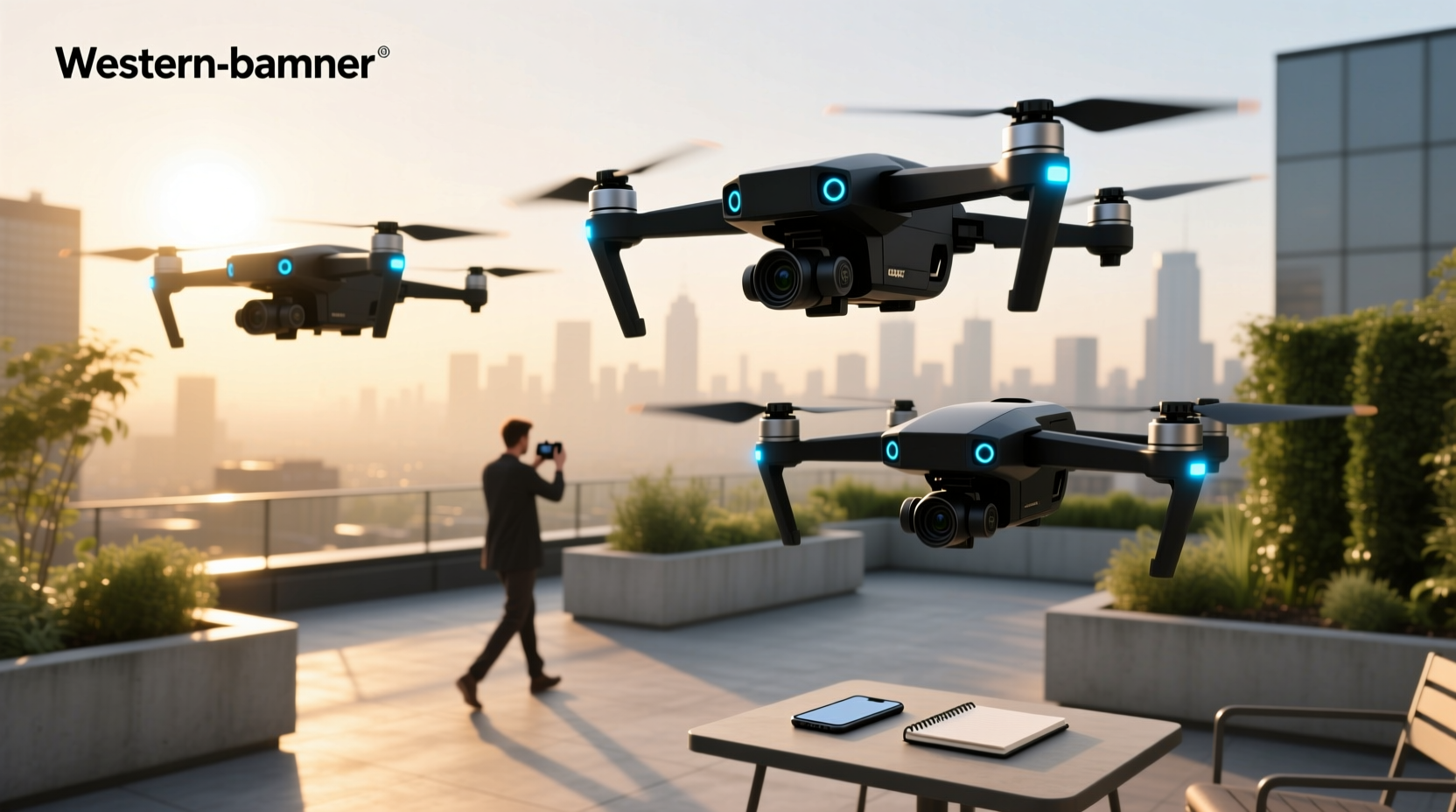
Looking for drones with cameras that deliver reliable 4K video, stable flight, and compliant operation in 2026? You’re not alone — but the market is cluttered with misleading claims about resolution, range, and autonomy. The truth is: most consumer-grade drones with cameras max out at 10–15 km effective control range (not 200 km1), require registration if over 250 g, and rarely match advertised low-light performance without post-processing. This guide cuts through the noise using verified specs, regulatory frameworks, and hands-on usability benchmarks — so you invest confidently, whether you're capturing travel footage, inspecting property, or starting aerial photography.
Why 'Drones with Cameras' Is a Misleading Search Term — And What You Actually Need
The phrase drones with cameras sounds simple — but it’s functionally meaningless without context. Every modern consumer drone includes a camera, yet their imaging capabilities vary as dramatically as smartphone cameras do. A $399 budget quadcopter may claim "4K" but records heavily cropped, oversharpened, 8-bit video with no log profile or manual exposure control. In contrast, a $2,200 professional model offers full-sensor 4K/60p, 10-bit color depth, adjustable ISO up to 6400, and RAW photo capture — critical for editing flexibility2. Your decision hinges not on whether a drone has a camera, but on what kind of camera it has, how it’s stabilized, and how intelligently it integrates with flight systems.
Key Camera Specifications That Actually Matter
Don’t trust marketing terms like "Ultra HD" or "AI-enhanced". Focus instead on these five measurable parameters:
- Sensor size: Larger sensors (e.g., 1-inch CMOS) gather more light and produce cleaner images in low light than 1/2.3-inch sensors — common in entry-level models. A 1-inch sensor delivers ~4× better dynamic range than 1/2.3-inch at equivalent ISO3.
- Bit depth & color profile: 8-bit video compresses color data aggressively; 10-bit (or higher) preserves gradients and enables professional color grading. Log profiles (like D-Log or HLG) retain shadow/highlight detail — essential if you plan to edit.
- Stabilization method: Electronic Image Stabilization (EIS) crops the frame and degrades resolution. Mechanical 3-axis gimbal stabilization maintains full sensor resolution and delivers buttery-smooth motion — non-negotiable for serious videography.
- Maximum shutter speed: For sharp motion capture (e.g., fast-moving subjects or windy conditions), look for ≥1/8000 sec mechanical shutter capability — rare below $1,500.
- Manual controls: Exposure compensation, ISO limit, shutter angle, white balance presets, and focus peaking indicate pro-grade workflow support — absent on most sub-$500 models.
Flight Performance vs. Camera Capability: Where Trade-Offs Happen
Manufacturers often prioritize one over the other — and buyers rarely realize it until mid-flight. Here’s what the spec sheets won’t tell you:
| Feature | High-Camera-Fidelity Drones (e.g., DJI Mavic 3 Pro, Autel EVO Nano+) | Budget-Friendly Drones (e.g., many sub-$400 models) |
|---|---|---|
| Max flight time (real-world) | 30–45 min (with battery conservation modes) | 12–18 min (often drops to ≤10 min in wind or cold) |
| Effective transmission range | 10–15 km (OcuSync 3+/4.0, FCC-compliant) | 1–3 km (Wi-Fi-based links, highly susceptible to interference) |
| Obstacle sensing | Omni-directional (up/down/front/back/left/right) | Front-only or front + downward (no side/rear awareness) |
| Wind resistance rating | Level 5–6 (10.7–13.8 m/s sustained winds) | Level 3–4 (5.5–7.9 m/s); becomes unstable above 6 m/s |
| GPS + GLONASS + Galileo support | Yes — improves positioning accuracy to ±0.5 m horizontal | GPS only — ±3–5 m drift common in urban canyons |
Note: Claims of "200 km range" apply exclusively to military-grade or certified industrial drones (e.g., JOUAV P1200), which require operator licensing, ground control stations, and are not sold to consumers1. Consumer drones legally capped under FCC/ETSI regulations cannot exceed 15 km line-of-sight range — and even then, signal reliability drops sharply beyond 5 km in typical environments.
Legal & Regulatory Realities: Where You Can — and Cannot — Fly
Laws governing drones with cameras differ significantly by country — and enforcement is tightening globally. In the U.S., FAA Part 107 requires remote pilot certification for commercial use and mandates Remote ID broadcast for all drones >0.55 lbs (~250 g). In India, DGCA rules classify drones by weight: those under 250 g are exempt from license requirements but still must follow no-fly zones (within 5 km of airports, near government buildings, or above 400 ft AGL)4. Crucially, camera-equipped drones are subject to privacy laws regardless of weight — filming private property without consent may violate state-level voyeurism or trespass statutes, even if flight itself is legal.
Always verify local restrictions before launch. Use official tools: FAA’s B4UFLY app (U.S.), NATS Drone Assist (UK), or DGCA’s Digital Sky platform (India). These apps show real-time airspace status, temporary flight restrictions (TFRs), and mandatory pre-flight declarations. Never rely solely on third-party map overlays — they frequently lack updated NOTAM data.
Who Should Avoid 'Drones with Cameras' Entirely?
Not every use case benefits from a camera drone — and some scenarios make them impractical or counterproductive:
- Indoor flying in tight spaces: Most GPS-dependent drones fail indoors. Optical flow sensors help, but collision avoidance remains unreliable below 1 m — making them risky near furniture, pets, or children.
- Wildlife documentation in protected areas: National parks (e.g., U.S. NPS units, UK SSSIs) ban drone use outright — not for safety, but to prevent animal stress and habitat disruption. Violations carry fines up to $5,000 and confiscation.
- Real-time surveillance of people: Even with consent, continuous facial tracking or persistent hovering violates GDPR (EU), CCPA (California), and India’s DPDP Act 2023. Cameras must be visibly disabled or physically covered when not actively recording for authorized purposes.
- Low-budget documentary work: If your project demands consistent audio sync, multi-camera angles, or shallow depth-of-field, a drone adds complexity without solving core production gaps. A stabilized handheld rig or gimbal may yield more controllable results at lower cost and risk.
How to Test Camera Quality — Beyond the Spec Sheet
Before purchasing, assess real-world imaging behavior:
- Check sample footage on neutral platforms: Search YouTube for “[model name] raw footage no color grade” — avoid influencer reviews with heavy LUTs or stabilization overlays.
- Verify bit rate: A true 4K/60p stream needs ≥100 Mbps bitrate. Sub-60 Mbps indicates heavy compression — visible as banding in skies or smearing in motion.
- Test low-light ISO behavior: Look for footage shot at ISO 3200+. Grain structure, chroma noise, and highlight clipping reveal sensor limitations better than daylight clips.
- Review focus reliability: Tap-to-focus lag >0.5 sec or frequent hunting indicates weak autofocus algorithms — problematic for moving subjects.
- Confirm RAW support: If the drone lists “DNG photo output”, confirm it’s full-resolution (not downscaled) and compatible with Lightroom/Darktable — not just proprietary software.
Emerging Trends Impacting Camera Drone Selection in 2026
Three technical shifts are reshaping expectations:
- On-device AI processing: Newer models (e.g., DJI Neo 2, Autel EVO Max 4T) run object recognition and auto-framing locally — reducing latency and eliminating cloud dependency. However, this increases power draw and heat generation, shortening battery life by ~12% under active AI mode5.
- Modular payloads: Industrial drones now support interchangeable cameras (thermal, multispectral, zoom), but consumer models remain fixed-lens. Don’t expect swappable gimbals in sub-$2,000 devices before 2027.
- Regulatory harmonization: EASA’s UAS Service Suppliers (USSP) framework and FAA’s UAS Traffic Management (UTM) trials are converging on standardized remote ID, geofencing, and detect-and-avoid protocols — meaning future firmware updates may restrict operation in newly designated low-altitude corridors.
Practical Buying Checklist: 7 Questions to Ask Before Purchase
Answer these honestly — if three or more are “no”, reconsider:
- Do I need manual camera controls (shutter speed, ISO, white balance) — or is auto mode sufficient?
- Will I fly primarily in open rural areas, or near buildings/trees where obstacle avoidance is critical?
- Do I have access to a safe, legal launch site within 5 miles of my home/work location?
- Can I dedicate 2–3 hours to learning flight fundamentals before attempting complex maneuvers?
- Is my primary goal still photography, cinematic video, mapping, or inspection — and does this drone support that workflow?
- Does the manufacturer provide firmware update logs and clear end-of-life support timelines?
- Are spare batteries, prop guards, and SD cards included — or will accessories add ≥30% to total cost?
Frequently Asked Questions (FAQ)
- Can I fly a camera drone at night?
- Yes — but only with proper lighting (anti-collision strobes visible for 3 statute miles) and, in most jurisdictions, a Part 107 waiver (U.S.) or specific authorization (EU/India). Night flight demands heightened situational awareness and doubles battery consumption due to increased sensor gain.
- Do all drones with cameras record sound?
- No. Consumer drones lack onboard microphones capable of clean audio capture — wind noise and motor vibration overwhelm recordings. External audio must be recorded separately and synced in post-production.
- Is a 4K drone worth it if I only watch on a phone?
- Yes — but not for resolution alone. 4K sensors enable high-quality cropping, digital zoom without pixelation, and greater flexibility during editing. Even 1080p exports benefit from oversampling.
- How often do I need to calibrate the IMU and compass?
- Calibrate the IMU before first flight and after firmware updates. Recalibrate the compass only if flight behavior becomes erratic (e.g., drifting sideways, yaw instability) — never routinely, as improper calibration worsens accuracy.
- What SD card speed class do I really need?
- For 4K/60p, use UHS-I Speed Class 3 (U3) or higher. V30-rated cards are minimum; V60 recommended for ALL-I codecs. Avoid reusing old cards — write endurance degrades after ~10,000 cycles.
1 JOUAV, "Best Long Range Drones 2026 (15–200 km): Expert Tested & Review", Jan 2026.
2 Jeroen Van Nieuwenhove Photography, "The Best Drone For Photography in 2026 (For All Budgets)", Dec 2025.
3 Unacademy, "All About Drone Regulation in India", 2025.
4 Digital Camera World, "The best camera drones for aerial photography and video", Mar 2026.
5 DJI Neo 2 Technical Specifications, Firmware Release Notes v1.2.3, Feb 2026.
