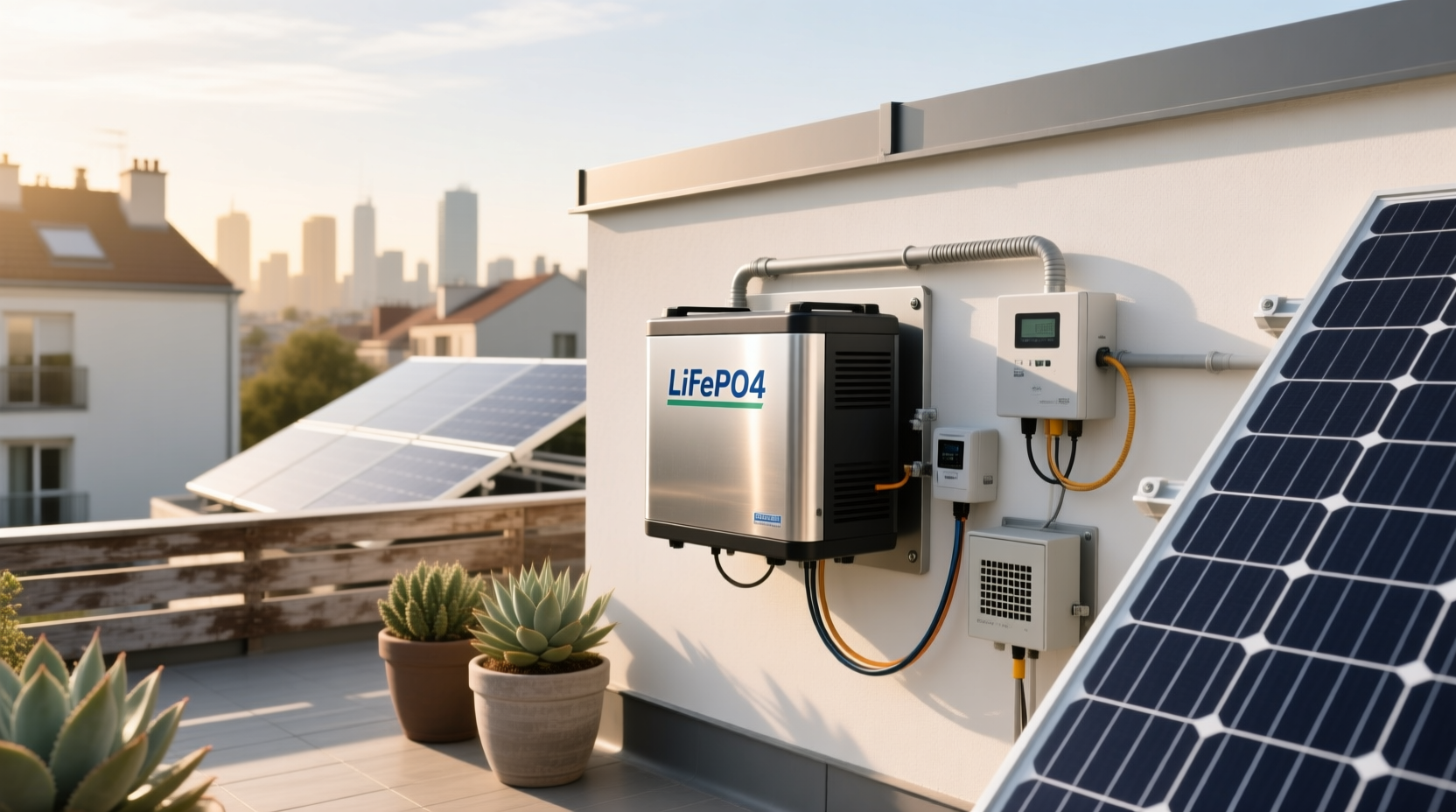
LiFePO4 (lithium iron phosphate) batteries are the most technically sound and widely deployed lithium-based energy storage solution for residential and off-grid solar systems as of 2024–20251. With 3,000–5,000+ full charge/discharge cycles, 90–95% round-trip efficiency, 100% usable depth of discharge (DoD), and inherent thermal stability, they outperform lead-acid and many other lithium chemistries in real-world solar applications2. However, their suitability depends not on general superiority alone—but on your system voltage, climate, charge controller compatibility, and long-term cost-of-ownership calculations. This guide cuts through marketing claims to deliver actionable, vendor-neutral insights for U.S. and EU homeowners, DIY solar integrators, and off-grid builders evaluating LiFePO4 batteries for solar.
Why LiFePO4 Is Now the Default Choice for Solar Storage
The shift toward LiFePO4 in solar isn’t driven by hype—it’s grounded in measurable electrochemical advantages that align directly with how solar energy is harvested, stored, and used.
✅ Long Cycle Life: 10× More Than Lead-Acid, Realistically
Lead-acid batteries (flooded or AGM) typically deliver 300–700 cycles at 50% DoD before capacity drops below 80%. In contrast, quality LiFePO4 cells maintain ≥80% capacity after 3,000 cycles at 100% DoD—and up to 5,000+ cycles at 80% DoD3. That means a well-maintained 4.8 kWh LiFePO4 bank installed in 2024 could still reliably power a 2 kW off-grid cabin in 2035—whereas a comparable lead-acid bank would likely need full replacement by 2027–2028. Crucially, this longevity only holds when paired with a properly configured Battery Management System (BMS) and compatible charging profile.
✅ High Round-Trip Efficiency: Less Energy Lost, More Usable kWh
Solar generation is intermittent and often occurs during peak sun hours—so every watt-hour captured matters. LiFePO4 batteries convert ~90–95% of incoming solar energy into storable electricity. Lead-acid averages just 70–85%, with efficiency dropping sharply below 50% state of charge (SoC). Over a year, that 10–15 percentage point gap can mean hundreds of extra usable kWh from the same PV array—especially valuable in grid-tied systems with time-of-use billing or off-grid setups where generator runtime must be minimized.
✅ Deep Discharge Without Degradation
Unlike lead-acid, which suffers permanent sulfation if discharged below ~50% SoC regularly, LiFePO4 tolerates routine 100% DoD cycling without accelerated aging—provided voltage limits are enforced by the BMS. This translates directly to usable capacity: a 10 kWh LiFePO4 bank delivers nearly all 10 kWh; a 10 kWh lead-acid bank should only be drawn to 5 kWh to preserve life. For small cabins, RVs, or backup systems where space and weight are constrained, this doubles effective storage density.
✅ Thermal & Chemical Stability: Lower Fire Risk, No Ventilation Required
LiFePO4’s olivine crystal structure resists oxygen release even under overcharge, high temperature, or mechanical stress—unlike NMC or LCO chemistries. It does not thermally runaway below ~270°C, compared to ~150–200°C for other lithium types1. This makes it suitable for indoor installation (e.g., basements, utility closets) without forced ventilation—critical for residential retrofits where garage or shed space is limited.
But LiFePO4 Isn’t Perfect: Four Real Limitations You Must Plan For
Despite its strengths, LiFePO4 introduces new engineering constraints—not flaws, but non-negotiable design considerations that, if ignored, cause premature failure or safety hazards.
⚠️ Upfront Cost Remains Higher—But Lifetime Cost Often Wins
A 4.8 kWh (48V 100Ah) LiFePO4 battery pack costs $3,000–$8,000 USD depending on cell grade, BMS sophistication, and enclosure type3. That’s 2–4× more than an equivalent lead-acid bank. Yet when amortized over 10–15 years—including replacement costs, maintenance labor, and lost energy yield—the total cost of ownership (TCO) favors LiFePO4 in most scenarios with >1,000 annual cycles. Use this rule of thumb: if your system cycles >250 times/year, LiFePO4 pays back within 5–7 years. Below that, lead-acid may still be rational—for seasonal cabins or low-use backup.
⚠️ Charging Below 0°C (32°F) Causes Irreversible Damage
Charging LiFePO4 at sub-zero temperatures forces lithium plating on the anode—a permanent, cumulative degradation mechanism that reduces capacity and increases internal resistance. Most reputable BMS units include low-temp charge cutoff (typically disabling charging below 0°C). You cannot override this safely. If your location regularly sees winter lows below freezing, you must either: (a) install the battery in a temperature-controlled space (>5°C), (b) use a heated battery enclosure (with independent thermostat and thermal cutoff), or (c) pair with a hybrid inverter that supports low-temp preheating (e.g., Victron ESS with external heater control). Passive insulation alone is insufficient.
⚠️ BMS Is Not Optional—It’s the Core Safety & Longevity Layer
Every LiFePO4 battery—whether a single 12.8V cell or a 48V modular stack—requires an active BMS to monitor per-cell voltage, temperature, and current. Unlike lead-acid, where overcharge simply vents gas, LiFePO4 overvoltage—even briefly—causes rapid capacity loss and thermal risk. A quality BMS must: (1) balance cells actively (not just passively), (2) log historical data, (3) communicate via CAN bus or Bluetooth to your inverter/monitoring system, and (4) support configurable voltage cutoffs. Avoid “BMS-integrated” packs with sealed firmware—these prevent future updates or custom charge profile tuning.
⚠️ Solar Charge Controller Compatibility Is Non-Negotiable
Your MPPT charge controller must offer a dedicated LiFePO4 charging algorithm—not just a generic “lithium” or “user-defined” mode. The ideal profile includes: (1) bulk stage at 14.2–14.6V (for 12V nominal), (2) absorption held for ≤30 minutes or until current drops to C/20, (3) float disabled or set to 13.5V max, and (4) temperature compensation disabled (LiFePO4 voltage is minimally temp-sensitive). Controllers lacking these features—such as older Outback or Morningstar models without firmware updates—will undercharge or overcharge LiFePO4, cutting cycle life by 30–50%. Always verify compatibility with your specific battery’s datasheet voltage specs before purchase.
How to Size & Configure LiFePO4 Batteries for Solar: A Step-by-Step Framework
There is no universal “best size.” Optimal capacity depends on three interdependent variables: daily energy demand (kWh), autonomy days (how many cloudy days you want to survive), and PV generation profile (kW, tilt, azimuth, shading).
Step 1: Calculate Usable Daily Load (Not Just Nameplate)
Add up *actual* watt-hours consumed per day—not appliance labels. Use a clamp meter or energy monitor (e.g., Emporia Vue, Sense) for 7–14 days. Include phantom loads (routers, refrigerators, inverters). Example: A 1,200 sq ft home using LED lighting, efficient fridge, and heat pump water heater may average 12–18 kWh/day. A 200W solar-powered shed might use 1.2 kWh/day. Never estimate—measure.
Step 2: Define Autonomy & Depth of Discharge Policy
For grid-tied backup: 1–2 days autonomy at 80% DoD is typical. For off-grid: 3–5 days at 90–100% DoD is standard. Note: Sizing for 100% DoD does not mean you’ll always drain fully—it means the battery can handle it when needed (e.g., extended storm). Oversizing beyond 5 days rarely improves ROI unless you face chronic low-sun conditions (e.g., northern latitudes in December).
Step 3: Match Voltage to Inverter & System Scale
• 12V/24V systems: Only for small setups (<1.5 kW inverter, <3 kWh storage)—e.g., RVs, tiny homes, portable solar. Higher current = thicker cables, greater resistive losses.• 48V systems: Standard for residential (3–10 kW inverters, 5–30 kWh storage). Balances safety, efficiency, and component availability.• High-voltage (200–800V): Used in commercial/utility-scale with string inverters. Not relevant for most homeowners.
Step 4: Derate for Real-World Conditions
Apply these multipliers to your calculated kWh:
- Temperature derating: -10% capacity at 10°C, -20% at 0°C (for discharge only—charging stops entirely below 0°C)
- Inverter efficiency: ÷ 0.94 (assume 94% AC/DC conversion loss)
- BMS overhead: ÷ 0.98 (small continuous draw)
- Aging margin: × 1.15 (to maintain 10-year usability)
Common Configuration Pitfalls—And How to Avoid Them
Even with correct sizing, poor configuration causes 60% of early LiFePO4 failures according to field service reports2.
Pitfall #1: Mixing Old & New Cells or Different Brands
Never parallel or series-connect LiFePO4 cells/batteries with different capacities, ages, or manufacturers—even if voltage matches. Internal resistance and capacity divergence accelerate imbalance, causing the BMS to cut off early or trigger fault codes. Replace entire banks, not individual modules.
Pitfall #2: Using Automotive-Grade Cells in Stationary Storage
Cells rated for EVs (e.g., high-C-rate LFP) prioritize burst power, not longevity at partial state of charge. They degrade faster under solar’s shallow, frequent cycling. Choose cells explicitly rated for stationary energy storage (e.g., CATL LFP ESS, BYD Blade ESS, or EVE LF105)—verified via datasheet cycle life graphs at 1C/0.5C rates.
Pitfall #3: Ignoring Communication Protocols
If your inverter (e.g., Growatt, Sol-Ark, Victron) supports CAN bus communication with the BMS, enable it. This allows automatic charge current limiting, state-of-charge synchronization, and fault propagation—preventing overloads during grid outages or high PV production. Without it, you rely on voltage-based estimation, which drifts over time.
Regional Considerations: U.S. vs. EU vs. Off-Grid
Regulatory, climatic, and grid-structure differences change optimal choices.
United States
UL 1973 and UL 9540A certification are de facto requirements for insurance and utility interconnection. Verify third-party test reports—not just manufacturer claims. NEC Article 706 mandates rapid shutdown, thermal monitoring, and ventilation interlocks for indoor installs. Most modern LiFePO4 banks meet this—but confirm with your AHJ (Authority Having Jurisdiction) before permitting.
European Union
CE marking is mandatory, but EN 62619 (industrial batteries) and EN 62620 (secondary cells) carry more weight than CE alone. Since 2023, EU Battery Regulation (EU) 2023/1542 requires carbon footprint declarations and recycled content reporting—impacting sourcing decisions for professional installers. Also note: 230V AC coupling is dominant; DC-coupled systems require strict IEC 61850-7-42 compliance for grid support functions.
Off-Grid & Remote Locations
Here, reliability trumps cost. Prioritize: (1) IP65-rated enclosures for dust/moisture, (2) wide operating temperature range (-20°C to +60°C discharge), (3) field-serviceable BMS with replaceable fuses/sensors, and (4) local technical support—not just warranty length. Avoid proprietary communication protocols with no public documentation.
Frequently Asked Questions (FAQ)
Q1: Can you solar charge a LiFePO4 battery?
Yes—provided your solar charge controller has a programmable LiFePO4 profile matching your battery’s voltage specifications (e.g., 14.4V bulk, 13.5V float for 12V nominal). Generic “lithium” settings often overcharge.
Q2: Is LiFePO4 good for solar panels?
Yes—its high efficiency, deep-cycle tolerance, long lifespan, and safety make it superior to lead-acid and competitive with other lithium chemistries for solar storage—when correctly integrated.
Q3: What are the disadvantages of LiFePO4 batteries?
Higher upfront cost, inability to charge below 0°C, absolute dependence on a functional BMS, and stricter voltage regulation requirements versus lead-acid. Energy density is also ~15% lower than NMC lithium.
Q4: Is Tesla using LiFePO4?
Tesla uses LiFePO4 in its entry-level Model 3 and Model Y variants sold in China and Europe (since 2022), and in Powerwall 3 (announced 2023, shipping late 2024). However, U.S.-spec Powerwalls still use NCA chemistry.
Q5: Do LiFePO4 batteries need a special charger?
Yes—they require a charger (or solar controller) with a LiFePO4-specific voltage profile. Using a lead-acid or generic lithium profile risks undercharging (reducing capacity) or overcharging (damaging cells).
