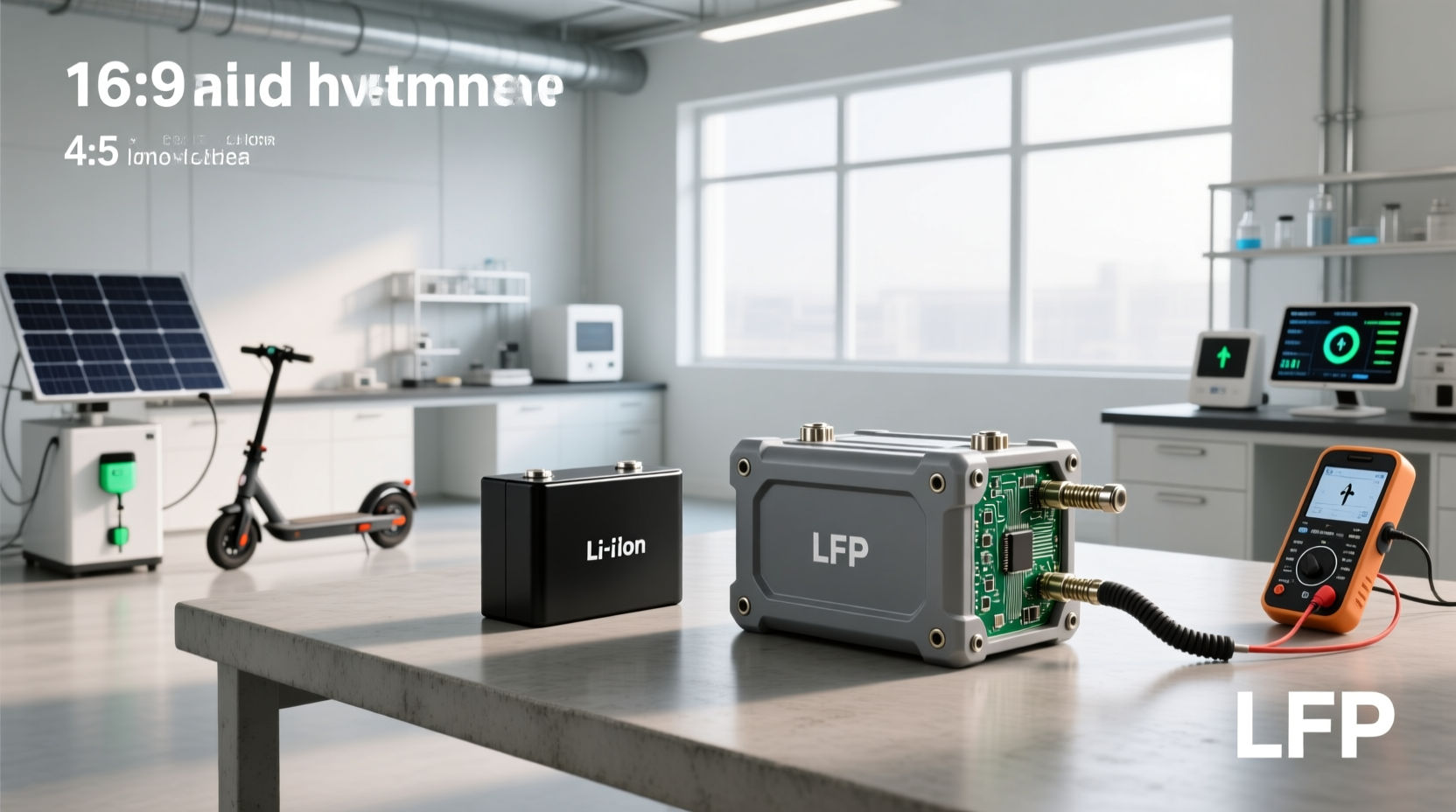
You’re not choosing between ‘better’ or ‘worse’ — you’re matching chemistry to use case. For stationary energy storage (solar, off-grid cabins, marine house banks), LiFePO4 (lithium iron phosphate) is almost always the superior long-term choice due to its 3–5× longer cycle life (2,000–10,000+ cycles), exceptional thermal stability, and tolerance for daily 100% depth-of-discharge 1. For portable electronics where weight, size, and peak power matter most — smartphones, laptops, wireless earbuds, drones — conventional lithium-ion (NMC or NCA) remains unmatched in energy density (150–250 Wh/kg vs. 90–120 Wh/kg for LiFePO4) and voltage platform (3.6–3.7 V nominal vs. 3.2 V) 2. This isn’t about upgrading — it’s about aligning battery physics with real-world demands. Below, we break down every technical, economic, and practical dimension so you can decide confidently — whether you’re sizing a 24V RV bank or selecting a power station for weekend camping.
Why This Comparison Matters Now
The global shift toward electrification has turned battery selection into a high-stakes decision. A mismatched choice doesn’t just cost money — it risks safety, shortens system life, or forces premature replacement. In 2024 alone, over 42% of residential solar installations in the U.S. used LiFePO4-based storage 3, while 98% of flagship smartphones continued using NMC lithium-ion. Yet confusion persists — especially because both are marketed as “lithium batteries.” The truth? They’re chemically distinct families with non-interchangeable strengths. Understanding the difference isn’t optional for installers, DIY energy builders, or even informed consumers buying a $2,000 portable power station.
Core Chemistry: Not Just Marketing Labels
Both LiFePO4 and conventional lithium-ion rely on lithium ions shuttling between anode and cathode during charge/discharge. But their cathode materials define everything else:
- Lithium-ion (NMC/NCA): Cathode made of nickel-manganese-cobalt oxide (NMC) or nickel-cobalt-aluminum oxide (NCA). High reactivity enables high voltage and energy density but increases thermal runaway risk under overcharge, mechanical damage, or high-temperature operation.
- LiFePO4 (LFP): Cathode built from lithium iron phosphate — an olivine-structured compound. Iron and phosphate bonds are far more stable, resisting oxygen release even at >200°C. This eliminates the primary ignition pathway seen in cobalt-based cells 4.
This fundamental difference explains why LFP batteries require no cobalt (reducing ethical sourcing concerns and raw material volatility) and why they tolerate full-state-of-charge storage without accelerated degradation — a critical advantage for solar systems that sit at 100% for days.
Safety: Thermal Stability Isn’t Optional — It’s Physics
When users search “LiFePO4 vs lithium ion,” safety is often the unspoken priority — especially after viral videos of swollen laptop batteries or EV fire recalls. Here’s what lab testing and field data show:
| Parameter | LiFePO4 | Standard Lithium-ion (NMC) |
|---|---|---|
| Onset temperature for thermal runaway | ≥270°C | 150–200°C |
| Heat generation during failure | Low (no oxygen release) | High (exothermic decomposition + O₂ release) |
| Flammability of electrolyte decomposition gases | Non-flammable (predominantly CO₂, H₂O) | Highly flammable (H₂, CH₄, C₂H₄) |
| BMS fault tolerance (e.g., single-cell overvoltage) | High — slower voltage rise, wider safe operating window | Low — rapid voltage climb; narrow margin before venting |
Real-world implication: An LFP battery damaged by impact may lose capacity but rarely ignites. An NMC cell subjected to identical stress has a documented 3–5× higher probability of thermal propagation in multi-cell packs 5. That’s why UL 9540A (the standard for battery system fire propagation testing) increasingly favors LFP for indoor or densely populated installations — including home energy storage certified for garage mounting.
Lifespan & Cycle Life: Beyond the “10-Year Warranty” Claim
Manufacturers advertise lifespan in years — but real-world longevity depends on how many full cycles a battery delivers at usable capacity. A “cycle” is defined as discharging 100% of rated capacity (not necessarily in one go). Here’s how they compare under standardized conditions (25°C, 0.5C charge/discharge, 80% depth of discharge):
- LiFePO4: 3,000–7,000 cycles to 80% remaining capacity. Some premium cells exceed 10,000 cycles when operated between 10–90% state-of-charge 6.
- Lithium-ion (NMC): 500–1,200 cycles to 80% capacity. Performance degrades faster below 10°C or above 35°C, and frequent 100% cycling cuts life by ~40%.
Crucially, LFP’s flat voltage curve (3.2–3.3 V across 80% of discharge) means consistent power delivery and simpler state-of-charge estimation — reducing BMS complexity and improving usable capacity accuracy. NMC’s sloping curve (3.0–4.2 V) requires precise voltage mapping, and small measurement errors translate to large SOC miscalculations — especially near extremes.
Energy Density & Physical Constraints: When Size and Weight Dictate Choice
Energy density — measured in watt-hours per kilogram (Wh/kg) or liter (Wh/L) — determines how much energy fits in a given mass or volume. This is where lithium-ion wins decisively:
- NMC lithium-ion: 180–250 Wh/kg, 500–700 Wh/L
- LiFePO4: 90–120 Wh/kg, 220–350 Wh/L
In practice, a 1 kWh NMC pack weighs ~4.5–5.5 kg and occupies ~3–4 liters. The same 1 kWh LFP pack weighs ~8–11 kg and needs ~5–7 liters. That 2.5× weight penalty matters profoundly for:
- 📱 Portable electronics — No smartphone could accommodate an LFP pack at current thickness targets.
- ✈️ Drones & e-bikes — Every 100 g impacts flight time or acceleration.
- 🚗 EVs with range anxiety — Though Tesla now uses LFP in standard-range Model 3/Y for cost and safety, its EPA range is ~10–15% lower than equivalent NMC versions.
But for fixed applications — like a 5 kWh solar battery bolted to your basement wall — weight and volume become secondary to lifetime cost and safety. As one installer put it: “You don’t move your AC condenser — why optimize for weight in a stationary battery?” 7.
Total Cost of Ownership: Upfront Price vs. Lifetime Value
Yes, LiFePO4 modules typically cost 15–30% more per kWh upfront than NMC equivalents. But total cost of ownership (TCO) flips the script over time:
| Metric | LiFePO4 (100Ah, 12.8V) | NMC Lithium-ion (100Ah, 12.8V) |
|---|---|---|
| Initial price (2024 avg.) | $850–$1,100 | $650–$850 |
| Expected cycles to 80% capacity | 4,000–6,000 | 800–1,200 |
| Total energy delivered (kWh) | 5,120–7,680 kWh | 1,024–1,536 kWh |
| Cost per delivered kWh | $0.11–$0.17 | $0.42–$0.83 |
Note: These figures assume proper BMS management, ambient temperatures of 15–25°C, and no warranty voidance from misuse. LFP’s lower self-discharge rate (1–3% per month vs. 2–5% for NMC) also reduces “idle loss” in seasonal applications like boat house banks or remote sensors 8. And because LFP tolerates partial states of charge without memory effect, users avoid complex “calibration cycles” required by some NMC devices.
Voltage Profile & Charging Requirements: Why You Can’t Swap Them
Swapping chemistries without adjusting charging parameters is the #1 cause of premature LFP failure. Key electrical differences:
- Nominal voltage: LiFePO4 = 3.2 V/cell; NMC = 3.6–3.7 V/cell. A 4S LFP pack is 12.8 V nominal; a 3S NMC pack is 11.1 V — making direct replacement impossible without voltage regulation.
- Full-charge voltage: LFP = 3.60–3.65 V/cell; NMC = 4.2 V/cell. Using an NMC charger on LFP risks chronic overvoltage — accelerating cathode corrosion and SEI growth.
- Charging profile: LFP benefits from constant-current/constant-voltage (CC/CV) but doesn’t require the tapering “absorption” phase NMC needs. Many LFP chargers skip absorption entirely — reducing charge time by 15–20%.
Bottom line: Never use a generic “lithium” charger unless explicitly rated for LiFePO4. Most quality LFP batteries include integrated BMS with cell-level balancing and low-temp charge cutoff (<0°C), but external chargers must respect those limits. Charging an LFP pack with a lead-acid or NMC profile may work once — but repeated use degrades cycle life by up to 60% 9.
Application Mapping: Where Each Chemistry Excels (and Fails)
Forget “best battery.” Focus instead on best-fit application:
✅ Strong LiFePO4 Candidates
- Solar + storage systems — Daily full cycling, long idle periods, safety-critical indoor placement.
- RV/marine house banks — Vibration resistance, wide temp range (-20°C to 60°C operational), no fire risk near living quarters.
- Golf carts & low-speed EVs — High discharge rates (up to 3C continuous), 2,000+ deep cycles, minimal maintenance.
- Off-grid telecom or sensor nodes — Low self-discharge, 10+ year calendar life, reliability over peak power.
✅ Strong Lithium-ion (NMC/NCA) Candidates
- Smartphones & tablets — Energy density dominates; safety managed via ultra-thin BMS and strict OEM firmware.
- Laptops & ultrabooks — Thin-profile cells, high burst power for CPU/GPU loads.
- Power tools — High discharge rates (up to 5C), compact form factor, fast recharge.
- Drones & FPV racers — Lightweight, high specific power (W/kg), rapid voltage response.
❌ Poor Fits for Both
- Wearable electronics (smartwatches, hearables): Neither LFP nor NMC scale well below ~500 mAh. Lithium-polymer (LiPo) dominates here due to ultra-thin flexible packaging.
- Extreme cold-start automotive SLI: Both chemistries suffer reduced cranking amps below -20°C. Lead-acid or AGM still lead in sub-zero engine starting.
Common Misconceptions — Debunked
Misconception #1: “LiFePO4 is just a ‘safer lithium-ion.’”
Reality: It’s a different cathode family — not a variant. LFP has lower conductivity, requiring carbon coating and nanostructuring for performance. Its voltage, kinetics, and failure modes are fundamentally distinct.
Misconception #2: “Higher voltage always means better performance.”
Reality: LFP’s lower voltage enables tighter cell-to-cell consistency and reduces insulation requirements — critical for high-voltage battery packs (e.g., 400V EV platforms).
Misconception #3: “All ‘lithium’ batteries need the same charger.”
Reality: Charging algorithms are chemistry-specific. Using the wrong profile causes lithium plating (LFP) or cathode dissolution (NMC) — irreversible damage.
How to Verify Claims Before Buying
Not all LFP or NMC batteries perform equally. Here’s how to vet them:
- Check datasheets — not marketing copy. Look for: cycle life graphs (not just “10,000 cycles”), calendar life at 25°C/40°C, and discharge curves at 0.2C, 1C, and 2C rates.
- Confirm BMS capabilities. Does it include cell-level voltage monitoring? Low-temp charge cutoff? Active balancing? Overcurrent protection (>150% rated)?
- Review third-party test reports. UL 1973, IEC 62619, and UN 38.3 certification are minimums. Look for UL 9540A (fire propagation) for stationary storage.
- Validate warranty terms. Does “10-year warranty” cover only defects — or capacity retention (e.g., “70% after 10 years”)? Is pro-rata proration disclosed?
If specs are vague or missing, assume worst-case performance. Reputable manufacturers publish full test data — not just highlights.
Frequently Asked Questions
- Can I replace my lead-acid RV battery with LiFePO4 using the same charger?
No. Lead-acid chargers apply bulk/absorption/float profiles incompatible with LFP. You’ll need an LFP-specific charger or a programmable unit set to 14.2–14.6 V absorption and 13.5 V float. - Do LiFePO4 batteries work well in cold weather?
They operate down to -20°C for discharge, but charging below 0°C causes lithium plating. Quality LFP batteries include low-temp cutoff in the BMS — never force charge frozen cells. - Is Tesla using LiFePO4 batteries?
Yes — in standard-range Model 3 and Model Y vehicles sold in North America and China since 2022. These use CATL and BYD LFP cells for improved safety and lower cost, though with slightly reduced range. - Why are LiFePO4 batteries heavier than lithium-ion?
Lower specific energy (Wh/kg) stems from the heavier atomic mass of iron and phosphate versus nickel/cobalt, plus lower operating voltage — requiring more cells in series to achieve the same pack voltage. - What’s the biggest disadvantage of LiFePO4?
Its lower energy density makes it impractical for weight- or space-constrained applications. Also, its flatter voltage curve complicates accurate state-of-charge estimation without coulomb counting or impedance tracking.
