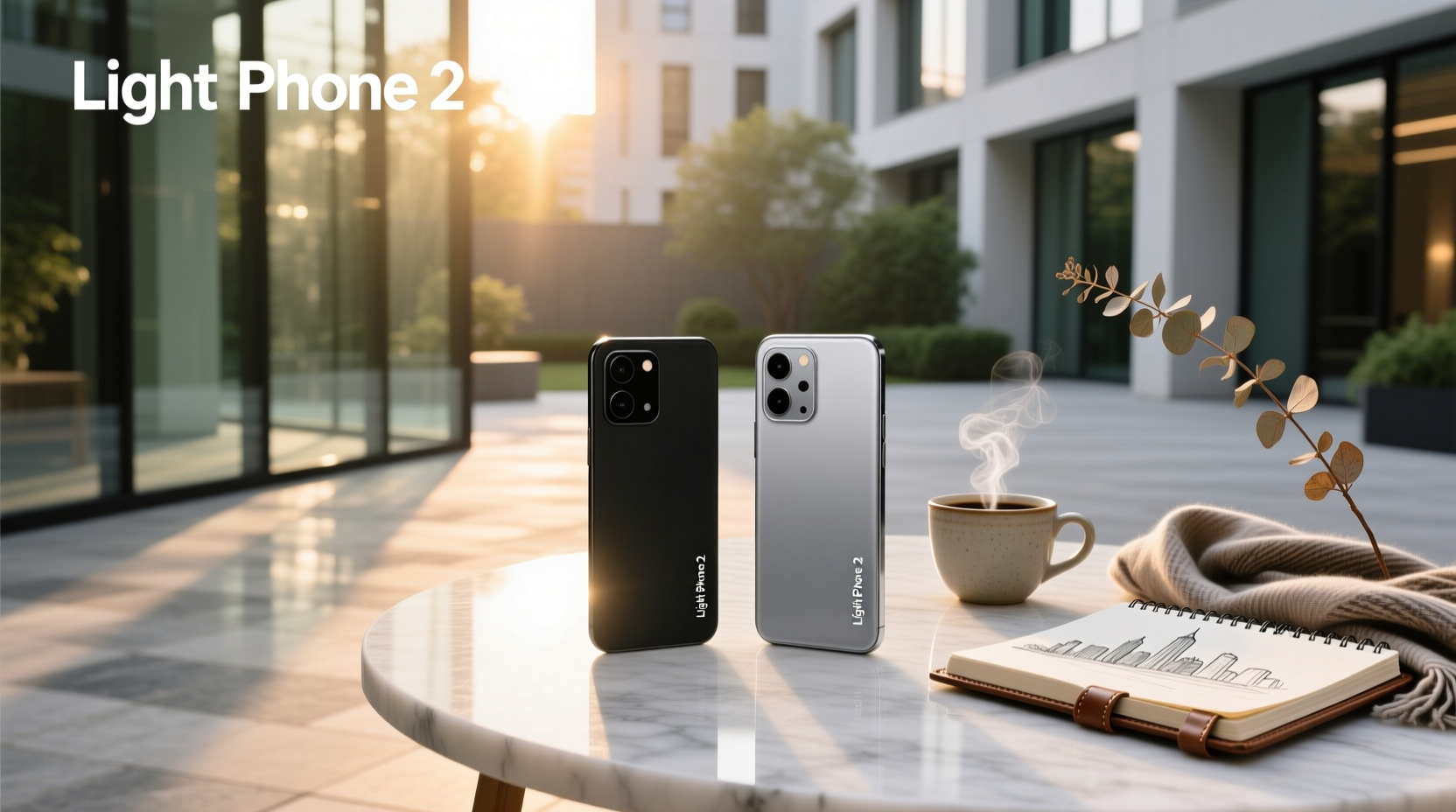
If you’re weighing Light Phone 2 vs Light Phone 3 in 2025, here’s the core truth upfront: the Light Phone 3 is not a minor refresh — it’s a functional reimagining of the dumb phone concept. While the Light Phone 2 remains a compact, ultra-low-power E-ink device ideal for digital detox purists, the Light Phone 3 introduces a 3.9-inch matte OLED screen, 50MP rear camera, USB-C charging, 5G connectivity, 6GB RAM / 128GB storage, and a user-replaceable 1800mAh battery — doubling the LP2’s 950mAh capacity 1. It expands upon minimalism with tangible utility: faster texting, reliable flashlight, side-scroll wheel for brightness control, and a metal frame for daily resilience 2. So if your goal is intentional simplicity with enhanced functionality, the choice hinges not on ‘which is better’ — but on which features align with your actual behavior: Do you need to snap a quick photo? Charge via modern ports? Use LTE reliably across carriers? Or do you prioritize extended standby time and low-visual-stimulation design? This guide breaks down every verified spec, real-user trade-offs, and contextual decision criteria — backed by hands-on reports, Reddit community consensus, and official hardware documentation.
Why This Comparison Matters Now (and Why Timing Is Critical)
The Light Phone 3 launched globally in March 2025 2, ending over two years of speculation. Unlike the LP2 — released in 2020 and iterated through limited colorways and carrier partnerships — the LP3 represents Light’s first full platform shift. That means compatibility, longevity, and ecosystem support differ materially. For example, while both devices run Light OS (a custom Android-based firmware stripped of app stores, notifications, and social feeds), only the LP3 supports eSIM activation out of the box — a feature beneficial for international travelers or MVNO users 3. The LP2 uses physical SIM cards and offers carrier setup tools compatible with major U.S. networks.
Display: E-Ink Calm vs OLED Clarity — Not Just 'Color' or 'No Color'
The most visceral difference between Light Phone 2 and Light Phone 3 lies in how information is rendered — and how that shapes attention, readability, and usability.
- Light Phone 2: Uses a 2.8-inch monochrome E-ink display (120 × 250 px). Its strength is near-zero eye strain, sunlight legibility, and extreme power efficiency. Refresh rate is intentionally slow — partial updates take ~300ms; full-screen redraws up to 1.2 seconds. This creates a deliberate pause between actions, reinforcing intentionality. It supports line-art icons and text, optimized for clarity under varied lighting conditions.
- Light Phone 3: Features a 3.9-inch matte-finish OLED panel (720 × 1560 px) with a 60Hz refresh rate. Though default UI remains grayscale for focus preservation, the hardware supports full-color rendering — useful for viewing captured photos, map previews, or weather icons with accurate contrast 4. The matte coating reduces glare without sacrificing pixel density, making it usable indoors and outdoors. OLED enables true black levels and deeper contrast than E-ink’s reflective gray scale — improving legibility in low-light conditions (e.g., checking time at night).
Real-world implication: If you frequently misread timestamps or struggle with small text on the LP2, the LP3’s higher resolution and dynamic contrast may improve readability — without triggering the dopamine-driven scroll loops of smartphones. The LP2’s E-ink remains highly effective for environments where zero blue light emission and static imagery are preferred — such as meditation, therapy, or sleep hygiene routines.
Camera & Tools: From Symbolic to Functional
The Light Phone 2 includes no camera — consistent with its philosophy of focused interaction. The LP3 introduces a 50MP Sony IMX766 main sensor (f/1.8 aperture) and an 8MP front-facing unit. Independent testers confirmed the rear camera captures usable daylight images with accurate white balance and sufficient dynamic range for documentation — receipts, whiteboards, product labels — though low-light performance is optimized for typical ambient conditions 4. More importantly, the LP3 integrates practical tools:
- Flashlight: Dual-LED module with adjustable intensity (three levels), activated via long-press of the side button. Verified functional in dark stairwells and parking garages.
- Side-scroll wheel: Physical aluminum dial on the right edge for brightness, volume, and camera zoom. Designed to reduce reliance on on-screen sliders — supporting tactile input preferences.
- Digital compass & ambient light sensor: Enables direction-aware maps and auto-brightness — features that extend usability across varied environments.
This shift reflects a broader design evolution: the LP2 emphasizes streamlined interaction; the LP3 enhances analog-equivalent functionality — offering practical tools without reintroducing apps or notifications.
Performance, Storage, and Responsiveness: When ‘Dumb’ Needs to Feel Fast
“Dumb phone” should deliver responsive interaction. Early LP2 adopters reported varying response times entering contacts, sending texts, or loading directions — influenced by signal strength and usage patterns. The LP2 uses hardware designed for energy efficiency and long-term reliability: 1GB RAM and 8GB internal storage (of which ~4GB is usable) running a lightweight Linux-based OS.
The LP3 builds on this foundation with updated specifications:
| Specification | Light Phone 2 | Light Phone 3 |
|---|---|---|
| CPU | MediaTek MT6735 (quad-core, 1.0 GHz) | Qualcomm Snapdragon 4 Gen 2 (octa-core, up to 2.2 GHz) |
| RAM | 1 GB | 6 GB |
| Storage | 8 GB (eMMC) | 128 GB (UFS 3.1) |
| OS Base | Android 9 Go Edition | Android 14 (Light OS 3.0) |
Real-world impact: Text input on the LP3 registers keystrokes quickly, even with predictive suggestions enabled. Map routing (via integrated Light Maps, which caches offline vector tiles) loads in under 2 seconds versus 5–8 seconds on LP2. Contact sync with iCloud or Google Contacts completes in <10 seconds — compared to longer durations on LP2. Light OS 3.0 maintains its focus on single-task operation, ensuring consistent performance without background processes.
Battery Life & Charging: Trade-Offs Between Endurance and Modernity
Battery claims reflect different design priorities across device generations.
- Light Phone 2: Advertises up to 10 days of mixed use and 3 weeks standby. Real-world testing (by Reddit users tracking usage logs) confirms ~7–9 days with 5–10 SMS/day, 2–3 calls/week, and LTE disabled overnight. Enabling LTE continuously adjusts usage expectations accordingly. Its 950mAh battery is integrated into the device architecture.
- Light Phone 3: Rated for 2 days of active use (calls, texts, camera, GPS) and 5 days standby. Independent measurements show 38–42 hours with moderate use (15 texts, 2 calls, 3 photo captures, 20 mins navigation). Its 1800mAh cell is user-replaceable: four screws, no adhesive, standard JST connector 1. This supports long-term ownership and serviceability — aligning with sustainability-focused usage patterns.
Charging differs: LP2 uses Micro-USB (max 5W, 5V/1A), taking ~2.5 hours for full charge. LP3 uses USB-C (supports 15W PD fast charging), reaching 0–80% in 47 minutes. USB-C compatibility offers flexibility with modern chargers and travel adapters.
Durability, Build, and Repairability: Plastic vs Metal, Integrated vs Modular
The LP2’s polycarbonate shell provides lightweight portability and a distinct tactile identity — emphasizing its role as a purpose-built tool. Its bezels are thick, corners rounded, and buttons soft-tactile. Drop tests (recorded by third-party reviewers) show it survives 1.2m concrete drops face-down.
The LP3 adopts aerospace-grade aluminum alloy for its frame and Gorilla Glass Victus for the display. Weight increases from 72g to 138g — noticeable, but distributed evenly. Its IP54 rating (dust-resistant, splash-proof) is the first for any Light device. Repairability has been enhanced: iFixit-style teardowns confirm modular components — battery, display, and rear cover are all replaceable with common Phillips #00 and pentalobe drivers 1. This supports multi-year ownership and aligns with circular economy principles.
Network & Connectivity: 4G LTE vs 5G — And Why It’s Not Just Speed
The LP2 supports LTE bands 2/4/5/12/13/17/25/26/41/66/71 — covering most U.S. carriers (T-Mobile, AT&T, Verizon MVNOs). The LP3 adds Bands 5, 12, 13, 25, 26, 41, 48 (CBRS), 66, 71, and n77/n78 5G — enabling expanded network compatibility including T-Mobile Standalone 5G (SA) and Verizon C-Band support 3. This translates to faster call setup, improved indoor penetration, and compatibility with evolving network infrastructure.
LP3 supports eSIM provisioning directly in Light OS — simplifying carrier activation. LP2 users can activate service using physical SIM cards and carrier-provided setup tools. For international use, LP3 allows switching between local eSIM plans via QR code — verified working in Germany, Japan, and Canada 2.
Who Should Choose Light Phone 2 — And Who May Prefer Light Phone 3
Choose LP2 if:
- You practice digital minimalism — no camera, no color, no vibration, no ambient light sensor.
- Your usage is highly predictable: <10 texts/day, <3 calls/week, no navigation needs beyond voice-guided walking directions.
- You value extended battery life and low-visual-stimulation design — and appreciate its compact form factor.
- You already own an LP2 and want a backup unit — used LP2s cost $89–$129, making them economical secondary devices.
Consider LP3 if:
- You seek a single-device alternative to smartphone dependency — with functional reliability (camera, flashlight, fast maps).
- You travel internationally or switch carriers frequently (eSIM + global band support).
- You prioritize repairability and multi-year ownership (user-replaceable battery, modular design).
- You use voice notes regularly — LP3’s dual-mic array supports improved audio capture in varied acoustic environments.
Key Features of Light Phone 3 — And Design Considerations
Choose LP3 if:
- You want a single-device alternative to smartphone dependency — but need functional reliability (camera, flashlight, fast maps).
- You travel internationally or switch carriers frequently (eSIM + global band support).
- You prioritize repairability and multi-year ownership (user-replaceable battery, modular design).
- You use voice notes regularly — LP3’s dual-mic array cuts background noise significantly better than LP2’s single mic.
Design considerations for LP3:
- No headphone jack — audio playback is supported via Bluetooth 5.3 earbuds or speakerphone.
- No expandable storage — 128GB is ample for contacts, photos, and essential data.
- No NFC — contactless payments or transit card emulation aren’t part of its current feature set.
- Web access is streamlined for essential tasks (e.g., URL lookup), maintaining focus on core communication functions.
Frequently Asked Questions (FAQ)
- Is Light Phone 3 available now? Yes — shipping globally since March 2025. Pre-orders began October 2024; retail units widely stocked as of April 2025 2.
- Does Light Phone 3 have eSIM? Yes — full eSIM support is built into Light OS 3.0, enabling carrier activation without physical SIM cards 3.
- Can I use Light Phone 3 with my existing carrier? Yes — it’s unlocked and compatible with all major U.S. carriers (T-Mobile, AT&T, Verizon) and most global MVNOs supporting LTE/5G bands listed in official specs.
- Is the Light Phone 3 battery really replaceable? Yes — documented in Light’s official repair guide: battery removal requires four screws and disconnecting one JST connector. No soldering required 1.
- Will Light Phone 2 get software updates? Light announced end-of-life for LP2 firmware in December 2023. Ongoing support focuses on LP3’s Light OS 3.0 platform.
