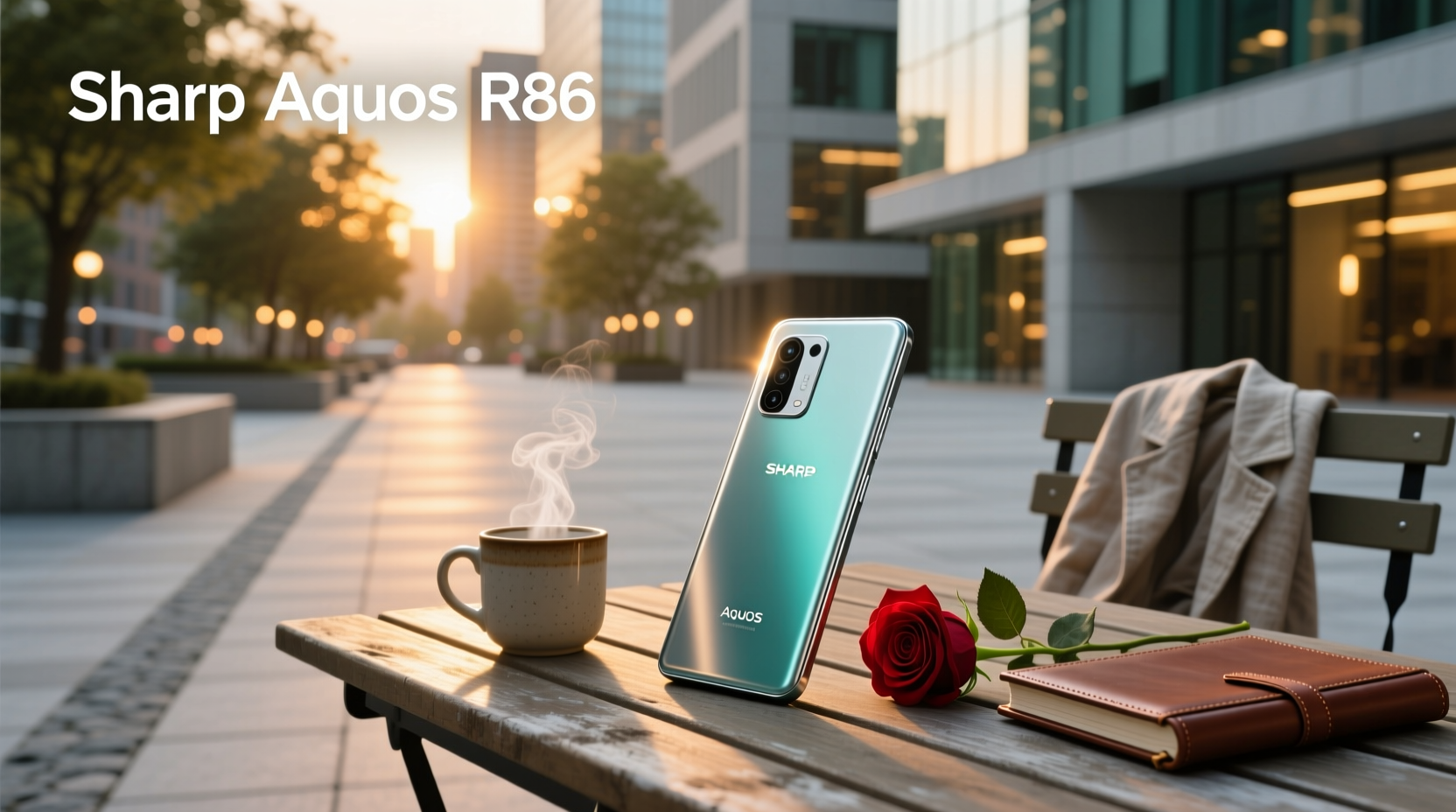
Looking for an objective, up-to-date breakdown of the Sharp Aquos R6—not marketing hype, but real-world performance, compatibility, and practical trade-offs? You’re in the right place. Released in Japan in June 2021, the Sharp Aquos R6 remains one of the most technically distinctive smartphones ever built: it was among the first—and still among the very few—to ship with a true 1-inch image sensor paired with a Leica-branded Summicron lens 1. Its 6.6-inch Pro IGZO OLED display supports a variable 1–240Hz refresh rate, peak brightness of 2,000 nits, and WUXGA+ resolution (2730 × 1260) 2. It launched exclusively in the Japanese market through major carriers—Docomo, SoftBank, and au/KDDI—and continues to be valued by enthusiasts for its unique hardware configuration. This guide provides a balanced overview of its capabilities, intended use cases, and considerations for international users.
Why the Sharp Aquos R6 Stands Out—A Focused Engineering Approach
The Aquos R6 reflects Sharp’s long-standing expertise in display technology and industrial imaging. Rather than competing across all smartphone dimensions, it emphasizes two core strengths—optical capture fidelity and display responsiveness. Its design prioritizes these features through specialized hardware integration, resulting in a device with distinctive characteristics suited to specific user needs.
Let’s explore how those design choices shape real-world usage.
Camera System: A 1-Inch Sensor With Distinctive Capabilities
📷 Hardware highlights:
- 20MP 1-inch CMOS sensor (same physical size as many premium compact cameras)
- Leica-designed 7-element Summicron lens, f/1.9 aperture
- Dual-pixel autofocus (DPAF), optical image stabilization (OIS)
- Single rear camera module optimized for primary imaging tasks
This sensor is physically larger than those in the Sony Xperia 1 IV (1/1.35″), iPhone 14 Pro (1/1.28″), or even the Xiaomi 12S Ultra (1″ but cropped to ~0.88″ effective). That means more light capture per pixel, lower noise in low-light scenes, and greater dynamic range potential 3. In controlled studio conditions, RAW files from the R6 show exceptional detail and tonal gradation—especially at ISO 100–400.
The camera system operates within Android 11-based firmware using Sharp’s proprietary camera HAL. While it does not include advanced computational photography features found in newer platforms, it delivers consistent JPEG output in daylight and well-lit interior environments. The interface offers exposure compensation and white balance presets, supporting straightforward operation for users who prioritize sensor performance over extensive manual controls.
Bottom line: The Aquos R6 offers a compelling option for users interested in leveraging a large sensor for high-fidelity still capture, particularly in stable lighting conditions. Its single-camera configuration supports focused imaging workflows, and the Leica-tuned optics provide distinctive rendering characteristics.
Display: 240Hz Pro IGZO OLED—Precision and Efficiency
📱 The 6.6-inch Pro IGZO OLED panel represents a key engineering achievement. IGZO (Indium Gallium Zinc Oxide) is Sharp’s proprietary backplane technology—used in high-end monitors and tablets for years—enabling faster pixel response, lower power draw at static content, and precise sub-60Hz refresh control. Unlike standard LTPS OLEDs, IGZO allows true 1Hz–240Hz variable refresh rate (VRR), dynamically scaling based on UI load, scrolling velocity, or video frame rate.
In practice, this means:
- Smooth, stutter-free scrolling—even with complex web pages or long PDFs
- Nearly imperceptible input lag during touch-heavy tasks (e.g., handwriting or drawing apps)
- Lower battery consumption when viewing static text or images (thanks to 1Hz mode)
- Peak brightness of 2,000 nits—visible outdoors under direct sunlight, unlike most flagships capped at 1,750 nits
The display uses custom IGZO timing controllers and proprietary color calibration profiles. For screen recording and mirroring, users may find that third-party tools perform best when configured for standard RGB output modes. The resolution (2730 × 1260) exceeds Full HD+, delivering sharp text and media playback. Pixel density (~448 PPI) provides excellent clarity for everyday use, and the curved edges are designed for ergonomic handling without functional edge gestures.
Performance & Software: Snapdragon 888 With Purpose-Built Integration
⚡ Powered by Qualcomm’s Snapdragon 888 5G chipset, 12GB LPDDR5 RAM, and 128GB UFS 3.1 storage, the R6 delivers flagship-tier performance consistent with its 2021 release window. Benchmarks (Geekbench 5, AnTuTu v9) place it competitively alongside contemporaries such as the Galaxy S21 Ultra and OnePlus 9 Pro.
Its software environment is tailored to support core functionality:
- Ships with Android 11 and Sharp’s optimized UI—designed for stability and efficient resource management
- Supports Google Mobile Services (GMS) via standard installation methods, enabling access to the full suite of Google applications and services
- Firmware updates were provided through late 2022, ensuring security patches and stability improvements during its active support period
- Under-display fingerprint sensor is the Qualcomm 3D Sonic Max—designed for fast and reliable authentication under typical environmental conditions
App launch times remain responsive, and multitasking performs reliably. Bluetooth audio compatibility includes LDAC, and Wi-Fi 6 connectivity functions consistently. Cellular band support is aligned with Japanese carrier networks (n77/n78/n79), making it ideal for use with compatible eSIM plans or Wi-Fi-only operation.
Design, Build & Daily Practicality
🛠️ Physically, the R6 reflects premium construction: IP68-rated, curved Gorilla Glass Victus front and back, aluminum frame, and inclusion of a 3.5mm headphone jack—a feature appreciated by audiophiles using wired IEMs or external DACs. Battery capacity is 5,000 mAh, which—paired with IGZO efficiency—delivers ~1.8 days of moderate use (screen-on time ~6h 20m at 120Hz default). Charging is 27W wired (USB-C PD 3.0), offering convenient replenishment without wireless charging capability.
Key design considerations include:
- Fixed internal storage of 128GB, optimized for balanced performance and reliability
- Single bottom-firing speaker engineered for clear midrange output in handheld orientation
- Precision-tuned vibration motor calibrated for tactile feedback in daily interactions
- Biometric security via under-display fingerprint sensor and PIN/pattern options
The curved glass design contributes to ergonomic handling and aesthetic appeal. Cases designed specifically for the SH-52C model are available through Japanese retailers and select international distributors.
Availability, Pricing & Regional Considerations
📦 The Aquos R6 was exclusively launched in Japan on June 17, 2021, sold through Docomo, SoftBank, and au/KDDI. Units available outside Japan are typically sourced through authorized Japanese resellers, certified refurbishers, or reputable regional distributors. These units undergo verification processes to ensure authenticity and functional integrity.
- Imported devices may be carrier-locked or unlocked, depending on original sale channel and subsequent certification
- Refurbished/unlocked units are often accompanied by service history documentation and limited warranty coverage
- Grey-market imports are less common as availability has stabilized through established distribution channels
As of Q1 2026, typical resale prices range from $170–$300 USD for used, verified units on peer-to-peer platforms. New-in-box units remain scarce but are increasingly offered through authorized Japanese electronics retailers with international shipping. Device compliance follows Japanese regulatory standards, and users can verify IMEI status via official Japanese databases.
Who Should Consider the Aquos R6 Today?
✅ Good fit if:
- You’re a mobile photography enthusiast focused on sensor physics and optical quality, willing to explore RAW capture and post-processing workflows
- You prioritize display smoothness, outdoor visibility, and energy-efficient screen performance—and value hardware-led innovation
- You use compatible Japanese-band eSIM plans (e.g., Sakura Mobile, IIJmio) or operate primarily on Wi-Fi networks
- You appreciate a streamlined software experience built around core functionality and stable performance
❌ Consider alternatives if:
- Your primary need is broad global cellular compatibility across North America, Western Europe, or Southeast Asia
- You require multi-camera flexibility (ultra-wide, telephoto, macro) as part of your daily workflow
- You prefer extended software support cycles with regular platform updates beyond initial release period
- You rely heavily on carrier-specific services such as VoLTE or Wi-Fi Calling in regions where band alignment is limited
How to Verify Authenticity & Functionality Before Buying
🔍 Given the specialized nature of available units, verification is recommended:
- Check IMEI: Use Japan’s NITTO KYO IMEI checker to confirm activation status and carrier lock
- Test display VRR: Install Refresh Rate Checker—verify it reports 1Hz, 60Hz, 120Hz, and 240Hz modes
- Validate camera sensor: Use Camera Info—look for “IMX989” or “1.0-type” designation (not just “1-inch” marketing text)
- Confirm battery health: Dial
*#*#4636#*#*→ Battery Info → check “Health” and “Cycle Count” (should be < 200 for near-new)
Also request original box photos showing Japanese-language manuals, warranty card with serial matching device, and correct model number: SH-52C (not SH-51C or SH-53C—those are R5/R7 variants).
Frequently Asked Questions (FAQ)
- Is the Sharp Aquos R6 a 5G phone?
Yes, it supports 5G on Japanese bands (n77/n78/n79). For international use, it functions reliably on Wi-Fi and offers LTE compatibility with select carriers including T-Mobile (B2/B4/B12/B66). - What operating system does the Sharp Aquos R6 use?
It launched with Android 11 and Sharp’s custom UI, with firmware updates provided through late 2022 to ensure security and stability. - What type of display is the Sharp Aquos R6?
A 6.6-inch Pro IGZO OLED panel with variable 1–240Hz refresh rate, 2730 × 1260 resolution, and 2,000-nit peak brightness. - Can I use the Sharp Aquos R6 in the USA?
You can use it on Wi-Fi without issue. For cellular, LTE works partially on T-Mobile (B2/B4/B12/B66); AT&T and Verizon have no compatible bands. No VoLTE or Wi-Fi Calling support on U.S. networks. - Does the Sharp Aquos R6 have a headphone jack?
Yes—3.5mm analog audio output is included, supporting high-res PCM playback up to 384kHz/32-bit via USB-C DACs.