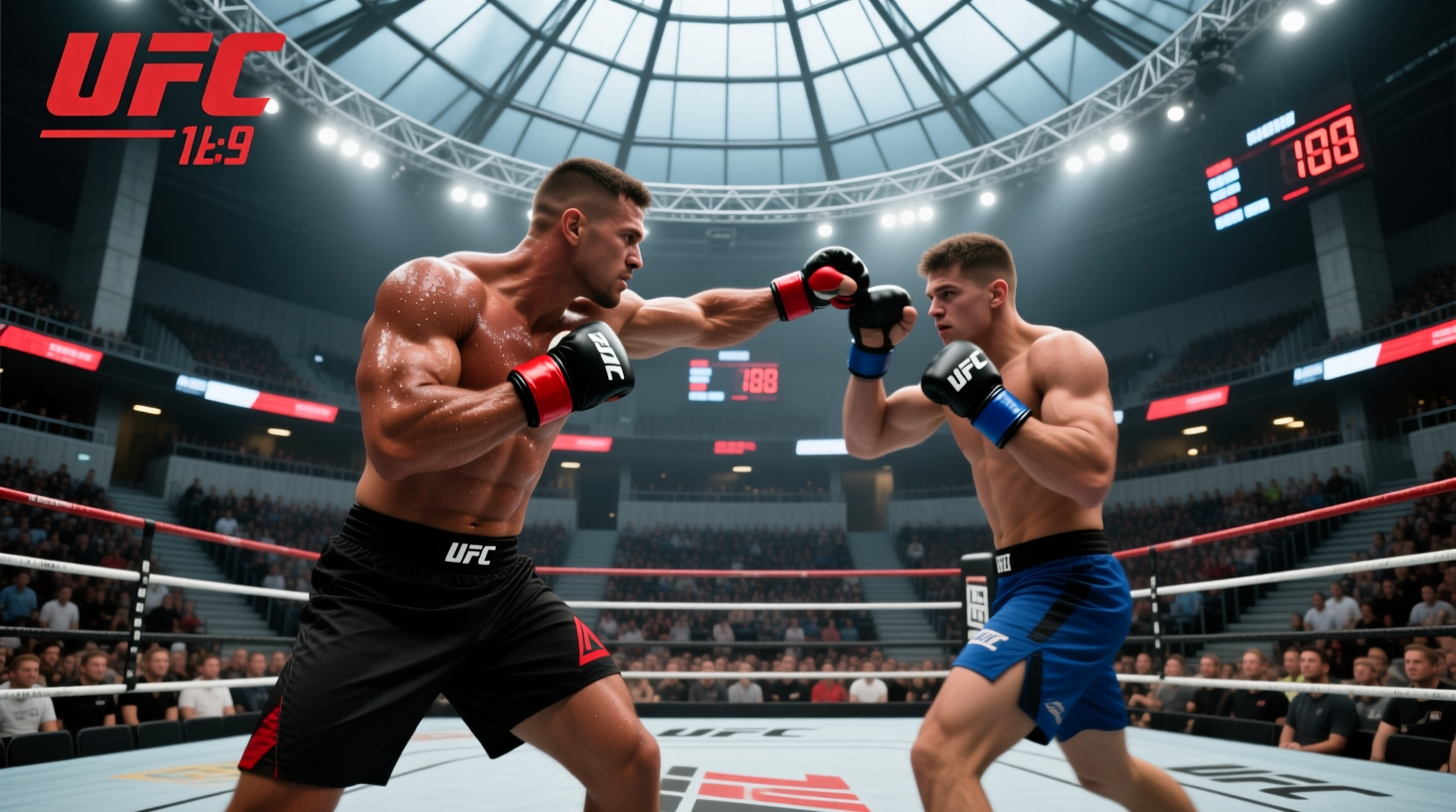
UFC is not boxing—it’s mixed martial arts (MMA). While boxing restricts fighters to punches above the waist with gloves, UFC permits striking (including boxing techniques), takedowns, grappling, ground fighting, and submissions across all ranges—making it a multidisciplinary combat sport1. If you searched "ufc boxing", you likely assumed UFC includes traditional boxing matches or that its fighters compete under boxing rules—but that’s a common misconception. This guide clarifies the structural, regulatory, and practical distinctions between UFC and boxing, explains where boxing skills appear *within* UFC, and helps you navigate live event access, regional broadcast differences, and historical context—so you stop confusing the two sports and start watching or following with accurate expectations.
Why People Confuse UFC With Boxing—and Why It Matters
The confusion arises from visible overlap: many UFC fighters train in boxing, use jab-cross combinations, wear similar gloves, and fight in a ring (though UFC uses an octagon). Broadcasters sometimes say “he landed a clean boxing combo” or highlight a fighter’s “Olympic boxing background”—reinforcing the association. But functionally, boxing and UFC operate under entirely separate rule sets, sanctioning bodies, judging criteria, and athletic development pathways.
This matters for viewers, new fans, athletes considering cross-training, and even bettors. Misunderstanding the scope of legal techniques—e.g., assuming kicks, knees, or chokes are allowed in boxing, or that UFC rounds end after 3 minutes regardless of action—leads to misinterpretation of outcomes, poor viewing decisions, or unrealistic training goals. Clarifying this early prevents downstream confusion about event scheduling, athlete preparation, and competitive fairness.
Core Structural Differences: Rules, Equipment & Scoring
Understanding how each sport defines legality, victory, and performance is foundational. Below is a direct comparison:
| Feature | Boxing | UFC (MMA) |
|---|---|---|
| Governing Body | WBC, WBA, IBF, WBO (sanctioned nationally/regionally) | State Athletic Commissions (e.g., NSAC, CSAC) + Unified Rules of Mixed Martial Arts |
| Fighting Area | Squared ring (typically 16–20 ft per side) | Octagonal cage (30 ft diameter; steel fence & padded canvas) |
| Allowed Techniques | Punches only (above waist); no kicks, knees, elbows, takedowns, or ground fighting | Punches, kicks, knees, elbows, takedowns, clinching, submissions (chokes, joint locks), ground-and-pound |
| Rounds & Duration | 12 rounds × 3 min (championship); 4–10 rounds × 2–3 min (non-title) | 5 rounds × 5 min (title fights); 3 rounds × 5 min (non-title); 1-min rest between rounds |
| Gloves | 8–10 oz (pro), 12–16 oz (amateur); heavily padded, open-thumb design | 4 oz; less padding, fingerless design for grappling control |
| Victory Conditions | KO, TKO, decision (10-point must system), disqualification, retirement | KO, TKO, submission, decision (10-point must system), DQ, doctor stoppage, corner stoppage, forfeit |
Note: While both use the 10-point must system, UFC judges weigh effective striking, grappling, aggression, and cage/ring control *equally*, whereas boxing judges prioritize clean punching volume, defense, and ring generalship—with no credit for takedowns or submission attempts.
Where Boxing Fits Inside UFC—And Why It’s Just One Tool
Boxing is not absent from UFC—it’s embedded. Roughly 70% of UFC fighters list boxing as a core discipline in their background, especially among stand-up oriented competitors like Jon Jones, Dustin Poirier, and Valentina Shevchenko. However, in UFC, boxing serves as a *component*, not the entire system. A fighter may throw a textbook jab-cross-hook sequence—but if their opponent shoots a double-leg takedown immediately after, the boxing exchange becomes relevant within a broader strategic context requiring integrated skill application.
This integration creates strategic complexity characteristic of MMA. For example:
- A boxer’s footwork supports evasion of punches and also positions for takedown defense.
- Head movement contributes to punch avoidance and also prepares for clinch entries and uppercut defense.
- Defensive posture balances hand protection with readiness for grappling exchanges and transitions.
So while elite boxing technique enhances a UFC fighter’s striking efficiency and timing, success in UFC reflects balanced proficiency across multiple disciplines—including wrestling, jiu-jitsu, and Muay Thai. That’s why many successful UFC athletes develop integrated training regimens from the outset2.
How to Watch UFC Events Legally—And Why “UFC on YouTube” Isn’t Full Coverage
Many users searching "ufc boxing" land on YouTube clips or Brazilian broadcaster pages—then wonder why full cards aren’t available. Here’s what’s actually accessible—and where regional restrictions apply:
- UFC Fight Pass: The official subscription service offering live PPV prelims, archived events (1993–present), documentaries, and regional shows. Available globally—with content libraries aligned to local licensing agreements3.
- YouTube: Highlights, post-fight interviews, and select classic full fights (e.g., Makhachev vs. Tsarukyan4). No live main cards or prelims—consistent with platform policies for premium live content.
- Brazil-specific coverage: Combate and Bandeirantes hold linear TV rights; ESPN Brasil’s UFC Fightcenter provides real-time stats and card updates alongside complementary analysis.
To verify current availability: visit UFC.com.br for localized event listings, then cross-check with your regional UFC Fight Pass dashboard. Time zones matter: Abu Dhabi events (e.g., Sandhagen vs. Nurmagomedov, Aug 3, 2024) stream at 2:00 PM ET—*not* local time5. Use UFC’s official “Event Time Zone Converter” tool before scheduling viewing.
Common Misconceptions—Debunked With Evidence
Based on “People Also Ask” data, three persistent myths need correction:
❌ "UFC has boxing matches."
No. UFC does not host standalone boxing bouts. Even when former boxers like Claressa Shields or Roy Jones Jr. appear, they compete under Unified MMA Rules—not boxing rules. Their boxing experience informs technique, but the contest format remains MMA.
❌ "UFC and boxing use the same gloves and safety standards."
False. UFC gloves expose fingers for grappling and reduce padding to allow grip and control—supporting diverse techniques within MMA’s framework. Boxing gloves prioritize hand protection and punch absorption. Research indicates differing injury profiles: UFC fighters sustain more facial lacerations but fewer concussions per hour of exposure than elite boxers—attributed to round length, pacing variability, and medical protocols6.
❌ "A boxer would dominate a UFC fighter in a real fight."
Context determines outcome. In a boxing-only scenario: yes. In an unrestricted environment governed by MMA rules: outcomes depend on technical execution, strategy, and adaptability across ranges. UFC fighters train extensively to integrate striking with takedowns, clinch control, and ground dominance—reflecting the sport’s multidisciplinary nature.
Training Implications: What Athletes Should Know Before Switching
If you’re a boxer considering MMA—or an MMA athlete adding boxing—you need realistic expectations:
- For boxers entering UFC: Expect 6–12 months minimum to develop competent takedown defense and foundational grappling awareness. Wrestling or judo fundamentals support long-term progression.
- For UFC fighters refining boxing: Focus on rhythm disruption (feints, angles, level changes) rather than pure volume. Integrate upper-body movement with situational readiness for transitions.
- Coaching note: Always contextualize boxing drills within sparring scenarios that include grappling entries. Integrated practice reinforces functional application across phases of MMA.
Certified coaches recommend using technical integration sessions—e.g., 3-minute rounds where Boxer A throws combos while Boxer B must shoot takedowns after every third punch—to simulate real pressure.
Regional Variations: How Broadcast Access Differs in Brazil, US, and EU
What you can watch—and when—depends heavily on geography:
| Region | Main Live Provider | Free Options? | Language Support | Notes |
|---|---|---|---|---|
| Brazil | Combate (linear), Bandeirantes (linear), UFC Fight Pass (streaming) | No free live main cards; some prelims on Combate Play | Portuguese commentary only on linear TV; Fight Pass offers English/Portuguese toggle | ESPN Brasil’s Fightcenter provides stats and analysis alongside video-free updates |
| United States | ESPN+ (exclusive), UFC Fight Pass (archival) | No free live coverage; ESPN+ requires subscription | English primary; Spanish audio available on select events | PPV main cards require additional purchase beyond ESPN+ base tier |
| European Union | Dazn (varies by country), UFC Fight Pass | Limited free highlights on Dazn app; no full live events without subscription | Multilingual commentary (English, German, French, Spanish) | UK uses TNT Sports; Germany uses DAZN; France uses Canal+ |
Always verify via UFC.com’s “Where to Watch” page—updated weekly—and check your local provider’s schedule. Time zone converters are essential: a 10 PM UK broadcast may be 5 PM ET or 6 AM JST.
Upcoming UFC Events: Contextualizing the 2024–2026 Calendar
Recent search data references events like UFC Seattle (Adesanya vs. Pyfer), UFC Miami (Prochazka vs. Ulberg), and UFC Newark (Chimaev vs. Strickland). These are *MMA* cards—not boxing. Key facts:
- All feature fighters with diverse backgrounds: Adesanya (kickboxing), Prochazka (karate), Chimaev (wrestling + boxing).
- No boxing-specific weight classes exist in UFC. “Lightweight” in UFC = 155 lbs; in boxing = 135 lbs—different standards reflect distinct sport structures.
- Card structure follows MMA norms: prelims (UFC Fight Pass), early prelims (ESPN+/UFC.com), main card (PPV or ESPN+).
For real-time updates—including confirmed fight times, injury replacements, and referee assignments—use the official UFC app or UFC.com.br. Third-party sites often lag by 24–48 hours.
How to Verify Information Yourself—A Step-by-Step Guide
Because broadcast rights, fighter statuses, and rules evolve, rely on primary sources:
- Confirm event date/time: Go to UFC.com → Events → Select event → Click “Time Zone Converter.”
- Check fighter eligibility: Search the fighter’s name + “NSAC license status” or “CSAC suspension history.” State commission sites publish real-time disciplinary records.
- Validate rule applications: Download the Unified Rules PDF—updated annually by the Association of Boxing Commissions.
- Assess broadcast accuracy: If a site claims “UFC live on YouTube,” check its domain and publication date. Official UFC uploads include “UFC” in the channel name and display verified checkmarks.
Frequently Asked Questions (FAQ)
Q: Does UFC have boxing matches?
A: No. UFC exclusively hosts MMA contests under the Unified Rules. Former boxers compete under MMA rules—not boxing rules.
Q: Can a boxer beat a UFC fighter?
A: Only under boxing rules. In an unrestricted setting governed by MMA rules, outcomes depend on integrated skill execution across striking, grappling, and positional control.
Q: Why do UFC fighters use boxing techniques?
A: Boxing provides efficient, high-percentage striking fundamentals—footwork, timing, defense, and power generation—that transfer effectively to MMA’s stand-up phase.
Q: Where can I watch UFC events legally in Brazil?
A: Live main cards air on Combate and Bandeirantes; prelims stream on UFC Fight Pass. ESPN Brasil’s Fightcenter offers real-time stats, analysis, and supplementary coverage.
Q: Is UFC safer than boxing?
A: Risk profiles differ. UFC has higher laceration rates but lower per-hour concussion incidence due to round length, varied pacing, and mandatory medical suspensions after knockouts.