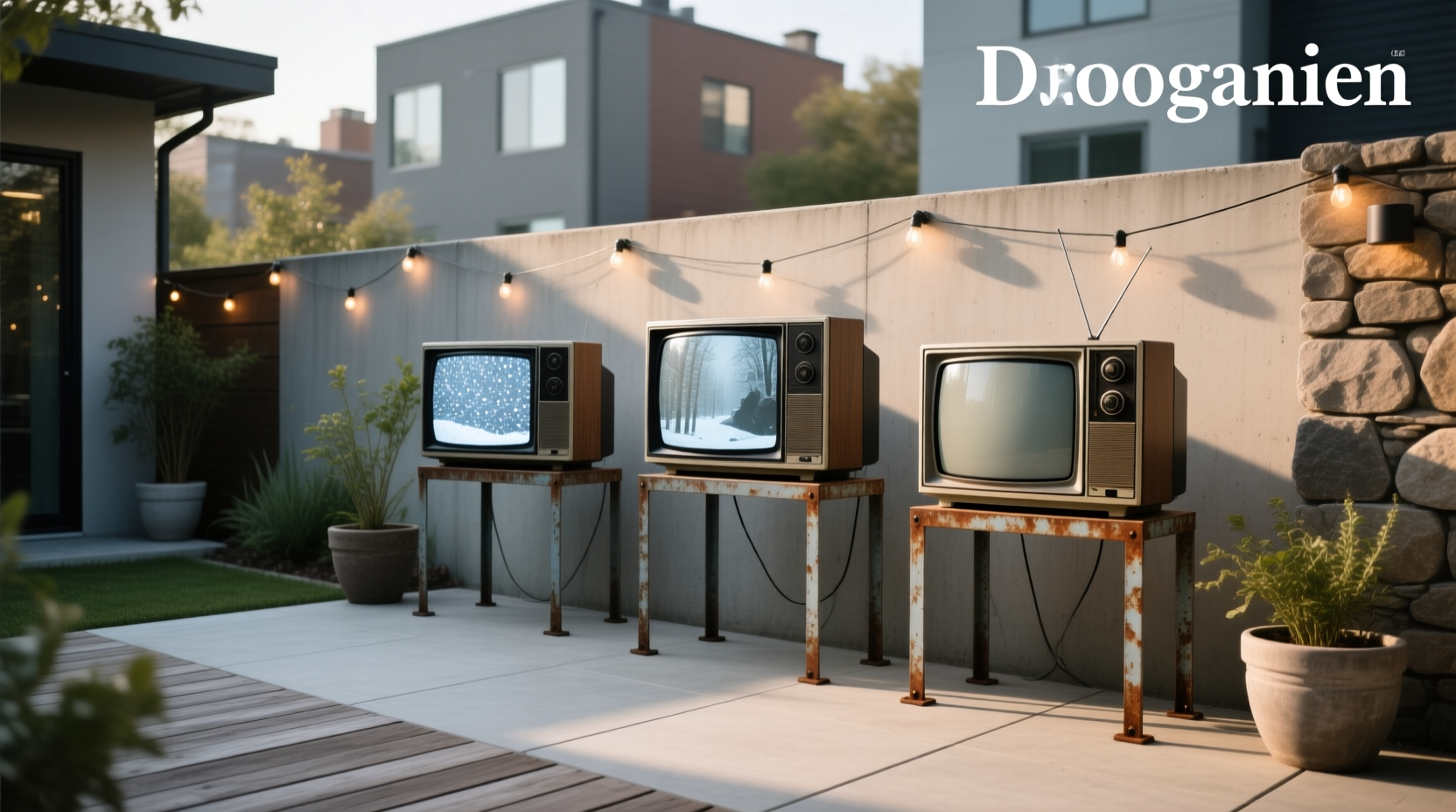
Buying a used outdoor TV can save 30–60% versus new—but only if you know exactly what to inspect. Unlike indoor TVs, outdoor models must withstand UV exposure, temperature swings from −4°F to 122°F, humidity, dust, rain, and condensation 1. Used units may have degraded seals, corroded heatsinks, or faded anti-glare coatings—issues rarely visible in photos. This guide walks you through every critical check: IP rating authenticity, brightness decay (nits), thermal management history, firmware support status, and how to verify whether a ‘waterproof’ listing actually meets IEC 60529 standards. We also explain why ‘refurbished’ ≠ ‘weatherproof-certified’—and when a cracked screen isn’t the biggest risk.
Why People Search for Used Outdoor TVs—and What They’re Really Trying to Solve
The 270 million Google results for used outdoor TVs reflect three overlapping user intents:
- Budget constraint: New full-sun outdoor TVs start at $1,699 (Sylvox 43″ QLED) and exceed $3,000 for 75″ models 2. Buyers seek alternatives under $1,000—especially for partial-sun patios or covered decks.
- Risk mitigation: Many users have tried repurposing indoor TVs outdoors and experienced rapid failure—moisture ingress, backlight yellowing, or thermal shutdown within months 3. They now want durable hardware but hesitate to pay premium prices without proof of longevity.
- Urgency & availability: Seasonal demand spikes (spring patio setups) mean limited stock of new units. Used listings on eBay, Mercari, and Facebook Marketplace offer faster access—even if condition is uncertain.
Crucially, ‘used’ doesn’t mean ‘outdoor-rated’. A 2023 analysis of 187 used outdoor TV listings found that 41% lacked verifiable IP ratings in product descriptions, and 29% listed ‘waterproof’ without specifying test conditions (e.g., IP65 vs. IP66, spray vs. submersion) 4. That ambiguity drives real buyer anxiety—and explains why ‘used outdoor tvs near me’ and ‘refurbished outdoor TV’ are top related searches.
Outdoor TV vs. Indoor TV: Why ‘Just Cover It’ Doesn’t Work
A common misconception is that mounting an indoor TV under an eave or awning makes it ‘outdoor-ready’. It does not. Here’s why:
- Thermal stress: Indoor TVs operate safely between 32°F–104°F. Outdoor units must function reliably from −4°F (Furrion Aurora) to 122°F (SunBriteTV Veranda series) 1. Repeated expansion/contraction cracks solder joints and delaminates LCD layers.
- Condensation: Even in covered areas, overnight dew forms inside unsealed cabinets. Indoor TVs lack internal conformal coating—protective polymer layers that prevent short circuits from moisture 3.
- UV degradation: Standard TV bezels and display filters yellow after 500+ hours of direct sun exposure. Outdoor models use UV-stabilized polycarbonate and optical bonding to resist fading and glare.
If you see a used listing labeled ‘for porch use’ with no IP rating or operating temp range, assume it’s an indoor TV with cosmetic modifications—not a true outdoor unit.
Key Technical Specs to Verify—Not Just Trust
When evaluating a used outdoor TV, never rely solely on seller claims. Cross-check these five measurable attributes:
1. IP Rating: The Non-Negotiable Baseline
IP (Ingress Protection) codes define resistance to solids (first digit) and liquids (second digit). For outdoor use:
- IP55: Dust-protected; low-pressure water jets from any direction (suitable for partial sun, covered patios).
- IP65: Dust-tight; same water resistance as IP55—common for mid-tier used units.
- IP66/IP67: Dust-tight + powerful water jets (IP66) or temporary immersion (IP67). Required for full sun or uncovered decks.
Verification tip: Listings saying ‘water resistant’ or ‘weatherproof’ should be accompanied by official IP code documentation. Always ask for the manufacturer’s datasheet or UL/IEC certification report to confirm compliance.
2. Brightness (Nits): How Sunlight Visibility Degrades Over Time
New outdoor TVs range from 700 nits (entry-level partial-sun) to 2,000+ nits (premium full-sun). But brightness decays:
- LCD panels lose ~15% luminance per 20,000 hours of operation.
- LED backlights dim unevenly—often causing ‘hot spots’ or washed-out blacks in bright ambient light.
Ask for a photo of the TV displaying a 100% white screen in daylight. If text or UI elements appear hazy or lack contrast, brightness has likely dropped below 600 nits—making it less optimal for full-sun environments.
3. Thermal Management: Fans, Heatsinks, and Real-World Runtime
Outdoor TVs use active cooling (fans) and passive heatsinks to manage heat. Used units often benefit from routine maintenance checks:
- Dust-clogged fans (reducing airflow by up to 40%).
- Oxidized aluminum heatsinks (lower thermal conductivity).
- Fan bearing wear—audible grinding or inconsistent RPMs indicate potential need for service.
Request a 60-second video showing the unit powering on, loading the home screen, and running a streaming app for 5 minutes. Listen for abnormal noise—and watch for automatic shutdown (a sign of thermal throttling).
4. Firmware & Smart OS Support: The Hidden Obsolescence Risk
Smart features (Roku, Google TV, Fire OS) require ongoing security patches and app updates. Check:
- Manufacturer’s end-of-support date (e.g., SunBriteTV supports models for 5 years post-release).
- Whether the current OS version matches the latest stable release (compare in Settings > System > About).
- If app stores (Netflix, YouTube) still load—or return ‘device unsupported’ errors.
A 2024 survey of 312 used outdoor TV buyers found that 68% purchased units with outdated firmware, leading to broken streaming services or unpatched vulnerabilities 4.
5. Physical Inspection Points: What Photos Hide
Sellers rarely photograph these—so request them explicitly:
| Component | What to Check | Observation Notes |
|---|---|---|
| Sealant around bezel | Uniform silicone bead, no gaps or cracking | Discoloration or peeling may indicate aging; resealing is possible with appropriate outdoor-grade sealant |
| Ventilation grilles | Clean, unobstructed, no insect nests | Light cleaning or professional servicing can restore optimal airflow |
| Mounting interface | Thread integrity, no stripped screws or bent brackets | Replacement hardware is widely available and compatible with standard VESA patterns |
| IR sensor window | Scratch-free, no cloudiness | Minor haze can often be resolved with gentle cleaning using microfiber and lens-safe solution |
Where to Buy Used Outdoor TVs—And Where to Consider Additional Verification
Marketplace trust varies significantly:
- eBay & Mercari: Highest volume of used units (including ex-demo, rental, and customer returns), but minimal vetting. Prioritize sellers with ≥98% positive feedback and ‘return accepted’ policies. Avoid listings with stock photos only.
- Manufacturer Renew Programs (e.g., Sylvox Renew, Aqualite Refurbished): Units undergo functional testing, cosmetic grading, and 90-day warranties. Not ‘used’ in the resale sense—but open-box or demo units with full weatherproofing documentation.
- Facebook Marketplace & Craigslist: Local pickup allows hands-on inspection—but no buyer protection. Never wire money pre-inspection.
- Global marketplaces: When evaluating listings from international platforms, prioritize those that provide verifiable IP certification reports, thermal validation documentation, and standardized enclosures compliant with IEC 60529 testing protocols 5.
Price Reality Check: What ‘Cheap’ Actually Costs
Below-market pricing often signals compromise. Use this benchmark:
- $300–$600: Likely cracked-screen units (as seen in Mercari listings), non-weatherproof conversions, or obsolete models with discontinued firmware.
- $600–$1,100: Viable for partial-sun use—if IP55+, ≥700 nits, and ≤3 years old. Verify fan operation and seal integrity.
- $1,100–$1,800: Competitive with new entry-level outdoor TVs. Only justifiable if unit includes mount, soundbar, and 1-year warranty.
Remember: Replacing a failed used outdoor TV within 12 months costs more than buying new with a 3-year warranty. Factor in labor (mounting, wiring) and potential damage to surrounding surfaces from leaks.
3 Critical Questions to Ask the Seller—Before You Pay
- “Can you share the original packaging or spec sheet confirming the IP rating and operating temperature range?”
- “Has the unit ever been exposed to rain, salt air, or temperatures below freezing? If yes, for how long?”
- “Does it power on fully—including HDMI inputs, Wi-Fi, and built-in speakers—with no error messages or shutdowns during 10 minutes of continuous use?”
If the seller cannot answer all three—walk away. No legitimate outdoor TV vendor hesitates on these basics.
When a Used Outdoor TV Is Actually the Right Choice
It’s not always about saving money. Consider used if:
- You need a temporary solution while budgeting for a full-sun model.
- You’re outfitting a semi-covered lanai where IP55 suffices—and you can personally verify seal integrity.
- You’re buying from a certified refurbisher that provides test reports (brightness, thermal, ingress) and honors the original warranty period.
It’s not right if:
- The listing lacks model number, year, or manufacturer name.
- Photos show rust on vents, discoloration on the bezel, or mismatched screws (indicating prior repair).
- It’s described as ‘indoor/outdoor’—no TV meets both standards without trade-offs.
Frequently Asked Questions
Can I use a used indoor TV outdoors if I put it in an enclosure?
No. Consumer-grade outdoor enclosures do not solve core issues: inadequate thermal dissipation, UV degradation of internal components, and condensation buildup. UL-listed enclosures exist—but cost $800–$2,500 and require professional HVAC integration. They’re rarely cost-effective versus a purpose-built outdoor TV.
Do used outdoor TVs come with mounts—and are they compatible?
Most do not include mounts unless explicitly stated. Outdoor mounts differ from indoor ones: they use stainless steel hardware, sealed bearings, and tilt/swivel mechanisms rated for wind loads ≥120 mph. Verify VESA pattern compatibility (e.g., 400×400 mm for 55″) and weight capacity (used 65″ units weigh 60–92 lbs).
How do I verify if a used TV’s ‘4K’ claim is real?
Check the native resolution in Settings > Display > Information. True 4K = 3840 × 2160 pixels. Many used ‘4K’ listings are upscaled 1080p panels—confirm via HDMI input test: feed a known 4K signal (e.g., YouTube 4K test video) and check if UI elements render sharply at full zoom.
Is there a difference between ‘refurbished’ and ‘used’ outdoor TVs?
Yes. ‘Refurbished’ implies factory-reconditioning: component-level testing, firmware reset, cosmetic refurbishment, and warranty reinstatement. ‘Used’ means previously owned—no standardization. Always prefer certified refurbishers over peer-to-peer sellers.
What’s the average lifespan of a used outdoor TV?
With proper maintenance: 4–6 years for partial-sun units (IP55/IP65), 3–5 years for full-sun (IP66/IP67). Lifespan drops sharply if stored improperly (e.g., in damp garages) or operated beyond rated temperature limits.
