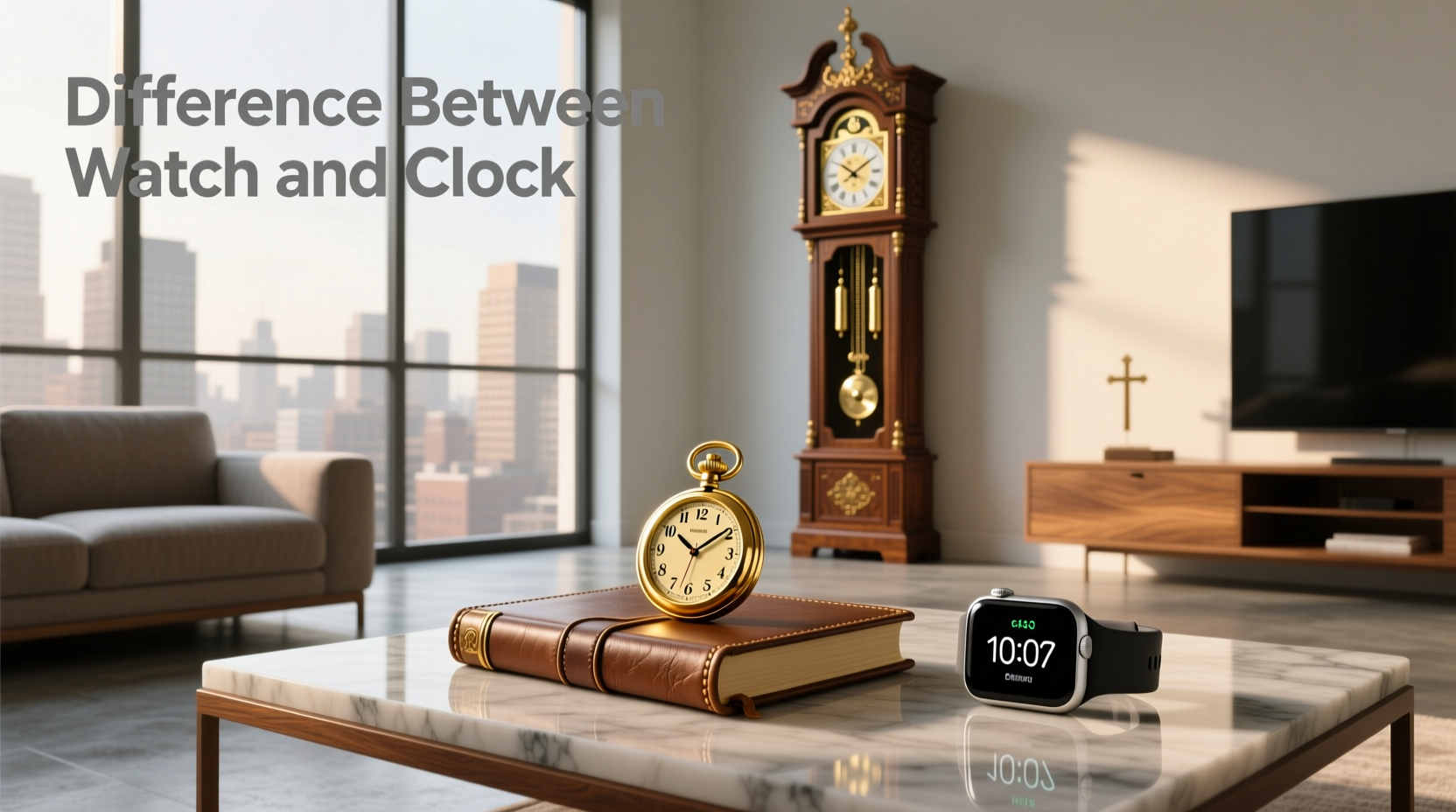
When searching for the difference between watch and clock, you’re not just asking about synonyms—you’re seeking clarity on two fundamentally distinct timekeeping categories defined by function, design, and history. A watch is a personal, portable timepiece—typically worn on the wrist or carried—while a clock is a stationary, environmental timekeeper, mounted on walls, placed on desks, or standing freestanding. This distinction isn’t arbitrary: it reflects centuries of engineering evolution, linguistic development, and human behavioral needs. Whether you’re choosing a timepiece for daily use, studying horology basics, or resolving classroom confusion, understanding these differences helps avoid misclassification (e.g., calling a smartwatch a ‘clock’) and supports informed decisions about form, function, and context. Below, we break down every meaningful dimension—size, portability, mechanics, power source, placement, purpose, terminology origin, and modern convergence—backed by historical evidence and functional analysis.
1. Portability & Physical Form: The Defining Boundary
Portability is the most immediate, observable difference—and the one most consistently cited across educational sources1. A watch is engineered for mobility: it fits on the wrist (via strap or bracelet), slips into a pocket (as in vintage pocket watches), or integrates into wearable tech like fitness trackers. Its compactness (typically under 50 mm in diameter and under 15 mm thick) enables constant proximity without impeding movement.
A clock, by contrast, is inherently non-portable in its primary configuration. Even battery-powered desk clocks are designed for fixed placement—not carried. Wall clocks require mounting hardware; grandfather clocks rely on floor stability and pendulum swing space; atomic clock receivers sit permanently near windows for signal reception. While some clocks have handles or stands, their size and weight (often >300 g, sometimes >30 kg) make them impractical for personal carry. This physical divide directly informs their roles: watches serve one person, anywhere; clocks serve a shared space, anchored in place.
2. Size & Scale: Engineering Constraints Dictate Design
Size isn’t just a consequence of portability—it’s a driver of technical architecture. Watches operate within strict dimensional limits. A standard mechanical wristwatch movement measures roughly 25–30 mm in diameter and 4–5 mm in height. These constraints necessitate miniaturized components: hairsprings thinner than a human hair, gear trains with teeth under 0.1 mm wide, and balance wheels oscillating at 2.5–5 Hz (18,000–36,000 vibrations per hour).
Clocks, freed from body-worn constraints, scale up dramatically. A mantel clock movement may be 80 mm wide; a tower clock movement can exceed 1 meter in length. Larger size allows heavier, more stable oscillators: pendulums (in grandfather or regulator clocks) rely on gravity and length (e.g., a 1-meter pendulum swings once per second); large balance springs in marine chronometers store more energy for longer autonomy. Crucially, size affects accuracy potential: larger pendulums suffer less from air resistance and thermal expansion errors—making large clocks historically more precise than early watches until the 19th century2.
3. Placement & Mounting: Where They Live Determines How They Work
Placement is both cause and effect of design. Watches are body-integrated: worn on the wrist (most common), attached to clothing (lapel pins, fobs), or held (pocket watches). This requires shock resistance (e.g., Incabloc shock protection), water resistance (ISO 22810 standards), and ergonomic curvature.
Clocks occupy architectural space. Wall clocks need secure anchors and level alignment; shelf clocks require stable, vibration-dampened surfaces; floor clocks demand level flooring and clearance for pendulum swing (often >10 cm front-to-back). Placement also affects calibration: analog wall clocks with quartz movements may drift if mounted on metal surfaces (interfering with magnetic stepper motors), while atomic wall clocks require line-of-sight to radio towers (e.g., WWVB in the US). Smart clocks with Wi-Fi rely on consistent network latency—unlike watches, which sync via Bluetooth to phones that handle internet timing.
4. Timekeeping Mechanism: From Pendulums to Quartz Crystals
Mechanism reveals deep engineering divergence. Historically:
- Clocks used pendulums (regulated by gravity and length) or balance wheels with verge escapements (early tower clocks). The pendulum’s period depends almost solely on its length—making it highly repeatable and accurate when temperature-stabilized.
- Watches used balance wheels paired with hairsprings, as pendulums cannot function reliably under motion or orientation changes. The balance wheel’s inertia and spring’s elasticity create harmonic oscillation—but it’s more sensitive to position, temperature, and magnetism than a pendulum.
Modern electronics blurred but didn’t erase this divide. Quartz watches use a 32,768 Hz tuning fork crystal—miniaturized to fit a 10 mm × 4 mm package. Quartz clocks use similar crystals but often lower-frequency variants (e.g., 32,768 Hz for precision, or 1 MHz for high-speed motor driving) and larger capacitors for stable voltage regulation over months. Atomic clocks (used in radio-controlled wall clocks) reference cesium-133 atom transitions—far beyond wrist-worn feasibility due to power and shielding requirements.
5. Power Source & Autonomy: Energy Management Reflects Use Case
Power delivery mirrors usage patterns:
| Device Type | Common Power Sources | Typical Runtime | Key Constraints |
|---|---|---|---|
| Watches | Lithium coin cells (CR2032), kinetic rotors, solar cells (e.g., Citizen Eco-Drive), manual winding | 1–10 years (battery); 40–80 hours (manual); indefinite (solar/kinetic with use) | Cell replacement requires specialized tools; solar charging needs consistent light exposure; kinetic requires ~8 hours/day wear |
| Clocks | AA/AAA batteries, AC mains (with transformer), USB-C power banks, solar + rechargeable battery | 6–24 months (batteries); continuous (AC); 3–12 months (solar) | AC-powered clocks risk time loss during outages unless backed by battery; solar clocks need south-facing windows in Northern Hemisphere |
Note: Smartwatches (e.g., Apple Watch, Wear OS devices) behave like watches in form but draw power like small computers—requiring daily charging. They’re still classified as watches because they’re worn and serve individual time access, not room-wide synchronization.
6. Purpose & Social Function: Beyond Telling Time
Function extends beyond measurement. Watches fulfill personal utility and identity expression: tracking workouts, receiving notifications, storing payment credentials, or signaling status (e.g., luxury watch ownership). Their constant visibility makes them accessories—a category clocks rarely enter.
Clocks serve collective coordination. School bells sync to master clocks; factory shifts align with wall-mounted timers; railway stations use synchronized digital clocks for passenger safety. Even decorative mantel clocks reinforce domestic rhythm (“tea time,” “bedtime”). This communal role explains why clocks dominate public infrastructure—while watches remain private tools.
7. Etymology & Linguistic Evolution: Why Two Words Exist
The words “clock” and “watch” stem from distinct Old English roots reflecting different time-related concepts:
- Clock derives from Middle Dutch clokke or Old French cloque, both meaning “bell”—referring to early tower clocks that struck bells to mark hours for entire communities. Sound, not sight, defined time before dials existed3.
- Watch comes from Old English woecce (“watchman”)—referring to night guards who monitored time to rotate shifts. Portable timekeepers emerged in the 15th century to help these “watchmen” track hours silently, replacing sundials and candle clocks. Thus, “watch” meant to guard time, not just display it.
This semantic split solidified as technology diverged: “clock” retained associations with large, public, auditory timekeeping; “watch” evolved to mean personal, visual, mobile timekeeping. Today, calling a wristwatch a “clock” isn’t technically wrong (both measure time), but it ignores centuries of functional and cultural distinction—much like calling a smartphone a “telephone” overlooks its computing role.
8. Modern Convergence & Edge Cases: When Lines Blur
Technology challenges traditional boundaries—but doesn’t eliminate them:
- Smart displays (e.g., Amazon Echo Show, Google Nest Hub) show time prominently yet function primarily as voice assistants. They’re clock-like in placement (stationary, room-focused) but watch-like in connectivity (syncing to personal calendars). Still, they lack portability and personal wearability—so they’re clocks with added features.
- Projection clocks cast time onto ceilings/walls. Though portable in device form, their output is environmental—aligning them with clocks in function.
- Pocket watches sit in a gray zone: portable like watches, yet often larger and more ornate than wristwatches. Historically, they predate wristwatches and were status symbols—bridging personal and ceremonial use.
- Atomic wristwatches (e.g., Casio Wave Ceptor) receive radio signals like wall clocks but retain wrist-worn form. They’re watches first—their atomic sync is an enhancement, not a reclassification.
The litmus test remains: Is it designed for continuous personal wear or fixed environmental deployment? If the answer is “wear,” it’s a watch—even with clock-grade accuracy.
9. Common Misconceptions Debunked
• Misconception: “All digital timepieces are clocks.”
Reality: Digital watches (e.g., Casio F-91W) are watches—defined by wearability, not display type.
• Misconception: “A clock is just a big watch.”
Reality: Size alone doesn’t define category. A 10-cm digital alarm clock is still a clock; a 6-cm mechanical wristwatch is still a watch—due to intended use and engineering priorities.
• Misconception: “Smartwatches replaced clocks.”
Reality: Smartwatches increased personal time access but didn’t replace shared-space timekeeping. Offices still use wall clocks for meeting start times; kitchens use stove-top timers—because group coordination requires visible, ambient references.
10. How to Choose: Practical Decision Framework
Ask these questions to determine what you actually need:
- Will you carry it constantly? → Choose a watch (prioritize comfort, battery life, durability).
- Does a room or group need synchronized time? → Choose a clock (prioritize visibility, accuracy sync, mounting options).
- Do you need alarms that wake multiple people? → Clocks offer louder, more reliable alarms (50–90 dB vs. watch’s 30–50 dB).
- Is precision critical (e.g., lab work, astronomy)? → Radio-controlled or atomic clocks beat even high-end mechanical watches for long-term stability.
- Do you value craftsmanship or heritage? → Mechanical watches offer intricate micro-engineering; antique clocks showcase macro-scale artistry (e.g., Vienna regulators, skeleton clocks).
Avoid buying a “large watch” thinking it functions like a clock—it won’t be visible across a room. Conversely, don’t expect a desk clock to survive a hike. Match form to function, not aesthetics alone.
Frequently Asked Questions (FAQ)
- Are clock and watch the same thing?
No. While both measure time, a watch is portable and personal; a clock is stationary and environmental. Their design, mechanics, and social roles differ fundamentally. - Why is a watch not called a clock?
Historically, “clock” referred to bell-striking public timekeepers; “watch” came from “watchman,” denoting personal timekeeping for shift workers. Linguistic roots reflect distinct purposes. - What’s the difference between a watch and a timepiece?
“Timepiece” is a broader, formal term for any device measuring time—including watches, clocks, chronometers, and sundials. All watches are timepieces, but not all timepieces are watches. - Can a device be both a watch and a clock?
No—category is determined by primary design intent. A wrist-worn device is a watch, even if it projects time. A wall-mounted device is a clock, even if it connects to your phone. - Do modern smartwatches blur the line between watch and clock?
They add clock-like features (weather, calendar, home control) but retain core watch attributes: wearability, personal data integration, and mobility. They extend the watch category—they don’t redefine it.