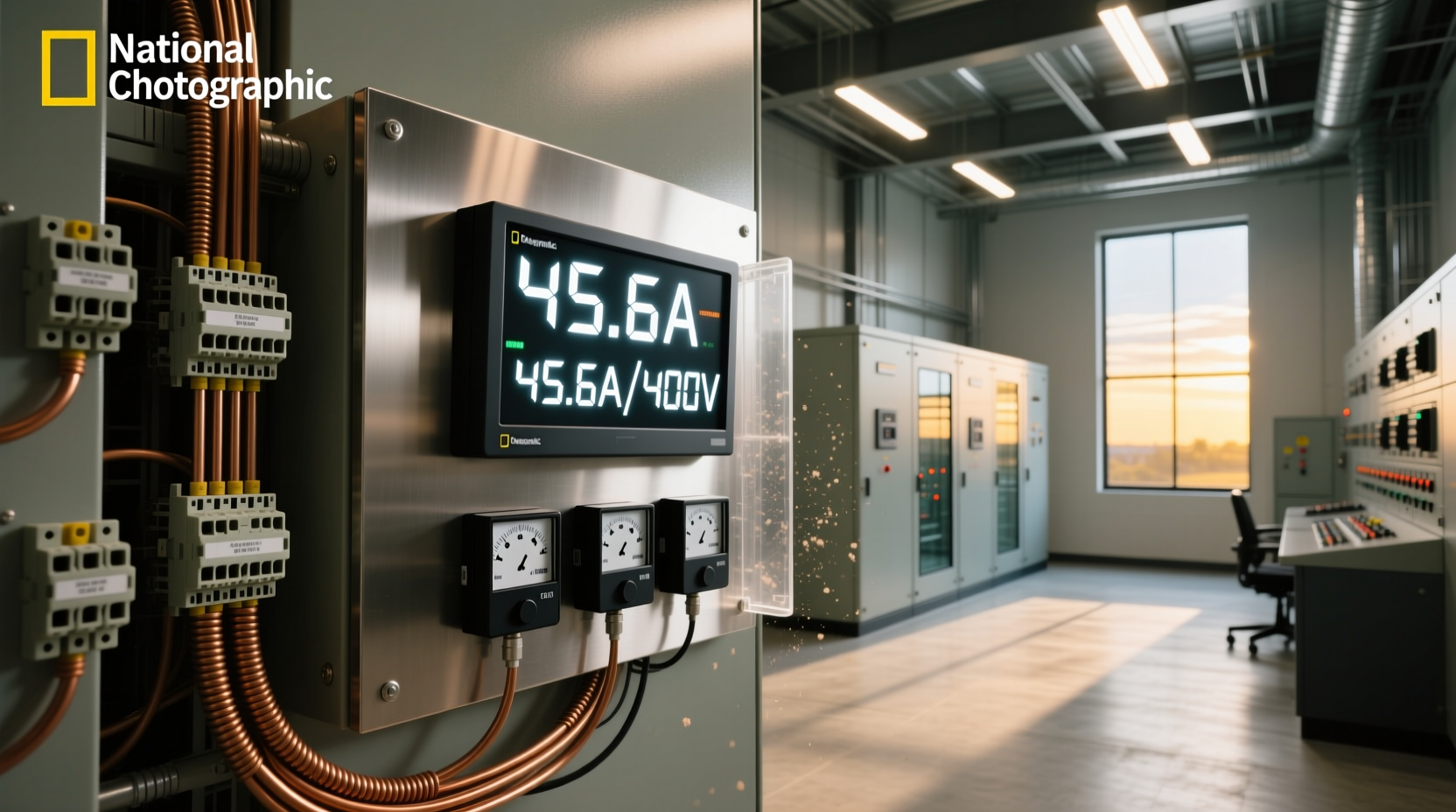
Over the past year, demand for compact, DIN-rail–mounted three-phase digital ammeters and voltmeters has risen sharply—not because of new regulations, but because more small-scale industrial users, solar integrators, and panel builders are replacing analog meters with multi-function digital units that deliver real-time voltage, current, power factor, and energy data on one screen. If you’re installing or upgrading a main distribution board, motor control center, or renewable energy interface, here’s what actually matters: choose a true-RMS, CT-compatible, 96×96 mm panel meter with independent voltage/current scaling and clear wiring labeling—and skip models requiring external shunts or custom firmware for basic operation. If you’re a typical user, you don’t need to overthink this. Skip complex programmable meters unless you’re logging data or integrating with SCADA. Avoid units without built-in phase selection or CT burden compensation—those cause misreads under unbalanced loads. This piece isn’t for keyword collectors. It’s for people who will actually use the product.
About Three-Phase Digital Ammeters and Voltmeters
A three-phase digital ammeter and voltmeter is a single-panel instrument designed to monitor AC voltage (L-L and L-N) and current across all three phases simultaneously. Unlike single-phase meters, it synchronizes sampling across phases to calculate balanced parameters like total active power (kW), reactive power (kVAR), apparent power (kVA), frequency (Hz), and power factor (PF). Typical use cases include:
- Monitoring incoming supply quality in commercial switchboards
- Verifying load balance across phases before adding new equipment
- Tracking energy consumption in HVAC or pump control panels
- Commissioning solar inverters feeding into a three-phase grid
- Preventive maintenance on aging motor starters
These devices are not multimeters. They’re fixed-installation instruments—often DIN-rail mounted, powered directly from the measured circuit (or via auxiliary supply), and calibrated for continuous duty. Most operate at 50/60 Hz, support 0–600 VAC input, and accept standard 1A or 5A current transformer (CT) outputs.
Why Three-Phase Digital Ammeters and Voltmeters Are Gaining Popularity
Lately, adoption has accelerated—not due to marketing hype, but because of three tangible shifts: (1) rising cost of downtime makes real-time imbalance detection valuable; (2) modular panel designs favor standardized 96×96 mm cutouts; and (3) solar + storage installations require verified phase-level metrics for utility compliance reports. Users no longer tolerate guessing whether a 12% voltage drop on Phase B is normal or dangerous. They want numbers—consistent, traceable, and readable at a glance. That’s why simple, factory-calibrated units now outsell high-end programmable meters in non-SCADA applications. If you’re a typical user, you don’t need to overthink this.
Approaches and Differences
There are two dominant hardware approaches—each with clear trade-offs:
- Integrated CT-input meters: Built-in CT terminals, internal burden resistors, and automatic range switching. Pros: Plug-and-play wiring, no external components, better noise immunity. Cons: Less flexibility if CT ratios change later. When it’s worth caring about: When installing in field environments with vibration or dust—fewer external connections mean fewer failure points. When you don’t need to overthink it: In clean indoor panels where CTs are already installed and won’t be swapped.
- External-sensor meters: Accept voltage inputs only; require separate current sensors (e.g., split-core CTs or Rogowski coils). Pros: Easier retrofitting, wider CT ratio compatibility. Cons: Extra wiring, calibration drift risk, higher chance of ground loop interference. When it’s worth caring about: When monitoring legacy motors with non-standard CTs or when future sensor upgrades are likely. When you don’t need to overthink it: For new panel builds where CTs are specified upfront—integrated units simplify commissioning.
Key Features and Specifications to Evaluate
Don’t default to “more digits = better.” Focus on these five measurable traits:
- True-RMS vs. average-responding: True-RMS handles non-sinusoidal waveforms (e.g., VFD outputs, LED lighting loads). Average-responding meters read up to 30% low on distorted currents. When it’s worth caring about: Any site with variable-speed drives, UPS systems, or modern electronics. When you don’t need to overthink it: Pure resistive loads (heaters, incandescent lighting) in stable environments.
- Input isolation and safety rating: Look for IEC 61010-1 CAT III 600 V or higher. Meters without certified isolation pose shock and arc-flash risks during fault conditions.
- Display readability: 0.5-inch or larger digits, contrast ≥ 5:1, viewing angle ≥ 120°. Backlit LCDs beat LED in dimly lit panels.
- Scaling flexibility: Can you set CT ratio (e.g., 1000:5) and PT ratio independently? Locked scaling forces reordering if CTs change.
- Power source independence: Units powered by measured voltage may blank during outages—critical for troubleshooting. Auxiliary 24VDC or 85–265 VAC supply avoids that.
Pros and Cons
Pros:
- Real-time visibility into phase imbalance—prevents overheating and premature breaker trips
- Digital accuracy (±0.5% typical) beats analog meter drift over time
- Multi-function output (kWh, PF, Hz) replaces multiple dedicated meters
- Standard 96×96 mm footprint fits most existing cutouts
Cons:
- No inherent data logging—requires optional RS-485 or Modbus add-ons
- CT saturation errors occur if selected ratio doesn’t match actual load range
- Non-programmable units can’t compensate for phase-angle shifts in capacitive loads
- Lower-cost units (< $80) often omit UL/cUL listing or third-party calibration certs
How to Choose a 3-Phase Digital Ammeter and Voltmeter
Follow this 6-step checklist—designed to prevent common oversights:
- Verify your CT type and ratio first. Don’t assume “5A output” means any 5A CT works. Match burden rating and knee-point voltage. If uncertain, choose a meter with adjustable burden (e.g., 1–5 Ω).
- Confirm voltage input range. Standard is 0–600 VAC L-L—but some meters cap at 480 V. Overvoltage spikes can damage unprotected inputs.
- Check display update rate. Anything slower than 500 ms per parameter feels sluggish during load changes. Look for “≥2 readings/sec” in specs.
- Avoid “auto-ranging” traps. Some meters auto-switch between 100V/400V ranges—but misread during transient surges. Fixed-range or manually selectable ranges are more reliable.
- Test the phase selector. Rotate through L1-L2-L3 and neutral readings. If values jump erratically or show “OL”, internal crosstalk or poor filtering is likely.
- Reject units without factory calibration report. Even basic meters should ship with ±0.5% tolerance documentation—not just “meets spec” claims.
If you’re a typical user, you don’t need to overthink this. Prioritize robustness over bells and whistles.
Insights & Cost Analysis
Based on 2023–2024 retail and distributor pricing across India, Saudi Arabia, and North America:
- Budget tier ($45–$75): Basic TRMS, 96×96 mm, CT-input, 4-digit LCD. No communication port. Examples: Mivan Technologies wall-mounted unit, generic Amazon.sa listings. Best for: Retrofitting older panels where only voltage/current visibility is needed.
- Mid-tier ($85–$140): Full 7-parameter display (V, A, kW, kVAR, PF, Hz, kWh), RS-485/Modbus, UL-listed. Examples: Selec Pro-Series, AEL India AE-DPM-96. Best for: New commercial panels requiring audit-ready data.
- Premium tier ($160–$280): Dual-display (voltage + current side-by-side), harmonic analysis (up to 25th order), Class 0.2 accuracy, cloud-ready gateway. Examples: RISH DPM 396 A/V 1, Technoversion multifunction meters 2. Best for: Energy audits or facilities with significant non-linear loads.
| Category | Best For / Key Advantage | Potential Problem | Budget Range (USD) |
|---|---|---|---|
| Integrated CT Input | Fast installation, minimal wiring, noise-resistant | Inflexible if CT ratio changes later | $45–$140 |
| External Sensor Ready | Retrofit-friendly, supports Rogowski or split-core CTs | Extra calibration steps; ground-loop risk | $70–$220 |
| Modbus-Enabled | SCADA integration, remote reading, alarm thresholds | Requires protocol knowledge; extra configuration time | $85–$280 |
| Harmonic-Capable | Diagnosing VFD-related heating or resonance | Overkill for linear loads; higher cost & complexity | $160–$280 |
Customer Feedback Synthesis
Aggregated from YouTube tutorials, Amazon.sa reviews, and technical forums (MrEngineers, Jr Electric School, The Electrical Guy):
✅ Top 3 praised traits: Clear labeling of CT terminals (reduces wiring errors), intuitive phase selector switch, stable readings under motor startup surges.
❌ Top 3 complaints: Missing English manual (common in budget imports), backlight too dim for cabinet interiors, inaccurate PF reading below 0.6 lag—often tied to low-cost current sensing.
Maintenance, Safety & Legal Considerations
These are safety-critical instruments—not accessories. Key considerations:
- Calibration: Re-calibrate every 2 years if used in revenue-grade or compliance contexts. Field verification with a reference clamp meter suffices for general monitoring.
- Mounting: Always use insulated DIN-rail adapters if mounting near busbars. Never mount directly to metal panels without gasketing.
- Legal compliance: In GCC countries, look for SASO IECEE CB Scheme recognition. In North America, UL 61010-1 or CSA C22.2 No. 1010.1 is mandatory for panel integration. CE marking alone is insufficient for safety approval.
- CT wiring: Torque CT secondary screws to manufacturer spec (typically 0.5–0.8 N·m). Loose connections cause heating and fire risk.
Conclusion
If you need fast, reliable phase monitoring for routine panel health checks, choose a UL-listed, true-RMS, integrated CT-input meter in the $85–$140 range—like Selec’s Pro-Series or AEL’s AE-DPM-96. If you need harmonic distortion analysis or long-term energy tracking, step up to a premium unit with Class 0.2 accuracy and Modbus. If you’re a typical user, you don’t need to overthink this. Skip models without clear CT burden specs or missing safety certifications—even if they’re 30% cheaper. Real-world reliability trumps theoretical feature counts.