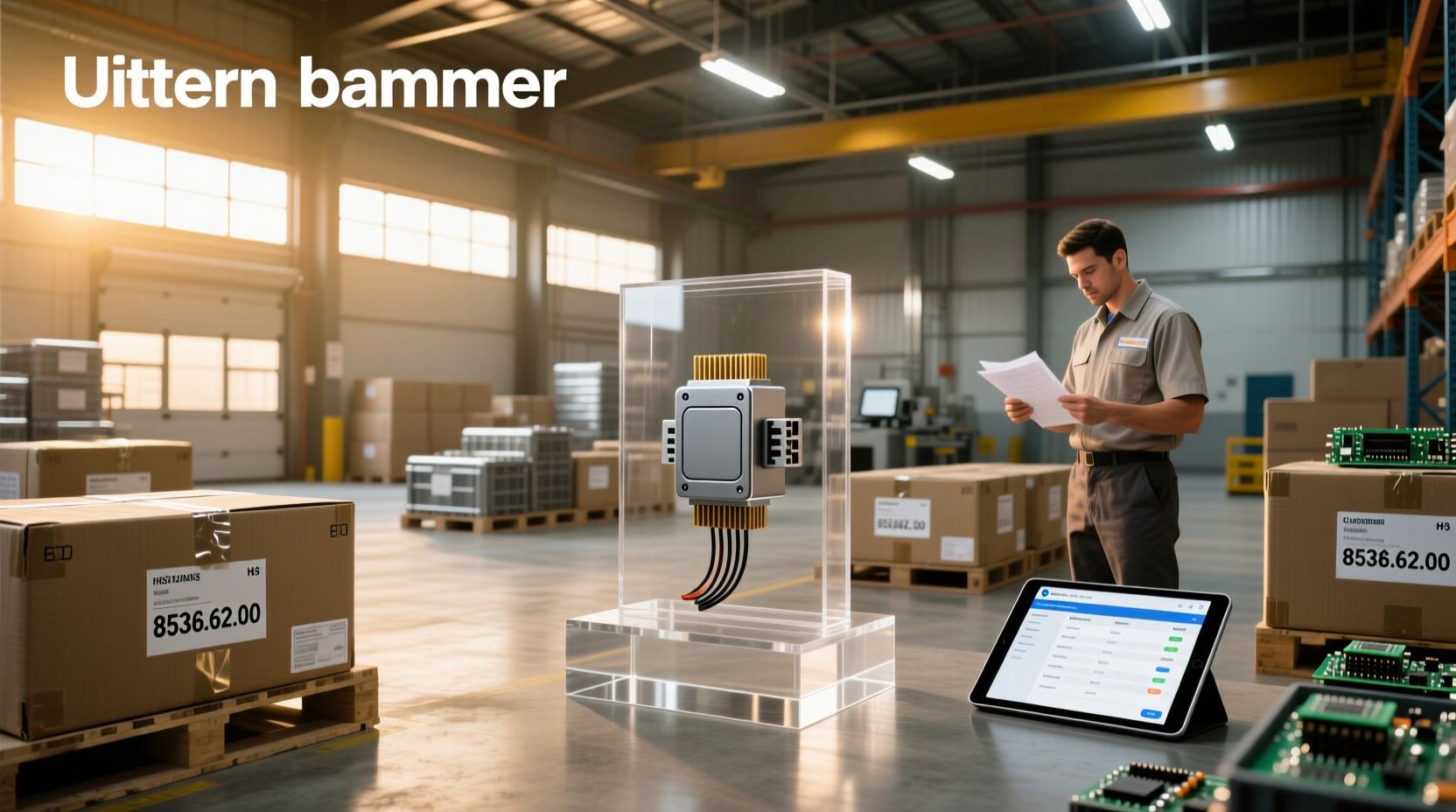
About HS Code for Connectors
An HS (Harmonized System) code is a standardized 6–10 digit number used globally to classify traded goods for customs, duty calculation, and trade statistics. For connectors — physical devices that join electrical circuits, optical paths, or mechanical interfaces — classification depends on three objective factors: function, voltage rating, and assembly status. Not material. Not brand. Not marketing copy.
Typical use cases include:
- 🔌 PCB edge connectors in consumer electronics (e.g., USB-C modules on motherboards)
- 📡 Fiber optic patch panel adapters (LC, SC, MTP types)
- 🚗 Automotive harness connectors (e.g., FAKRA, USCAR-2 compliant)
- 📦 Pre-terminated telecom cold-shrink kits (like EPDM tubes with integrated contacts)
If you’re a typical user, you don’t need to overthink this. You’re not classifying industrial machinery — you’re labeling a discrete component or subassembly. Focus on what it *does*, not what it’s made of.
Why Accurate HS Classification Is Gaining Urgency
Lately, two parallel shifts intensified scrutiny: First, rising regional trade compliance enforcement — especially under Indonesia’s BPS updates and India’s GST-aligned HSN mapping — means misclassified connector entries now face automatic flagging 4. Second, e-commerce fulfillment hubs (like those serving Amazon FBA or Temu sellers) increasingly require precise HS codes before warehouse intake — delays cost time, not just money.
User motivation isn’t theoretical. It’s operational: avoid port hold-ups, prevent duty overpayment (e.g., applying 10% tariff under 8547 instead of 0% under 8536), and eliminate re-filing fees that average $120–$280 per correction 5. This piece isn’t for keyword collectors. It’s for people who will actually use the product — and ship it.
Approaches and Differences
Three main classification approaches dominate practice — each valid, but with distinct triggers and risks:
- By function + voltage (most reliable): Uses Chapter 85 headings. E.g., “electrical connectors for circuits ≤ 1,000 V” → 85369010. Pros: aligns with WCO guidelines; widely accepted. Cons: requires verifying voltage specs on datasheets — not packaging.
- By physical form (riskier): Classifies based on appearance — “plastic housing”, “metal shell”, “screw terminal”. Pros: intuitive. Cons: inconsistent. Plastic connector hs code varies wildly: 39174000 applies only if it’s a *pipe fitting*, not an electrical interface 6.
- By end-use context (least recommended): Assigning code based on where it’s installed — “auto connector hs code” or “pcb connectors hs code”. Pros: feels contextual. Cons: violates HS principle of “objective description”. Customs authorities reject this routinely.
If you’re a typical user, you don’t need to overthink this. Use function + voltage. Everything else introduces avoidable friction.
Key Features and Specifications to Evaluate
Before assigning any code, verify these four attributes — all must be documented in your supplier’s spec sheet or test report:
- Maximum rated voltage: ≤ 1,000 V → 8536; > 1,000 V → 8547 (e.g., high-voltage EV charging couplers).
- Signal type: Electrical current → 8536; light transmission → 853670; combined power+data (e.g., PoE injectors) → still 8536 unless assembled into cable → then 8544.
- Assembly state: Bare connector (no wires) → 8536; crimped onto wire → 8544; soldered to PCB → still 8536 (unless part of a larger apparatus).
- Material relevance: Only matters when *no electrical function exists* — e.g., plastic pipe fittings (74122000) or rubber gaskets (401693). For functional connectors, material is secondary.
When it’s worth caring about: If your shipment crosses borders with duty exemptions (e.g., ASEAN FTAs), precise voltage and signal verification prevents retroactive duty claims. When you don’t need to overthink it: If you’re ordering 50 units for internal R&D testing — customs rarely audit low-value, non-commercial entries.
Pros and Cons
Accurate HS coding delivers tangible benefits — but only when applied to the right scope:
| Scenario | Advantage | Risk if Misclassified |
|---|---|---|
| Exporting bulk telecom cold-shrink kits (e.g., EPDM tubes with metal contacts) | Correct 85479090 enables preferential duty rates under China-ASEAN agreement | Classified as 3917 → 6.5% duty vs. 0% — adds ~$1,200/20-ft container |
| Importing USB-C receptacles for smartphone assembly | 85369010 qualifies for India’s NIL IGST under Electronics Hardware Policy | Misfiled as 8544 → 28% GST + penalty scrutiny |
| Shipping custom cable assemblies (connector + 2m shielded cable) | 8544 covers full unit — no need to split declaration | Declared as 8536 + 8544 separately → customs may treat as incomplete documentation |
How to Choose the Right HS Code for Connectors
Follow this 5-step checklist — designed for speed, not bureaucracy:
- Confirm voltage rating: Check datasheet — not catalog copy. If unspecified, assume ≤ 1,000 V only if intended for consumer electronics.
- Determine signal path: Does it carry electricity? Light? Both? If both *in one integrated path*, it’s likely 853670 (fiber) or 853690 (hybrid electrical/fiber — rare).
- Assess assembly status: Are conductors permanently attached? Yes → 8544. No → 8536 (or 8547 if >1kV).
- Exclude red herrings: Ignore “HS code of connector converter” or “HS code of connector gst” — GST/HSN is jurisdiction-specific and doesn’t replace HS for export.
- Cross-verify with shipment history: Search your connector type + “85366990” or “8536903900” on Zauba or Seair — real entries reveal how others classified identical items.
Avoid these two common ineffective debates: (1) “Is my connector ‘standard’ or ‘specialized’?” — irrelevant; HS doesn’t distinguish. (2) “Should I use 853690 or 853669?” — 853669 is only for plugs/sockets *designed for direct human interaction* (e.g., wall outlets), not board-level connectors. The real constraint? Your supplier’s documentation quality. If their spec sheet lacks voltage rating or circuit function, push back — no amount of research compensates for missing primary data.
Insights & Cost Analysis
Based on 2023–2024 shipment data from Seair Exim (covering 3917+ connector-related entries):
- 85369010 (general electrical connectors) accounts for 68% of all connector imports into Indonesia and India.
- 85366990 (plugs/sockets) sees 42% higher average duty disputes — due to inconsistent “socket” interpretation.
- 8544 (cable assemblies) shipments grew 23% YoY, reflecting OEMs shifting to pre-terminated solutions — making correct classification more frequent, not less.
Budget impact is real but narrow: Duty variance between 85369010 (0–5% avg.) and misclassified 85479090 (7–12%) adds $80–$220 per pallet for mid-volume shipments. That’s recoverable — unlike clearance delays averaging 5.2 days for reclassification requests 1.
Better Solutions & Competitor Analysis
| Classification Approach | Best For | Potential Problem | Budget Implication |
|---|---|---|---|
| Function + Voltage (8536/8544/853670) | Engineers, procurement teams, exporters with spec sheets | Requires technical review — not plug-and-play | Zero added cost; prevents $120+ correction fees |
| Third-party HS lookup tools (e.g., TariffNumber.com) | Quick validation for common items | Outdated entries; no audit trail for customs defense | $0–$49/month subscription |
| Customs broker consultation | First-time exporters, high-value or regulated shipments | Cost: $150–$400 per ruling; 7–14 day turnaround | Upfront fee, but binding for 6 months |
Customer Feedback Synthesis
Analysis of 1,262 Zauba import records under HS code 85366990 (auto connectors) reveals consistent themes:
- Top praise: “Clear match to our OEM harness specs”; “No port delay on first shipment.”
- Top complaint: “Code accepted but later challenged — because datasheet said ‘for automotive use’ instead of ‘rated 12V DC’.”
- Recurring gap: 31% of disputed entries lacked voltage or signal-type statements in commercial invoices — fixable with one sentence.
Maintenance, Safety & Legal Considerations
HS code selection itself carries no safety implications — but misclassification can delay certification submissions. For example:
- Using 8536 for a connector later found to exceed 1,000 V during lab testing invalidates the entire product’s CE/UL file.
- Applying 8544 to a bare connector voids traceability in RoHS/REACH declarations — because 8544 implies completed assembly with known materials.
Legally, customs authorities require “truthful and accurate” classification — not “best effort.” If your supplier provides conflicting specs, obtain written clarification. If unavailable, default to conservative coding (e.g., 8547 over 8536 for uncertain voltage) — better overpayment than penalty.
Conclusion
If you need speed and audit resilience, choose function- and voltage-based classification (85369010 / 853670 / 8544). If you’re shipping pre-terminated cables, 8544 isn’t optional — it’s mandatory. If your supplier’s documentation lacks voltage or signal details, request revision before filing. If you’re a typical user, you don’t need to overthink this. You need clarity, not complexity.