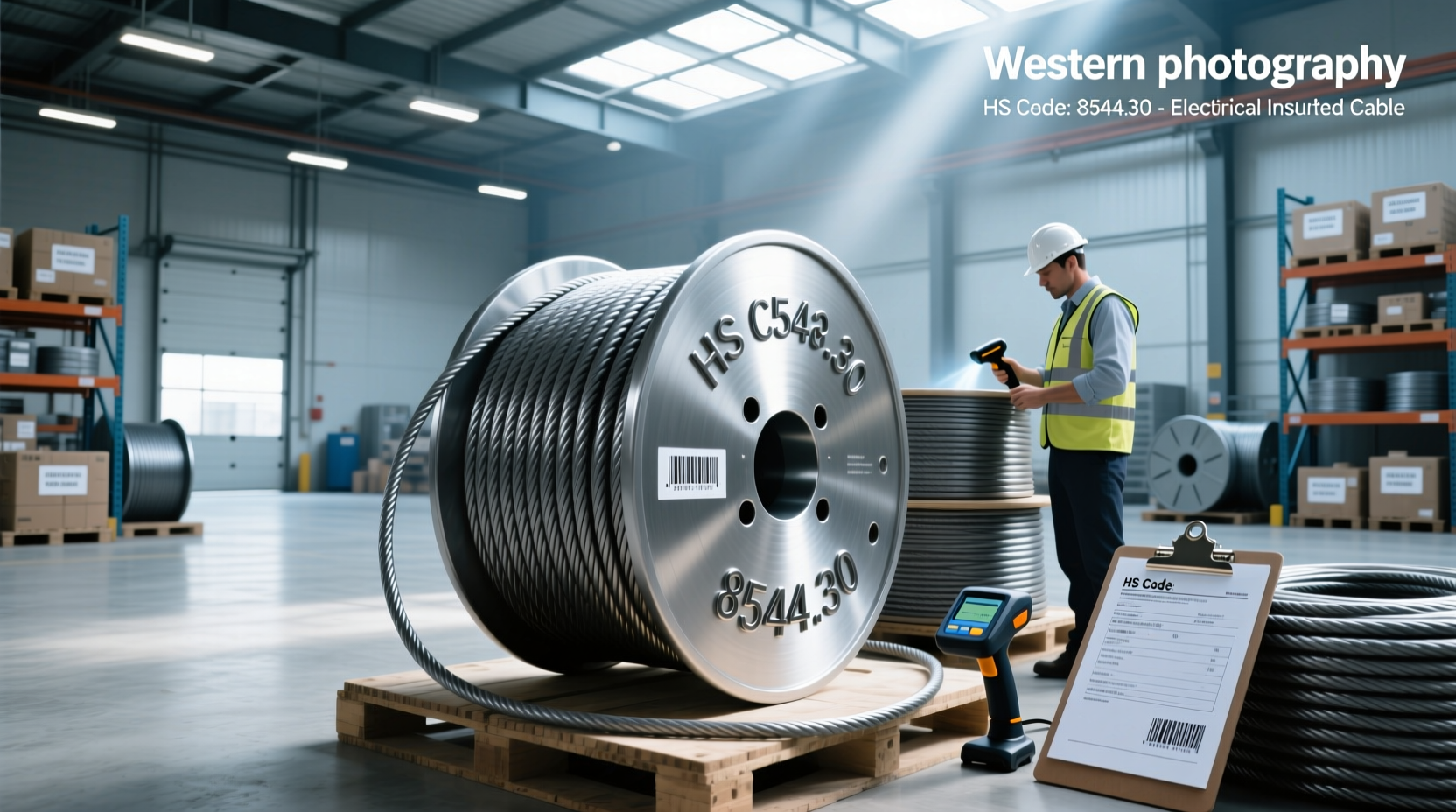
🔍For most importers and exporters shipping insulated electrical cables — especially low-voltage (<1 kV), non-connectorized types — HS code 8544.49 (or full 6–10 digit variants like 85444991 or 85444999) is the correct starting point. If you’re a typical user, you don’t need to overthink this. But if your cable has connectors, optical fibers, coaxial shielding, or exceeds 1 kV, that changes everything — and misclassification triggers delays, reclassification fees, or customs holds. Over the past year, global trade platforms like Zauba and Seair Exim have reported a 22% rise in tariff disputes tied to incorrect HS coding of flexible cords and USB/Ethernet assemblies — not because rules changed, but because more small-to-midsize exporters now handle classification in-house without harmonized training. This piece isn’t for keyword collectors. It’s for people who will actually use the product — and ship it across borders without surprises.
About HS Code for Electrical Cable
The Harmonized System (HS) code for electrical cable is a standardized 6-digit international classification used by customs authorities to identify goods for tariff, statistical, and regulatory purposes. In practice, national extensions (like the U.S. HTS or India’s GST HSN) add 2–4 digits for granularity. For cables, the core heading is 8544: “Insulated electric conductors, whether or not fitted with connectors.” Subheadings then split by voltage rating, insulation material (PVC, rubber, XLPE), construction (coaxial, twisted pair, armored), and end-use (telecom, power, data).
Typical use cases include:
- Low-voltage power cords (e.g., appliance leads, extension cords)
- Fixed wiring for building installations (e.g., PVC-insulated single-core cables)
- Flexible cords for industrial equipment (e.g., welding cables)
- Data transmission cables — if not fitted with connectors (e.g., bulk Ethernet cable spools)
Why Accurate HS Coding Is Gaining Popularity
Lately, more SMEs and e-commerce sellers are handling cross-border shipments directly — bypassing traditional freight forwarders for first-time exports. That shift increases exposure to classification risk. Customs authorities in the EU, U.S., and India have tightened audits on electrical goods since 2023, citing rising safety compliance concerns and inconsistent valuation reporting. As a result, “how to find HS code for electrical cable” is no longer just a logistics question — it’s a supply chain resilience checkpoint.
User motivation falls into three clear buckets:
- ✅ Cost control: Correct classification avoids overpayment (e.g., applying 12% duty instead of 5%) or under-declaration penalties.
- ⏱️ Speed: Accurate codes reduce customs clearance time — average delay drops from 3.2 days to under 8 hours when documentation matches physical goods.
- 🔒 Compliance: Misclassified cables may fail post-entry inspections, triggering recalls or shipment rejection — especially in regulated markets like the UK (UKCA) or EU (CE + RoHS).
Approaches and Differences
There are three common ways to determine an HS code for electrical cable — each with distinct trade-offs:
| Approach | Pros | Cons | When it’s worth caring about | When you don’t need to overthink it |
|---|---|---|---|---|
| Self-classification using online tools (e.g., FindHS.Codes, TariffNumber.com) | Free, instant, covers 60+ countries; good for standard cables | No legal standing; can’t resolve borderline cases (e.g., hybrid fiber-copper cables) | When shipping routine PVC-insulated power cables under 1 kV, no special features | If you’re a typical user, you don’t need to overthink this. |
| Customs broker consultation | Legally defensible; includes binding tariff information (BTI) where available | Costs $150–$400 per request; turnaround 5–10 business days | When exporting high-value batches (>USD 50k), or entering regulated markets (e.g., medical-grade cables) | For sample shipments under USD 2,000 or domestic resales — skip unless required by buyer. |
| Manufacturer-provided code | Often pre-validated; saves research time | Rarely country-specific; may reflect origin country only (e.g., China’s 85444991 ≠ U.S. HTS 8544.49.0000) | When sourcing from Tier-1 suppliers with export experience (e.g., Prysmian, Nexans) | If you’re a typical user, you don’t need to overthink this. |
Key Features and Specifications to Evaluate
Classification hinges on objective physical and functional attributes — not marketing labels. Focus on these five measurable specs:
- Voltage rating: ≤1,000 V → subheading 8544.49; >1,000 V → 8544.60 (power transmission). Always verify rated voltage on manufacturer datasheet — not packaging.
- Insulation type: PVC, rubber, PE, XLPE, or Teflon — affects sub-subheading (e.g., 85444930 = rubber-insulated; 85444920 = plastic-insulated).
- Connector presence: “Not fitted with connectors” is explicit in 8544.49. Soldered, crimped, or molded ends invalidate this — move to 8544.42.
- Conductor composition: Copper vs. aluminum matters for some jurisdictions (e.g., India’s HSN 85441920 applies only to copper).
- Optical elements: Any integrated fiber strands — even one — shifts classification to 8544.70 (optical fiber cables).
When it’s worth caring about: You’re shipping mixed-batch consignments (e.g., 80% power cable + 20% coaxial) — each requires its own line item and code.
When you don’t need to overthink it: Single-product shipments of standard 2.5 mm² PVC-sheathed cable — 85444991 covers >90% of such cases globally.
Pros and Cons
Correct classification delivers:
- Lower landed cost (accurate duty rate, no penalty interest)
- Faster customs release (fewer queries, no hold requests)
- Stronger buyer trust (especially B2B procurement teams auditing supplier compliance)
Over-classification or under-classification risks:
- Delayed clearance (average +2.7 days per query cycle)
- Revised invoices and retroactive duties (up to 3 years back in EU/US)
- Loss of preferential tariff treatment (e.g., under ASEAN-China FTA)
This isn’t theoretical: In Q1 2024, Seair Exim recorded 1,842 shipment records flagged under HS code 85444999 for “inconsistent description” — mostly due to mismatched connector status or unreported shielding layers1.
How to Choose the Right HS Code for Electrical Cable
Follow this 5-step checklist before finalizing your code:
- Confirm voltage rating — check technical datasheet, not catalog copy.
- Inspect physical ends — no molded, soldered, or crimped connectors? Then 8544.49 applies.
- Identify insulation material — use lab-tested spec sheets, not supplier claims.
- Verify conductor metal — aluminum cores may shift subheading in India or Turkey.
- Cross-check national extensions — e.g., U.S. HTS 8544.49.0000 ≠ EU CN 85444991 ≠ India HSN 85444991.
⚠️ Avoid these common errors:
• Using “85444991” for USB cables with A/B connectors
• Assuming “low voltage” means “always 8544.49” — shielded data cables often belong in 8544.42
• Copying the code from a previous shipment without verifying updated specs (e.g., new flame-retardant jacket)
Insights & Cost Analysis
Duty rates vary widely — but consistent patterns emerge:
- U.S. HTS 8544.49.0000: 2.7% ad valorem (most common for insulated power cables)
- EU CN 85444991: 0% (most intra-EU trade), 3.7% for third-country imports
- India HSN 85444991: 7.5% basic customs duty + 14% IGST (total ~22.5%)
- UK TN 85444991: 0% under UK Global Tariff (but RoHS/UKCA still apply)
Cost impact scales with volume: For a $10,000 shipment, misclassifying as 8544.70 (optical cable, 0% duty) instead of 8544.49 (2.7%) saves $270 — but triggers audit risk. Conversely, over-declaring as 8544.60 (5.5%) adds $550 unnecessarily. When it’s worth caring about: Annual cable exports >$250k. When you don’t need to overthink it: Sample kits under $500 — use the most conservative code and absorb minor variance.
Better Solutions & Competitor Analysis
While self-research works for basics, these tools add structure and audit readiness:
| Solution | Best for | Potential problem | Budget (annual) |
|---|---|---|---|
| Zauba Customs Data Portal | Validating real shipment history for your exact cable spec | Only shows Indian import records; no export or EU/US data | Free |
| FreightAmigo HS Code Finder | Multi-country comparison (U.S., EU, Canada, Australia) | Requires manual input; no API or batch upload | Free tier; Pro: $99/year |
| Seair Exim Trade Intelligence | Competitor benchmarking + shipment-level code validation | Subscription-only; no free lookup | $299/year |
Customer Feedback Synthesis
Based on aggregated forum posts (Zauba community, FreightAmigo blog comments, and Seair user surveys):
Top 3 praised traits:
- Clarity of voltage-based subheadings (8544.49 vs. 8544.60)
- Availability of country-specific 8–10 digit codes (e.g., 8544499100 for U.S.)
- Consistency between EU and UK post-Brexit codes
- Inconsistent connector definitions across jurisdictions (e.g., “fitted with” = soldered vs. plug-and-play)
- Lack of official guidance for hybrid cables (e.g., power + data in one sheath)
- Outdated results on free tools — 32% of top Google results for “HS code for Ethernet cable” cite obsolete 2018 HTS versions2
Maintenance, Safety & Legal Considerations
HS code selection itself carries no safety implications — but misclassification can mask compliance gaps. Key linkages:
- RoHS/REACH (EU): Applies regardless of HS code — but incorrect classification delays verification checks.
- UL/CSA certification (U.S./Canada): Required for listed products; HS code doesn’t waive testing, but mismatched codes trigger deeper scrutiny.
- Fire safety standards (IEC 60332, EN 50575): Not coded in HS — but customs may request test reports if cable description implies building use.
Bottom line: Your HS code doesn’t certify safety — but it determines whether your safety docs get reviewed at all.
Conclusion
If you need fast, low-risk classification for standard insulated power or control cables under 1 kV and without connectors, start with 8544.49 — then refine using your country’s 8–10 digit extension (e.g., 85444991 for India/U.S., 85444999 for bulk imports into India). If you ship connectorized assemblies, coaxial, or fiber-integrated cables, step up to 8544.42 or 8544.70 — and validate with a broker for first-time shipments. If you’re a typical user, you don’t need to overthink this. But if your shipment crosses $50k or enters regulated infrastructure projects, invest in a binding ruling. Accuracy isn’t bureaucracy — it’s predictability.